
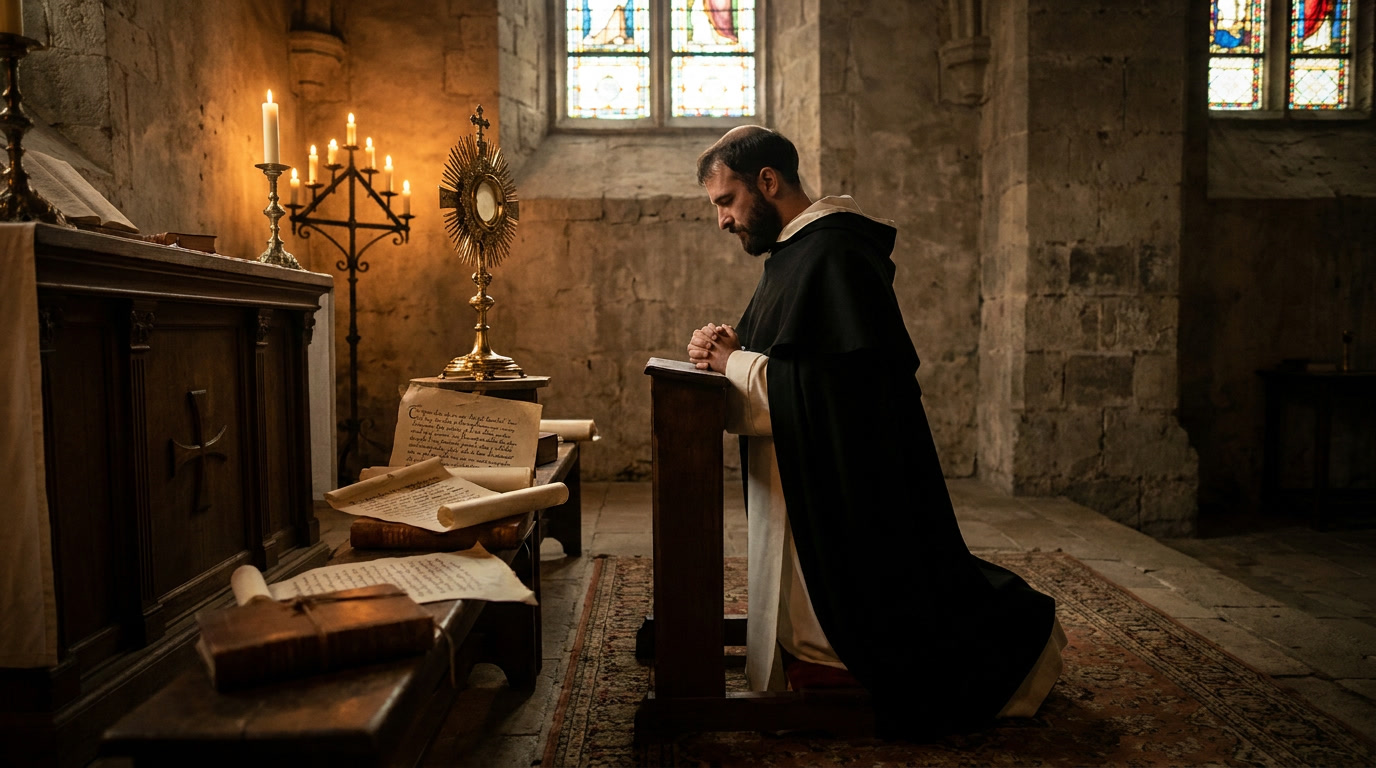
"O sacred banquet in which Christ is received, the memory of his passion is renewed, the mind is filled with grace, and a pledge of future glory is given to us."
Saint Thomas Aquinas penned these words for the Office of Corpus Christi, capturing the essence of Christ's teaching in John's Gospel. When Jesus declared himself the living bread from heaven, he revealed the profound mystery that Aquinas would later illuminate through both reason and faith. The Eucharist stands as the source and summit of Catholic life, transforming ordinary bread and wine into the very Body and Blood of Christ.
Thomas Aquinas lived from 1225 to 1274, earning the title "Angelic Doctor" for his extraordinary synthesis of faith and reason. This Dominican friar revolutionized Catholic theology through his Summa Theologica while maintaining the heart of a mystic. Pope Pius V declared him a Doctor of the Church, recognizing his unparalleled contribution to understanding divine mysteries.
The Living Bread That Transforms
Aquinas understood what the crowds in John's Gospel could not grasp. Christ's flesh is not consumed as ordinary food but transforms the one who receives it. "The effect of this sacrament ought to be considered from what Christ does in it," Aquinas taught. The Eucharist does not become part of us; rather, we become part of Christ's mystical body.
This transformation echoes through every Mass. Each reception of Holy Communion deepens our participation in divine life. Aquinas recognized that the Eucharist satisfies the deepest human hunger—not merely for sustenance, but for union with God himself.
Eucharistic Devotion in Daily Life
The saint's approach to Eucharistic devotion offers practical wisdom for modern Catholics. Aquinas emphasized both the intellectual understanding of transubstantiation and the humble reception of mystery. His prayers before and after Mass reveal a scholar who approached the altar with childlike faith.
Through Lectio Divina, believers can meditate on Christ's Eucharistic presence as Aquinas did—allowing Scripture to illuminate the profound reality of the Mass. The saint's method combines rigorous study with contemplative prayer, showing that reason serves faith rather than replacing it.
The Pledge of Future Glory
Aquinas saw the Eucharist as both present grace and future promise. When Christ speaks of raising up those who eat his flesh on the last day, he offers a foretaste of eternal communion. The saint understood that each Mass connects earth to heaven, time to eternity.
This perspective transforms how Catholics approach both suffering and joy. The Eucharist sustains pilgrims on their earthly journey while promising the eternal banquet to come. Aquinas lived this truth, finding in daily Mass the strength for theological study and pastoral care.
Pray in the Spirit of Saint Thomas Aquinas
Approach the Eucharist with both mind and heart engaged. Before Mass, ask for the grace to understand more deeply what Christ offers. After receiving Communion, remain in silent thanksgiving, allowing the mystery to work within you. Study the Church's teaching on the Eucharist not as mere academic exercise but as preparation for more fruitful participation in the sacred liturgy.
Frequently Asked Questions
What did Saint Thomas Aquinas teach about the Eucharist?
Saint Thomas Aquinas developed the theological explanation of transubstantiation, teaching that the bread and wine become the actual Body and Blood of Christ while retaining their physical appearance. He emphasized that the Eucharist transforms the recipient rather than being transformed by them.
Why is Saint Thomas Aquinas associated with Corpus Christi?
Pope Urban IV commissioned Saint Thomas Aquinas to compose the liturgy for the new feast of Corpus Christi in 1264. Aquinas wrote the prayers, hymns, and readings for this celebration of the Eucharist, including the famous "Pange Lingua" and "Tantum Ergo."