
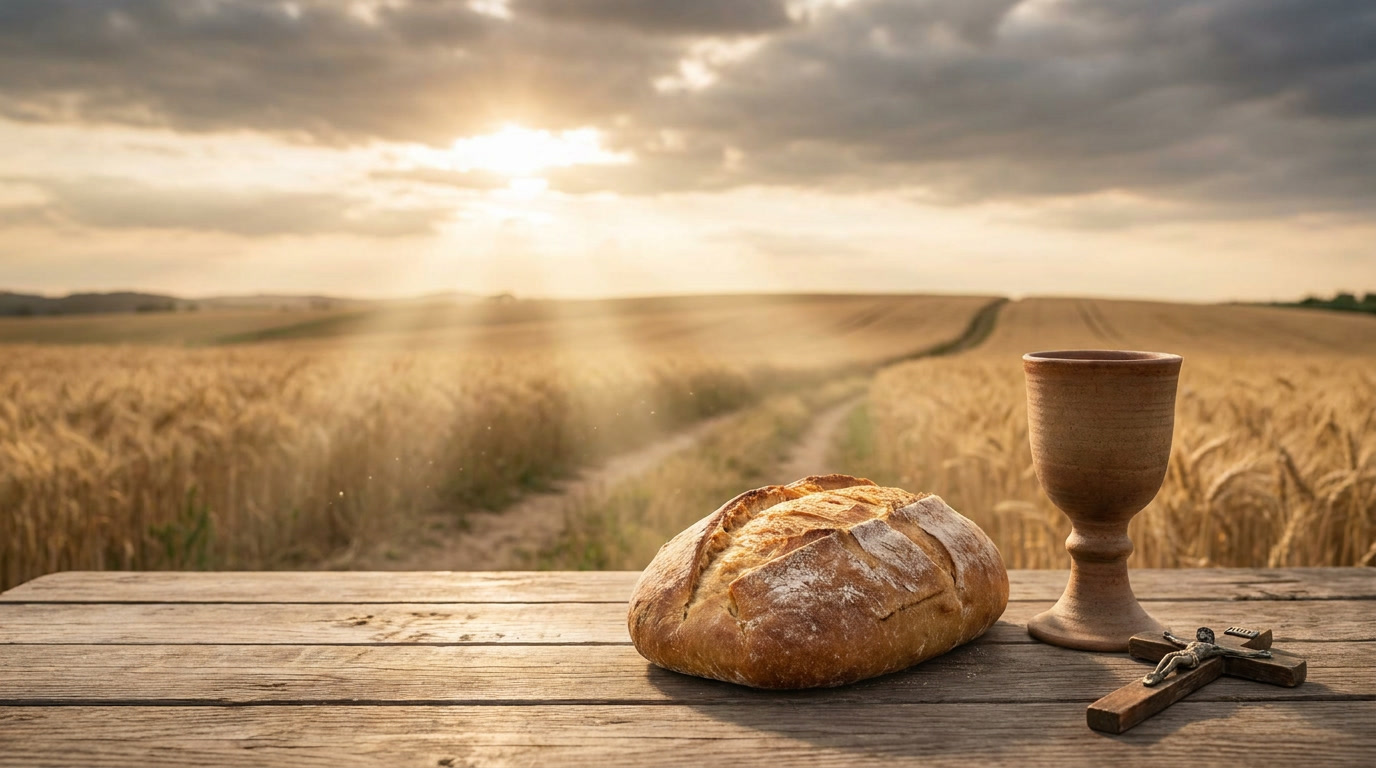
"I am the living bread that came down from heaven; whoever eats this bread will live forever; and the bread that I will give is my flesh for the life of the world." — John 6:51
On this Solemnity of the Most Holy Body and Blood of Christ, the living bread that Jesus speaks of in John 6:51-58 reveals the profound mystery of the Eucharist. These words, spoken near Capernaum after the multiplication of loaves, challenge human understanding just as they did the Jewish crowds. The bread of life discourse reaches its climax here, where Christ declares himself not merely spiritual nourishment, but true food and drink.
The Scandal of the Incarnation Made Edible
The Jews quarreled among themselves, asking "How can this man give us his flesh to eat?" Their confusion mirrors our own when faced with the Eucharistic mystery. Christ's response grows more explicit, not less. He speaks of eating flesh and drinking blood — language that would have horrified his Jewish audience, for whom consuming blood violated the deepest dietary laws.
Yet Jesus doubles down. "Unless you eat the flesh of the Son of Man and drink his blood, you do not have life within you." The Greek verb he uses, "trogo," means to gnaw or chew — physical, not metaphorical eating. Saint John Chrysostom observed that Christ used such concrete language precisely to prevent his words from being spiritualized away.
True Food, True Drink: The Eucharistic Reality
"For my flesh is true food, and my blood is true drink." Here Christ distinguishes between ordinary nourishment and supernatural sustenance. The manna that sustained Israel in the desert was temporary bread for temporary bodies. Those who ate it still died. The bread Christ offers transcends physical hunger to satisfy the deepest longing of the human heart.
Saint Thomas Aquinas teaches that the Eucharist contains Christ's true Body and Blood, soul and divinity. This is not symbolic representation but sacramental reality. When Christ says "whoever eats this bread will live forever," he speaks of eternal life beginning now, sustained by his own divine life within us.
The Mutual Indwelling
"Whoever eats my flesh and drinks my blood remains in me and I in him." The Eucharist creates not just communion but union. As natural food becomes part of our body, this supernatural food makes us part of Christ's mystical body. The Latin term "manducatio" captures both the eating and the spiritual transformation that follows.
Life Because of the Father
Christ grounds his promise in the relationship between Father and Son: "Just as the living Father sent me and I have life because of the Father, so also the one who feeds on me will have life because of me." The Eucharist draws us into Trinitarian life itself. We share not just in Christ's humanity but in his divine sonship.
This passage invites contemplation through Ignatian Contemplation, where we might place ourselves among the confused crowds, wrestling with Christ's radical words. What draws us toward this living bread? What holds us back?
Pray With This Reading
The profound mystery of the Eucharist calls for Lectio Divina, allowing Christ's words to penetrate slowly, deeply. Read the passage multiple times. Notice which phrases kindle wonder or resistance. Let the living bread speak to your hunger for divine life.
On this feast of Corpus Christi, approach the Eucharist with renewed reverence. Christ has not left us orphaned but feeds us with his very self. The bread that came down from heaven awaits us at every Mass, offering life that death cannot touch.
Frequently Asked Questions
What does "living bread" mean in John 6:51?
Living bread refers to Christ himself as spiritual nourishment that gives eternal life, unlike ordinary bread that sustains only physical life. This bread "came down from heaven," indicating its divine origin and supernatural power to transform those who receive it in faith.
Why did the Jews find Jesus' words about eating his flesh so disturbing?
Jewish law strictly forbade consuming blood and viewed eating human flesh as abhorrent. Jesus' language deliberately challenged their understanding, using concrete terms that pointed toward the future reality of the Eucharist while shocking his immediate audience.
How does the Eucharist give eternal life according to this passage?
The Eucharist contains Christ's true Body and Blood, making the recipient a partaker in divine life. As Christ has life because of the Father, those who feed on him receive that same divine life, creating an unbreakable bond that transcends death.