
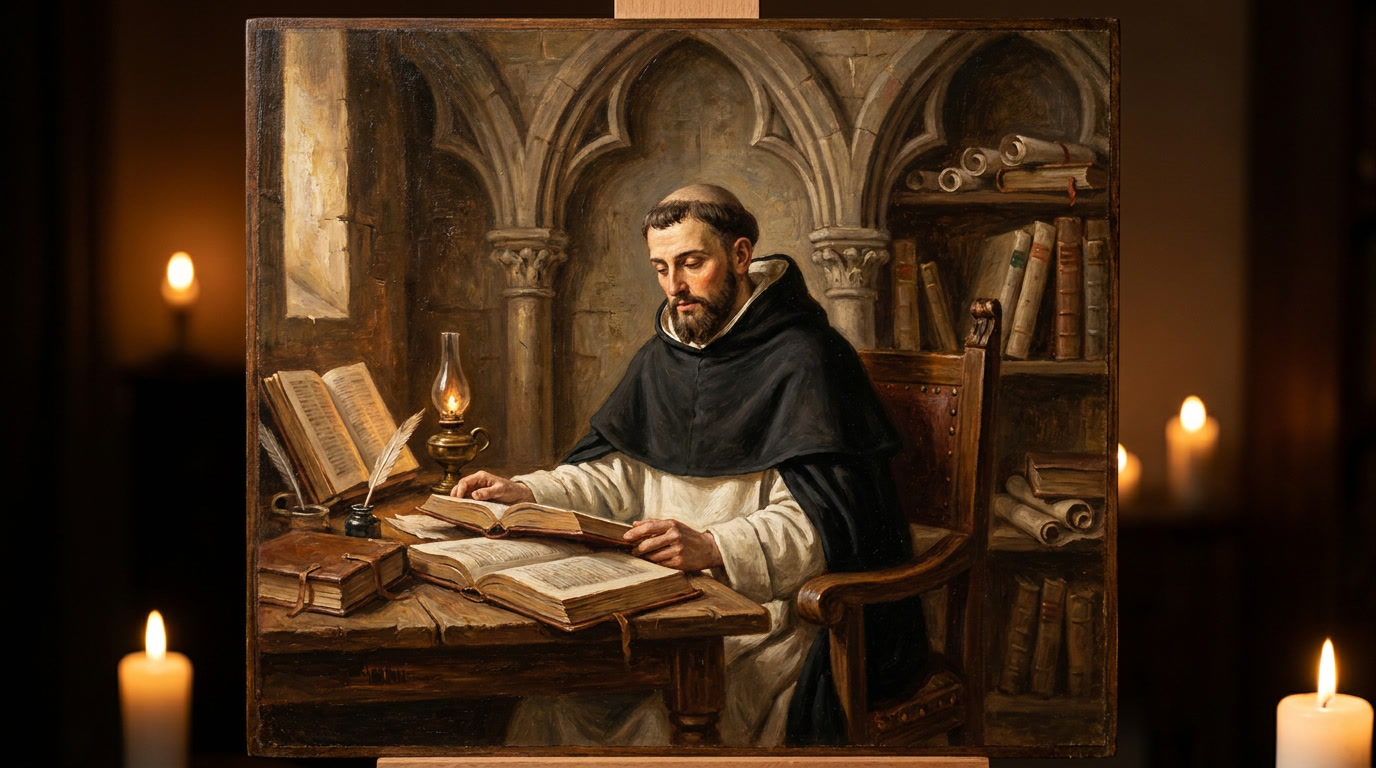
"To one who has faith, no explanation is necessary. To one without faith, no explanation is possible."— Saint Thomas Aquinas
The Gospel presents Jesus teaching in the temple, posing a question that confounded the scribes: How could the Messiah be both David's son and David's lord? This mystery of Christ's dual nature — human and divine — finds its greatest theological exposition in the work of Saint Thomas Aquinas, the thirteenth-century Dominican friar whose penetrating intellect illuminated the deepest truths of faith.
Thomas lived from 1225 to 1274, earning the title "Angelic Doctor" for his extraordinary synthesis of Aristotelian philosophy and Christian doctrine. His Summa Theologica remains the cornerstone of Catholic theological education, demonstrating how human reason can serve divine revelation without compromising either.
When Mystery Meets Understanding
The scribes in today's Gospel stumbled because they sought to reduce divine mystery to human categories. Thomas Aquinas faced similar challenges when Islamic and Jewish philosophers claimed that faith and reason were incompatible. Yet where others saw contradiction, Thomas perceived harmony.
Christ's question about being both son and lord reveals the inadequacy of purely human reasoning when approaching divine mystery. Thomas taught that while reason can lead us toward God, only faith illuminates the fullness of truth. The Incarnation — God becoming man — transcends logic without destroying it.
The Humble Path to Truth
Thomas demonstrated that intellectual pride blinds us to wisdom. The scribes' confidence in their knowledge prevented them from recognizing truth standing before them. The great crowd, however, "heard this with delight" because they approached with open hearts.
In his prayers, Thomas often began with the words "I place myself in Your presence, O Lord." This practice of Ignatian contemplation helps us follow his example of approaching divine mystery with intellectual humility. Knowledge serves love, not the reverse.
Living the Questions
Thomas Aquinas never claimed to exhaust divine mystery through his writings. Near the end of his life, after a profound mystical experience, he declared all his theological work "like straw" compared to what had been revealed to him. This teaches us that the deepest questions about God are meant to be lived, not merely solved.
The relationship between Christ's humanity and divinity remains a mystery that shapes our daily discipleship. When faced with suffering, we find comfort in his humanity. When tempted to despair, we draw strength from his divinity. Both truths sustain us simultaneously.
Pray in the Spirit of Saint Thomas Aquinas
Begin each day by acknowledging the limits of human understanding. Ask not for all mysteries to be solved, but for grace to live faithfully within them. Let questions about God draw you deeper into prayer rather than away from it. Remember that the greatest saints combined rigorous thinking with profound humility before the divine.
Frequently Asked Questions
What is Saint Thomas Aquinas the patron saint of?
Saint Thomas Aquinas is the patron saint of students, schools, universities, and Catholic education. His feast day is January 28th, though he is also commemorated throughout the liturgical year for his contributions to theology.
How did Saint Thomas Aquinas approach faith and reason?
Thomas Aquinas taught that faith and reason are complementary paths to truth. He believed human reason could demonstrate certain truths about God, while revelation provides truths beyond reason's reach. Both come from God and cannot truly contradict each other.