
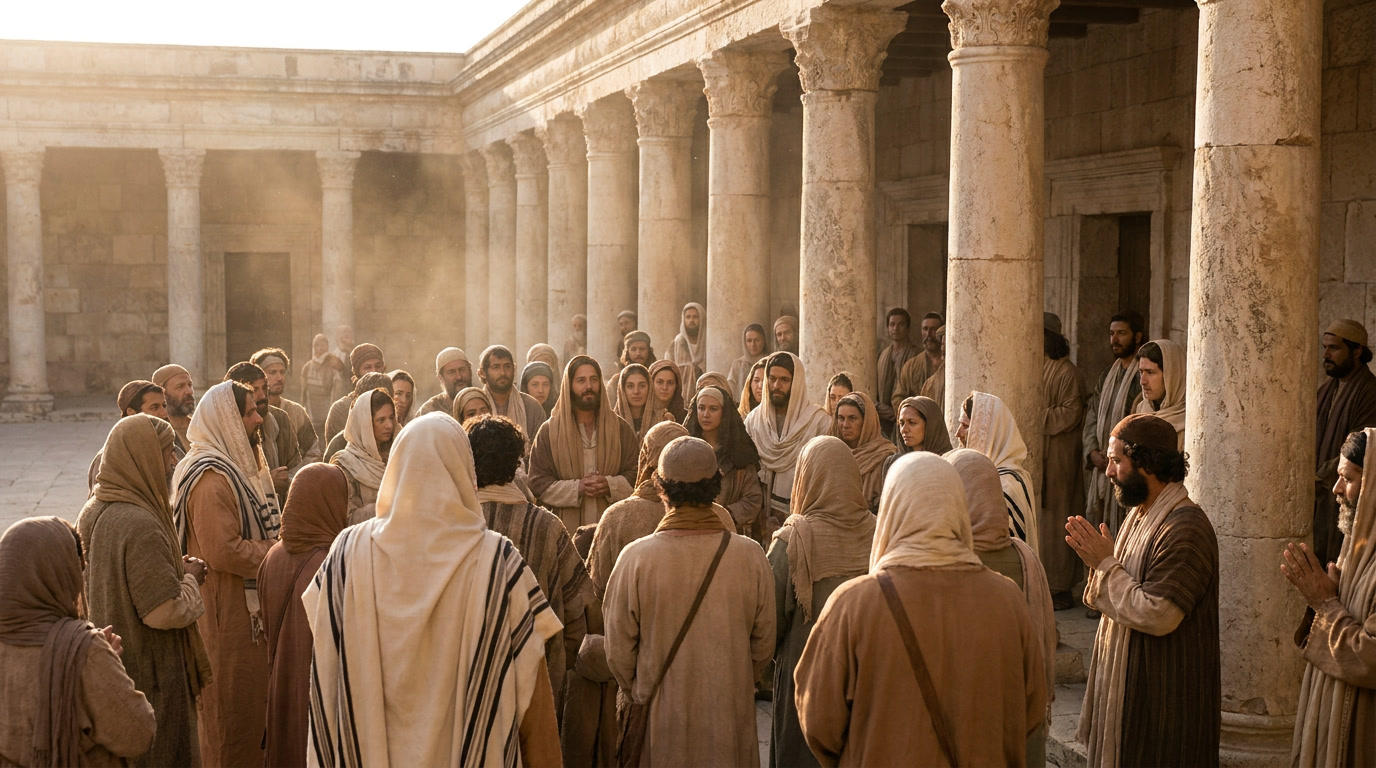
As Jesus was teaching in the temple area he said, "How do the scribes claim that the Christ is the son of David? David himself, inspired by the Holy Spirit, said: The Lord said to my lord, 'Sit at my right hand until I place your enemies under your feet.' David himself calls him 'lord'; so how is he his son?" The great crowd heard this with delight. — Mark 12:35-37
In the temple courts, Jesus poses a question that cuts through centuries of expectation. The scribes proclaimed the Messiah would be David's son, yet David himself calls this coming one "lord." This riddle reveals the profound mystery of Christ's identity—fully human, yet eternally divine.
The Scribes' Limited Understanding of the Messiah
The scribes taught correctly that the Messiah would descend from David's line. Scripture promised this through the prophet Nathan: "Your house and your kingdom shall endure forever before me" (2 Samuel 7:16). Yet their understanding remained earthbound, focused on political restoration and temporal kingship.
Jesus exposes the inadequacy of purely human categories. The Messiah cannot be reduced to genealogy alone. Saint Augustine observed that while Christ took flesh from David's lineage, His divine nature transcends all human ancestry.
David's Prophetic Recognition of Divine Lordship
David, speaking through the Holy Spirit in Psalm 110, acknowledges his descendant as "lord." This paradox—a father calling his son "lord"—points beyond natural relationships to supernatural reality. The psalmist glimpses the eternal sonship of Christ, seated at the Father's right hand before time began.
Saint Thomas Aquinas noted that David recognized in the Messiah both his kinship and his kingship. The prophet-king understood that his royal line would culminate not in another earthly ruler, but in the eternal Word made flesh.
The Crowd's Delight in Divine Truth
Mark records that the great crowd "heard this with delight." Truth resonates in the human heart, even when the mind struggles to grasp its fullness. The people sensed that Jesus revealed something profound about God's plan—something that transcended their teachers' limited vision.
This delight echoes Mary's Magnificat: "My soul proclaims the greatness of the Lord." When divine truth breaks through human understanding, joy follows. The crowd intuited what the scribes could not accept: Jesus spoke with authority that came from above.
Saint Boniface and the Courage to Proclaim Truth
Today we honor Saint Boniface, the English monk who carried the Gospel to Germanic tribes. Like Jesus in the temple, Boniface faced those who claimed religious authority yet missed divine truth. He cut down the sacred oak of Thor, demonstrating that Christ's power surpassed all earthly claims to divinity.
Boniface's martyrdom reminds us that proclaiming Christ's true identity often meets resistance. The apostle of Germany died defending the Gospel that Jesus himself revealed in today's passage—that He is both David's son and David's Lord.
Pray With This Reading
This Gospel passage invites contemplative prayer that moves beyond intellectual analysis to encounter the living Christ. Consider engaging with this mystery through Ignatian Contemplation, placing yourself among the crowd in the temple courts, listening as Jesus poses His challenging question.
Allow the Holy Spirit to reveal what the scribes could not see—that Jesus stands before them as both human and divine, the fulfillment of every promise made to David's house.
Frequently Asked Questions
Why did Jesus ask about the Messiah being David's son?
Jesus challenged the scribes' incomplete understanding of the Messiah. While correctly teaching that the Messiah would descend from David, they missed His divine nature. Christ's question reveals that the Messiah is both David's descendant and David's Lord.
What does Psalm 110 mean when it says "The Lord said to my lord"?
This psalm distinguishes between God the Father ("The Lord") and the Messiah ("my lord"). David recognizes that his descendant holds divine authority, seated at God's right hand. Jesus uses this to demonstrate His dual nature as both human and divine.
How does Saint Boniface connect to this Gospel reading?
Saint Boniface, like Jesus, proclaimed divine truth to those with limited religious understanding. Both faced opposition for revealing that earthly categories cannot contain God's reality. Boniface's martyrdom echoes Christ's ultimate sacrifice for proclaiming His true identity.