
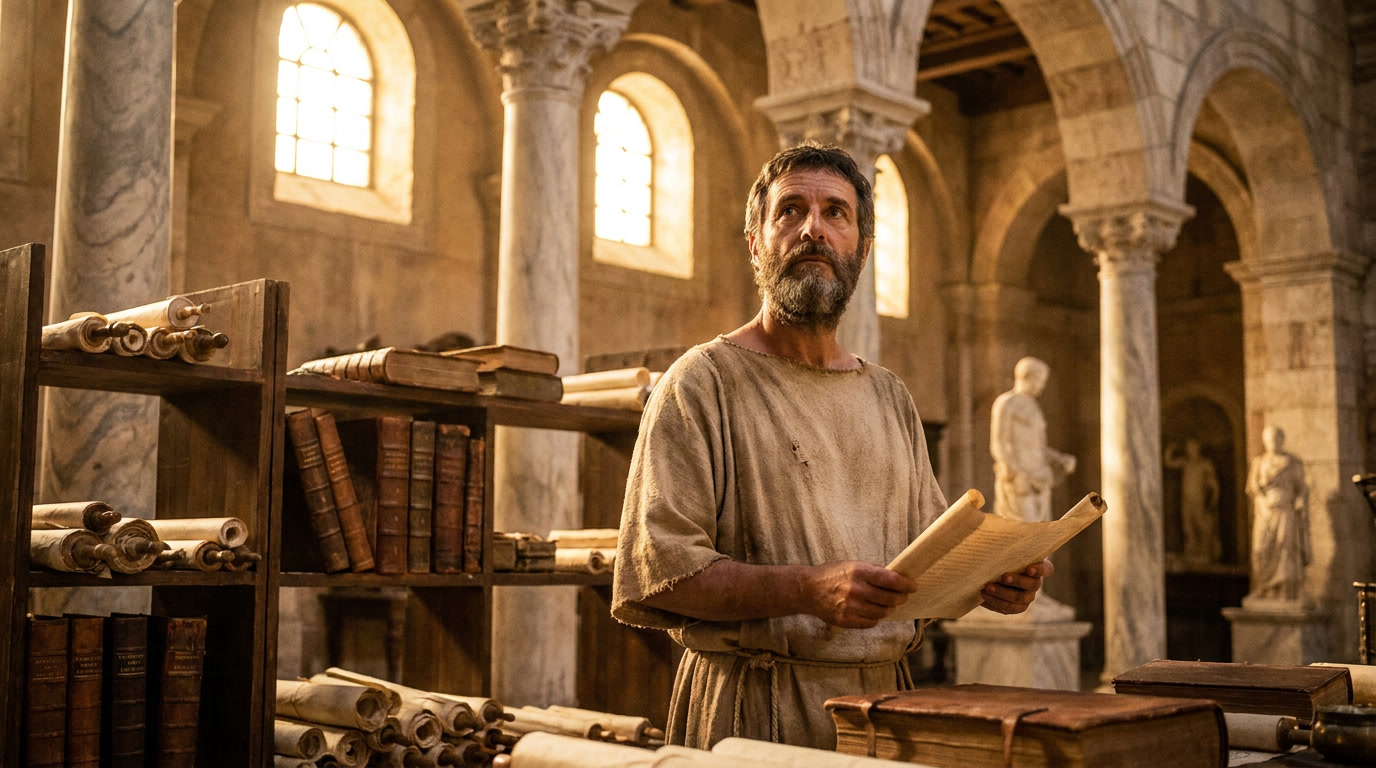
"We who once delighted in fornication now embrace only chastity, we who formerly used magical arts dedicate ourselves to the good and unbegotten God; we who valued above all things the acquisition of wealth and possessions now bring what we have into a common stock, and communicate to everyone in need."
Saint Justin Martyr understood what the tenant farmers in today's Gospel refused to accept. The vineyard belongs to God. Everything returns to Him. Justin's conversion from philosophy to Christianity, and ultimately to martyrdom, reveals the same truth Christ speaks in Mark's parable: those who reject the Son will face divine judgment, but the vineyard will be given to others.
Born around 100 AD in Samaria, Justin pursued truth through various philosophical schools before encountering an elderly Christian who introduced him to Scripture. This meeting changed everything. The philosopher became an apologist, defending Christianity with the same intellectual rigor he once applied to pagan wisdom.
The Courage to Confront False Tenants
Justin's martyrdom in Rome around 165 AD mirrors the fate of the servants in Christ's parable. Like those messengers sent to collect the vineyard's fruit, Justin proclaimed God's ownership of all creation. The Roman authorities, like the wicked tenants, refused to acknowledge any authority beyond their own.
His trial records survive, showing how he refused to sacrifice to pagan gods. "No one in his right mind gives up piety for impiety," he told the prefect. The tenant farmers thought they could claim the vineyard by killing the heir. Rome thought it could silence God's voice by executing His witnesses.
Philosophy as Preparation for Truth
Justin never abandoned reason when he embraced faith. Instead, he recognized that Greek philosophy prepared him for the fullness of revelation in Christ. The vineyard owner in today's Gospel shows patience, sending servant after servant. God shows similar patience, allowing human wisdom to develop before sending His Son.
Justin wrote that seeds of truth existed in all authentic philosophy, but Christ contained the complete Logos. The tenant farmers represent those who grasp partial truths but refuse the full revelation. They mistake their role as caretakers for ownership itself.
Martyrdom as the Ultimate Surrender
The parable ends with the son's murder and the vineyard's transfer to faithful tenants. Justin's death exemplifies this transition. His blood, shed for refusing to deny Christ, became seed for future believers. The persecutors thought they were eliminating a threat. Instead, they were fulfilling God's plan.
Modern disciples face the same choice. Will we be faithful tenants who render God His due, or will we claim ownership of gifts that belong entirely to Him? Lectio divina on today's parable can help us examine our own hearts for areas where we've forgotten our role as stewards.
Pray in the Spirit of Saint Justin Martyr
Saint Justin, philosopher and martyr, you discovered that all truth leads to Christ. When faced with the choice between temporal safety and eternal truth, you chose truth. Help us recognize that everything belongs to God. Grant us courage to speak for Christ when the world demands our silence. Through your intercession, may we be faithful tenants of God's vineyard, rendering to Him the fruits of righteousness. Amen.
Frequently Asked Questions
What did Saint Justin Martyr teach about Christianity and philosophy?
Saint Justin Martyr taught that philosophy, especially Platonic thought, served as preparation for Christian revelation. He believed that divine truth existed in fragmentary form throughout human wisdom, but reached completion in Christ as the full embodiment of the Logos.
How did Saint Justin Martyr die?
Saint Justin Martyr was beheaded in Rome around 165 AD during the reign of Marcus Aurelius. He was arrested with several companions and executed after refusing to sacrifice to pagan gods, maintaining his Christian faith until death.