
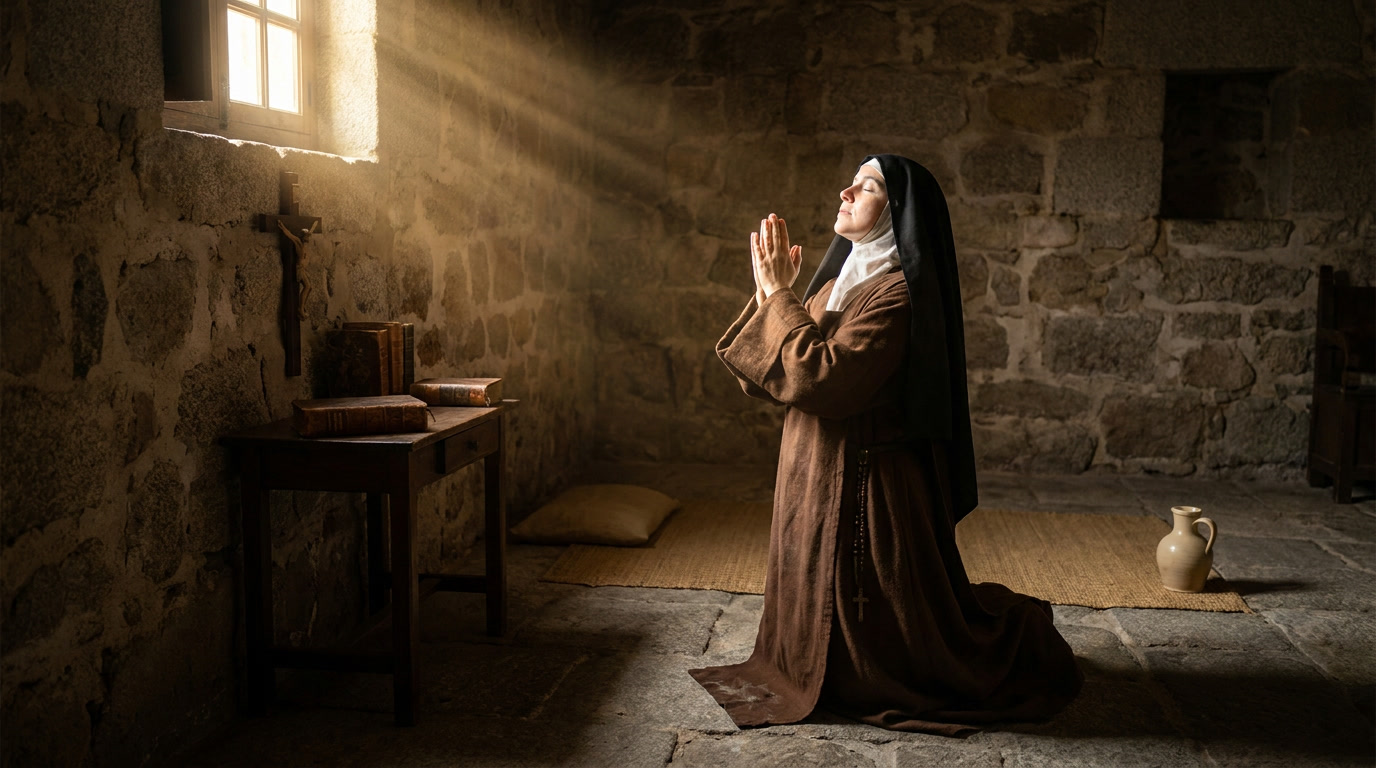
"Let nothing disturb you, let nothing frighten you. All things pass away: God never changes. Patience obtains all things. Whoever has God lacks nothing; God alone suffices."
Saint Teresa of Avila understood the depths of divine union that Jesus speaks of in today's Gospel from John 17. When Christ prays to the Father for glory, Teresa recognized this as the soul's ultimate calling - to dwell in perfect communion with the Trinity through prayer and surrender.
The Mystic of Avila: A Soul on Fire
Teresa Sanchez de Cepeda y Ahumada lived in sixteenth-century Spain, transforming from a worldly young woman into one of the Church's greatest mystics. Born in 1515, she entered Carmelite religious life but struggled for years with mediocre prayer and worldly attachments.
Her conversion came through encountering a statue of the wounded Christ. This moment ignited a spiritual fire that would lead her to reform the Carmelite order and pen some of Christianity's most profound mystical writings, including "The Interior Castle" and "The Way of Perfection."
The Glory That Comes Through Self-Knowledge
In John's Gospel, Jesus speaks of the glory he shared with the Father "before the world began." Teresa taught that this divine glory becomes accessible to souls through what she called the "interior castle" - the depths of the human soul where God dwells.
"Know yourself," Teresa insisted, echoing the ancient wisdom that leads to divine union. She understood that recognizing our poverty opens us to receive God's riches. The glory Jesus speaks of flows not from human achievement but from surrendering to divine love.
Teresa's seven mansions of the soul map this journey from self-knowledge to mystical marriage with Christ. Each mansion represents deeper intimacy with God, moving from vocal prayer to the heights of contemplative union.
Living in Divine Friendship
When Jesus prays for his disciples in today's Gospel, he reveals the tender care of divine friendship. Teresa experienced this same intimacy, describing prayer as "nothing else than an intimate sharing between friends."
This friendship transforms ordinary moments into encounters with the sacred. Teresa found God while cooking, cleaning, and managing her convents. "Among the pots and pans," she declared, "the Lord walks."
The glory Jesus seeks for his followers becomes tangible through this kind of friendship with God. Ignatian contemplation can help cultivate this intimate awareness of Christ's presence in daily life.
Pray in the Spirit of Saint Teresa
Teresa's path to divine union began with honest self-examination and faithful prayer, even when it felt dry or difficult. She remained convinced that God desires intimate friendship with every soul.
Consider Teresa's counsel: begin where you are, with whatever prayer feels authentic. Whether through vocal prayer, meditation, or simply sitting in God's presence, trust that the Lord who calls you to glory will provide the grace needed for the journey.
The same Christ who prayed for divine glory in today's Gospel dwells within the castle of your soul, waiting to share that glory through friendship and love.
Frequently Asked Questions
What is Saint Teresa of Avila known for?
Saint Teresa of Avila is renowned for her mystical writings, particularly "The Interior Castle," her reform of the Carmelite order, and her profound teachings on contemplative prayer and union with God.
How can I apply Teresa of Avila's teachings to modern life?
Teresa's emphasis on finding God "among the pots and pans" shows how ordinary activities become prayer through awareness of God's presence. Her teaching on the interior castle encourages regular prayer, self-knowledge, and trust in God's desire for intimate friendship with every soul.