
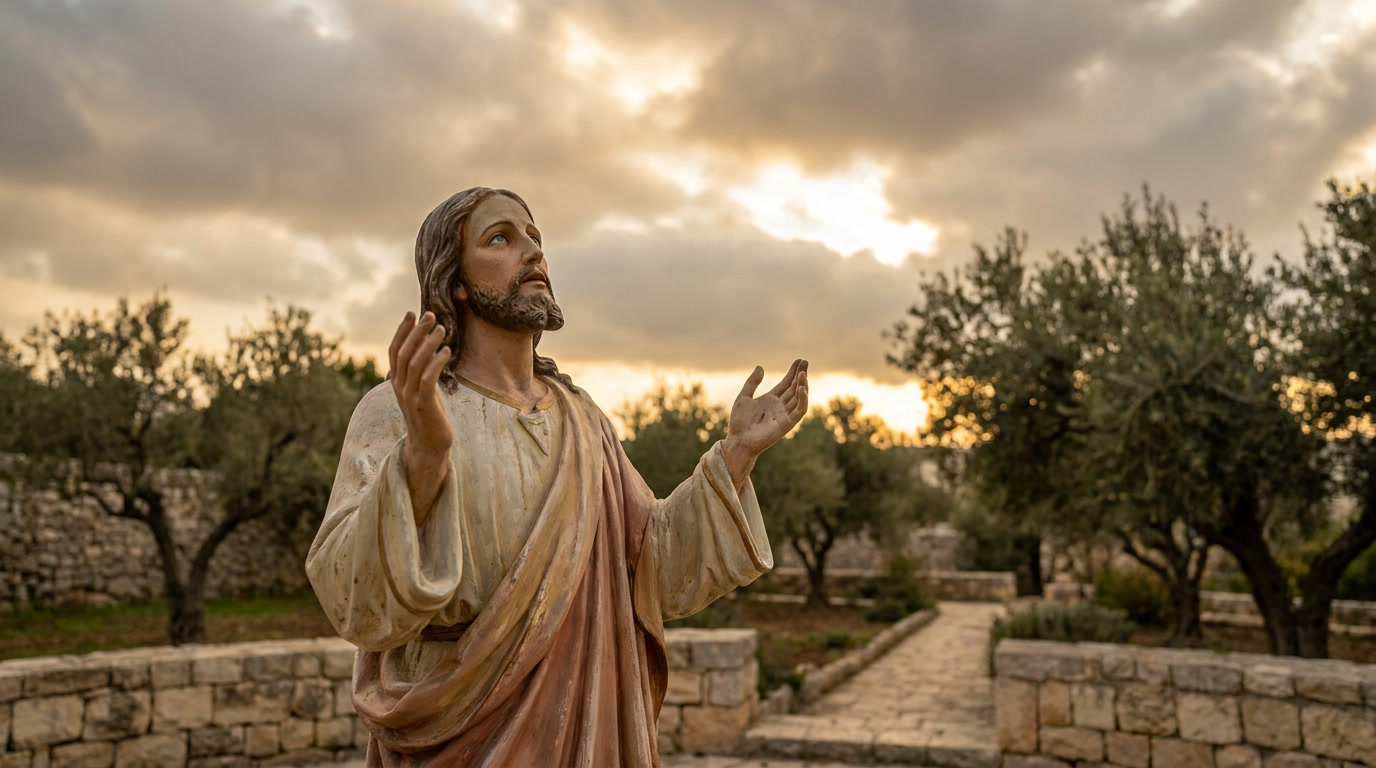
"Jesus raised his eyes to heaven and said, 'Father, the hour has come. Give glory to your son, so that your son may glorify you, just as you gave him authority over all people, so that your son may give eternal life to all you gave him. Now this is eternal life, that they should know you, the only true God, and the one whom you sent, Jesus Christ.'" - John 17:1-11a
The Priestly Prayer of Jesus stands as one of Scripture's most intimate moments. Here Christ lifts His eyes to heaven, speaking directly to the Father before His passion. This prayer reveals the heart of eternal life: knowing God through His Son.
The Hour of Glory Arrives
"Father, the hour has come." These words echo throughout John's Gospel. The hour Jesus spoke of at Cana has arrived. Not the hour of defeat, but of glory.
Glory in John's Gospel means revelation. When Jesus asks the Father to glorify Him, He seeks the full revelation of divine love through the cross. The crucifixion becomes coronation. Suffering transforms into triumph.
Saint John of the Cross understood this mystery. In his dark nights, he discovered that God's greatest gifts often come wrapped in apparent loss. The cross reveals glory because it shows love's ultimate expression.
Eternal Life Defined
"This is eternal life, that they should know you, the only true God, and the one whom you sent, Jesus Christ." Jesus redefines eternal life. Not endless duration, but divine relationship.
To know God in Scripture means intimate communion, not mere intellectual understanding. Adam "knew" Eve. God "knows" His people. This knowing involves the whole person—mind, heart, soul.
Saint Teresa of Avila spent her life pursuing this knowledge. Through prayer, she discovered that knowing God transforms everything. The soul recognizes its true home. Peace replaces restlessness.
The Work Accomplished
"I glorified you on earth by accomplishing the work that you gave me to do." Jesus speaks of His mission in past tense, though the crucifixion awaits. In God's eternal perspective, the work is complete.
What work did Jesus accomplish? Revealing the Father's name. Making God known. Bridge-building between heaven and earth. The disciples received this revelation and believed.
Now Jesus prays for them specifically: "I pray for them. I do not pray for the world but for the ones you have given me." This distinction matters. Christ's immediate concern focuses on those called to continue His mission.
The Unity of Father and Son
"Everything of mine is yours and everything of yours is mine." Jesus reveals the perfect unity between Father and Son. No competition exists in the Trinity. No jealousy. Complete self-giving.
This unity extends to the disciples: "I have been glorified in them." The Father's glory shines through the Son, and the Son's glory shines through His followers. Glory multiplies when shared, never diminishes.
Saint Thérèse grasped this truth in her Little Way. She understood that her smallness could contain God's greatness. Humility becomes the vessel for divine glory.
Pray With This Reading
This passage invites deep contemplation. Consider using Ignatian Contemplation to place yourself in the scene. Imagine Jesus raising His eyes to heaven. Notice His posture, His voice, His expression.
What does it mean that eternal life is knowing God? How does this knowledge differ from other kinds of knowing? Let the prayer of Jesus become your prayer.
Frequently Asked Questions
What is the Priestly Prayer of Jesus?
The Priestly Prayer (John 17) is Jesus's longest recorded prayer, spoken before His arrest. He prays for Himself, His disciples, and all future believers. It reveals His heart and mission before the passion.
What does "eternal life" mean in John 17?
Eternal life in John's Gospel means knowing God intimately through Jesus Christ. It begins now, not just after death. This knowledge involves relationship, not mere information about God.
Why does Jesus pray only for His disciples, not the world?
In this specific moment, Jesus focuses on those called to continue His mission. Later in John 17, He expands His prayer to include all future believers. His priority reflects pastoral care for those He is leaving behind.