
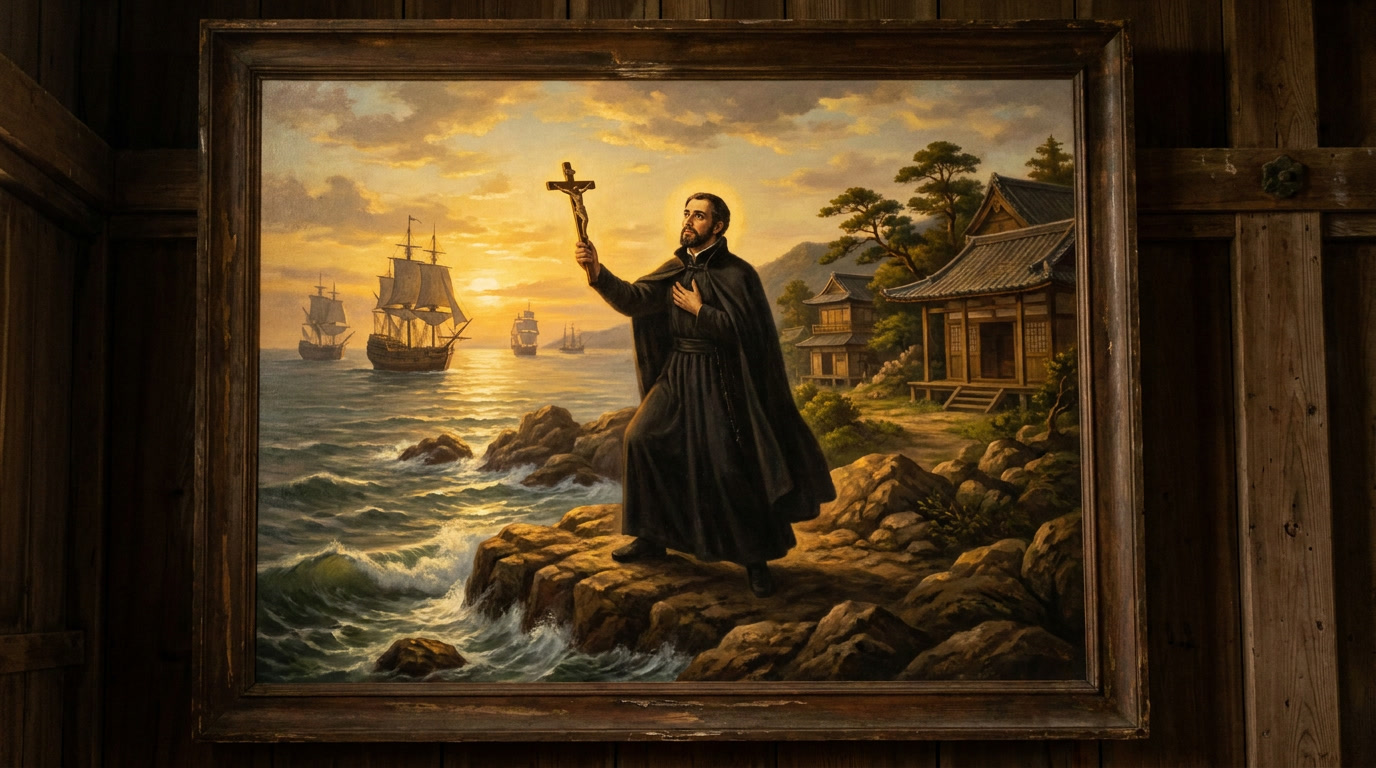
"It is not the actual physical exertion that counts towards one's progress, nor the nature of the task, but by the spirit of faith with which it is undertaken."
The Ascension of the Lord presents us with Christ's Great Commission, calling His disciples to make disciples of all nations. Few saints embodied this missionary mandate with greater fervor than St. Francis Xavier, whose life exemplifies what it means to carry the Gospel to the ends of the earth with unwavering faith.
Born into Spanish nobility in 1506, Francis Xavier initially pursued worldly ambition at the University of Paris. His transformation began through his friendship with St. Ignatius of Loyola, who challenged him with the question: "What does it profit a man if he gains the whole world but loses his soul?" This encounter led Francis to become one of the founding members of the Society of Jesus and eventually one of history's greatest missionaries.
Answering the Call to Go Forth
When Christ commanded His apostles to "go therefore and make disciples of all nations," He entrusted them with divine authority. St. Francis Xavier understood this commission not as mere suggestion but as sacred imperative. His missionary journeys took him from India to Japan, baptizing hundreds of thousands and establishing Catholic communities across Asia.
Francis Xavier's approach to evangelization reveals the heart of the Great Commission. He learned local languages, adapted to cultural customs, and met people where they were. His letters describe sleeping on beaches, walking countless miles, and enduring physical hardships—all for the sake of bringing souls to Christ. This saint reminds us that authentic discipleship requires sacrifice and genuine love for those we seek to reach.
The Promise of Divine Presence
Christ's final words in Matthew's Gospel offer profound comfort: "I am with you always, to the close of the age." St. Francis Xavier drew strength from this promise during his most challenging moments. When faced with hostile crowds, dangerous voyages, and cultural barriers, he trusted in Christ's abiding presence.
The saint's correspondence reveals deep reliance on this divine companionship. He wrote of feeling Christ's strength when his own failed, of finding peace in prayer when surrounded by chaos. Through Ignatian Contemplation, we can follow Francis Xavier's example of seeking Christ's presence in our own missionary efforts, whether in foreign lands or our neighborhood.
Modern Missionaries in Daily Life
St. Francis Xavier's example challenges contemporary Catholics to examine their own response to the Great Commission. Not everyone is called to foreign missions, but every baptized Catholic shares in the mandate to make disciples. This might mean sharing faith with colleagues, volunteering in parish ministries, or simply living with such integrity that others are drawn to Christ.
The saint's writings emphasize that missionary work begins with personal conversion. He understood that one cannot give what one does not possess. Before embarking on his journeys, Francis Xavier spent months in prayer and spiritual preparation, allowing Christ to transform his own heart first.
Pray in the Spirit of St. Francis Xavier
Place yourself in God's presence and ask for the grace to respond generously to His call. Reflect on the areas of your life where Christ is asking you to be His witness. Consider how you can carry the Gospel message through your words, actions, and presence to those around you. Ask St. Francis Xavier to intercede for you, that you might have his courage and zeal in sharing the Good News.
Frequently Asked Questions
What is St. Francis Xavier the patron saint of?
St. Francis Xavier is the patron saint of missions, missionaries, and the propagation of the faith. He is also patron of Japan, India, and the East Indies, reflecting his extensive missionary work in these regions.
How did St. Francis Xavier die?
St. Francis Xavier died on December 3, 1552, on Shangchuan Island near mainland China while waiting for permission to enter the country. He was only 46 years old and died of fever, having spent the last decade of his life in missionary work across Asia.