
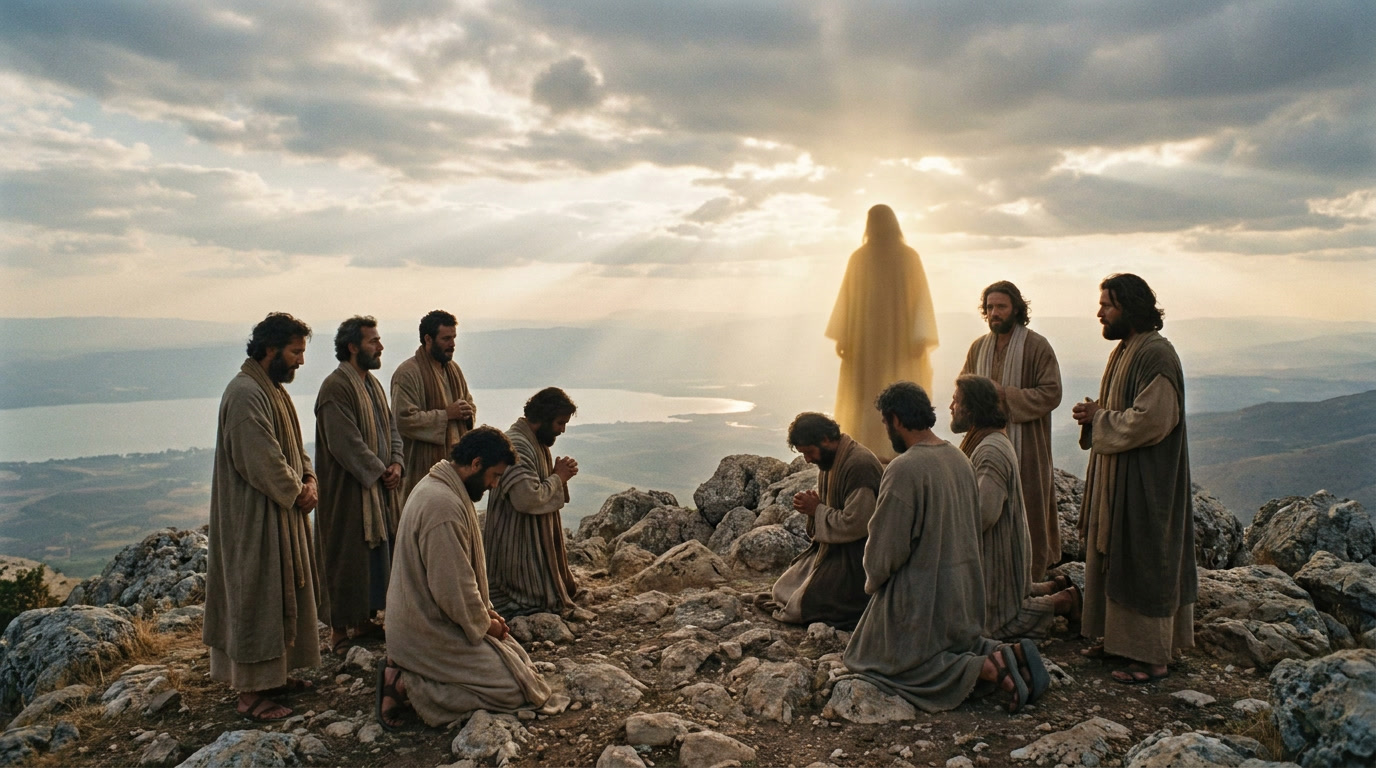
"Now the eleven disciples went to Galilee, to the mountain to which Jesus had directed them. And when they saw him they worshiped him; but some doubted. And Jesus came and said to them, 'All authority in heaven and on earth has been given to me. Go therefore and make disciples of all nations, baptizing them in the name of the Father and of the Son and of the Holy Spirit, teaching them to observe all that I have commanded you; and lo, I am with you always, to the close of the age.'" - Matthew 28:16-20
The Great Commission stands as Christ's final earthly command, delivered on a Galilean mountain where worship and doubt existed side by side. This passage from Matthew 28:16-20 reveals how the Ascension of the Lord transforms uncertainty into universal mission, offering hope for every believer who has wrestled with faith.
Worship Amidst Doubt: The Human Response to Divine Authority
Matthew records a striking detail: "when they saw him they worshiped him; but some doubted." Even among the eleven apostles, faith and uncertainty coexisted in the presence of the risen Christ. This honest acknowledgment offers profound comfort.
The Greek word for "doubted" (distazo) suggests hesitation rather than outright rejection. These were men who had walked with Jesus for three years, witnessed his death, and now encountered him alive. Their doubt was not weakness but human wrestling with divine mystery.
Saint Augustine reminds us that doubt can serve faith when it leads to deeper seeking. The apostles' worship amid uncertainty models how believers approach Christ—not with perfect understanding, but with reverent hearts open to grace.
All Authority Given: The Foundation of Christian Mission
Before commissioning his disciples, Jesus establishes the foundation: "All authority in heaven and on earth has been given to me." This declaration transforms everything. The one who speaks is not merely teacher or prophet, but Lord of creation itself.
The passive voice—"has been given"—points to the Father's conferral of cosmic authority upon the Son. This authority spans both realms: heaven, where spiritual powers reign, and earth, where human kingdoms rise and fall. No sphere exists beyond Christ's dominion.
Saint John Chrysostom emphasized that this authority empowers the seemingly impossible command that follows. The disciples, once fearful and scattered, now receive their mission backed by divine omnipotence.
Go and Make Disciples: The Universal Call to Mission
The Great Commission unfolds in four movements: go, make disciples, baptize, and teach. Each verb carries weight, building upon Christ's established authority to create a comprehensive vision of Christian mission.
"Go therefore" (poreuthentes) implies movement, departure from comfort zones. The "therefore" connects directly to Christ's authority—because all power belongs to him, his followers must advance with confidence.
"Make disciples of all nations" (panta ta ethne) shatters every boundary. The Gospel transcends racial, cultural, and geographical limitations. Saint Paul would later embody this universal scope, carrying Christ's message from Jerusalem to Rome.
Baptism "in the name of the Father and of the Son and of the Holy Spirit" reveals the Trinitarian foundation of Christian initiation. This formula, preserved by the Church for two millennia, marks the believer's entry into divine life itself.
The Eternal Promise: Christ's Abiding Presence
The Great Commission concludes with perhaps the most comforting promise in Scripture: "I am with you always, to the close of the age." The Greek "ego meta hymon eimi" echoes God's covenant language throughout salvation history.
This presence is not temporary consolation but permanent reality. Though Christ ascends to the Father's right hand, he remains mystically present with his Church through all generations. The Holy Spirit, prayer, sacraments, and gathered community become vehicles of this promised presence.
Saint Teresa of Avila found deep consolation in this promise during her most challenging spiritual seasons. Christ's "always" encompasses every moment of doubt, mission, and growth in the Christian journey.
Pray With This Reading
The Great Commission invites contemplative prayer that moves from personal encounter to universal mission. Consider engaging this passage through Ignatian Contemplation, placing yourself among the eleven disciples on that Galilean mountain. Feel the mix of worship and doubt, hear Christ's authoritative voice, and receive his commission as your own calling.
Frequently Asked Questions
What does the Great Commission mean for Catholics today?
The Great Commission remains the Church's fundamental mission mandate. Every Catholic participates through evangelization, catechesis, and witness. The command applies not only to missionaries and clergy but to all believers in their daily lives, workplaces, and relationships.
Why did some disciples doubt even after seeing the risen Christ?
The disciples' doubt reflects honest human response to divine mystery. Seeing the crucified Jesus alive challenged every category of understanding. Their doubt was not sinful but natural, showing that faith often coexists with questions and uncertainty.
How does Christ remain with us always as promised in Matthew 28:20?
Christ fulfills his promise through multiple means: the Holy Spirit dwelling within believers, his real presence in the Eucharist, his word proclaimed in Scripture, and his mystical body gathered as Church. Prayer and sacramental life make this presence tangible for faithful Catholics.