
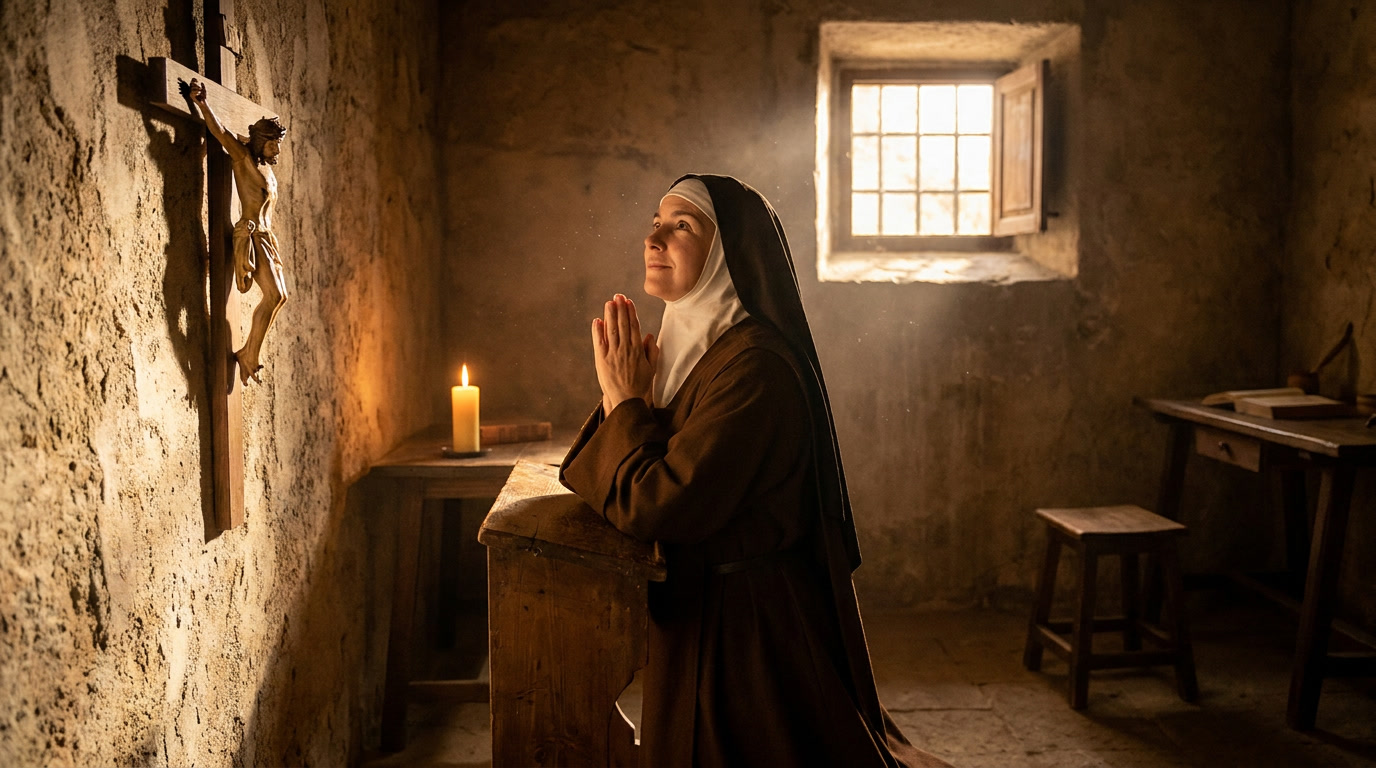
"Let nothing disturb you. All things pass. God does not change. Patience obtains all. Whoever has God lacks nothing. God alone suffices."
St. Teresa of Avila understood the profound mystery that Jesus reveals in today's Gospel: the Spirit of truth remains with us and dwells within us. Her mystical experiences and practical wisdom guide us toward recognizing God's indwelling presence in our ordinary lives.
Born Teresa Sánchez de Cepeda y Ahumada in 1515, she entered the Carmelite convent of the Incarnation in Ávila at age twenty. For nearly two decades, she struggled with lukewarm prayer and worldly attachments. Then, at thirty-nine, she experienced a profound conversion that launched her into the depths of mystical prayer and tireless reform of the Carmelite order.
The Interior Castle of God's Dwelling
Teresa's masterwork, "The Interior Castle," maps the soul's journey toward union with God. She describes the soul as a crystal castle with many rooms, at whose center dwells the King of Glory. This vision perfectly mirrors Christ's promise: "you are in me and I in you." Teresa knew that God's presence isn't distant or abstract. The Trinity makes Its home within each baptized soul.
Her teaching cuts through spiritual complexity. God doesn't hide in extraordinary experiences alone. The Divine Guest awaits recognition in the quiet moments of daily life—in patient endurance, acts of charity, and faithful observance of God's commandments.
Love Expressed Through Faithful Obedience
"If you love me, you will keep my commandments," Jesus declares. Teresa grasped this connection between love and obedience with startling clarity. She wrote that true prayer isn't measured by spiritual consolations but by the determination to conform one's will to God's will. Love proves itself through action, not feeling.
Teresa's reforms often met fierce opposition. Yet she persisted, founding seventeen convents across Spain. Her obedience wasn't blind submission but enlightened cooperation with grace. She understood that keeping Christ's commandments creates space for the Spirit's dwelling within us.
Practical Mysticism for Modern Disciples
Teresa bridges the gap between mystical heights and practical living. She taught that God can be found in pots and pans as easily as in ecstasy. This wisdom speaks directly to contemporary disciples seeking the Spirit's presence amid busy schedules and worldly concerns.
Her approach to prayer remains remarkably accessible. Mental prayer, she explained, is simply friendly conversation with the One who loves us. This contemplative practice opens the heart to recognize the Spirit's movements throughout the day.
Teresa also understood that spiritual growth requires community. Her reformed convents emphasized fraternal charity and mutual support. Christ's promise to send the Advocate includes this communal dimension—the Spirit works through relationships, not isolation.
Pray in the Spirit of St. Teresa of Avila
Begin each day by acknowledging the Trinity's presence within your soul. Throughout daily tasks, offer brief prayers of love and surrender. Teresa called these "aspirations"—short flights of the heart toward God. Remember that keeping Christ's commandments isn't burden but privilege, the natural expression of love for the One who first loved us.
End each day by examining how the Spirit moved through ordinary moments. Teresa discovered that God's greatest gifts often come disguised as routine encounters and simple acts of service.
Frequently Asked Questions
What is St. Teresa of Avila known for?
St. Teresa of Avila is renowned as a Doctor of the Church, mystical theologian, and reformer of the Carmelite order. She authored spiritual classics including "The Interior Castle" and "The Way of Perfection," describing the soul's journey toward union with God through prayer and virtue.
How did St. Teresa of Avila experience God's presence?
St. Teresa experienced God's presence through both extraordinary mystical phenomena and ordinary prayer. She taught that God dwells within every soul and can be encountered through mental prayer, which she described as intimate conversation with Christ who loves us.