
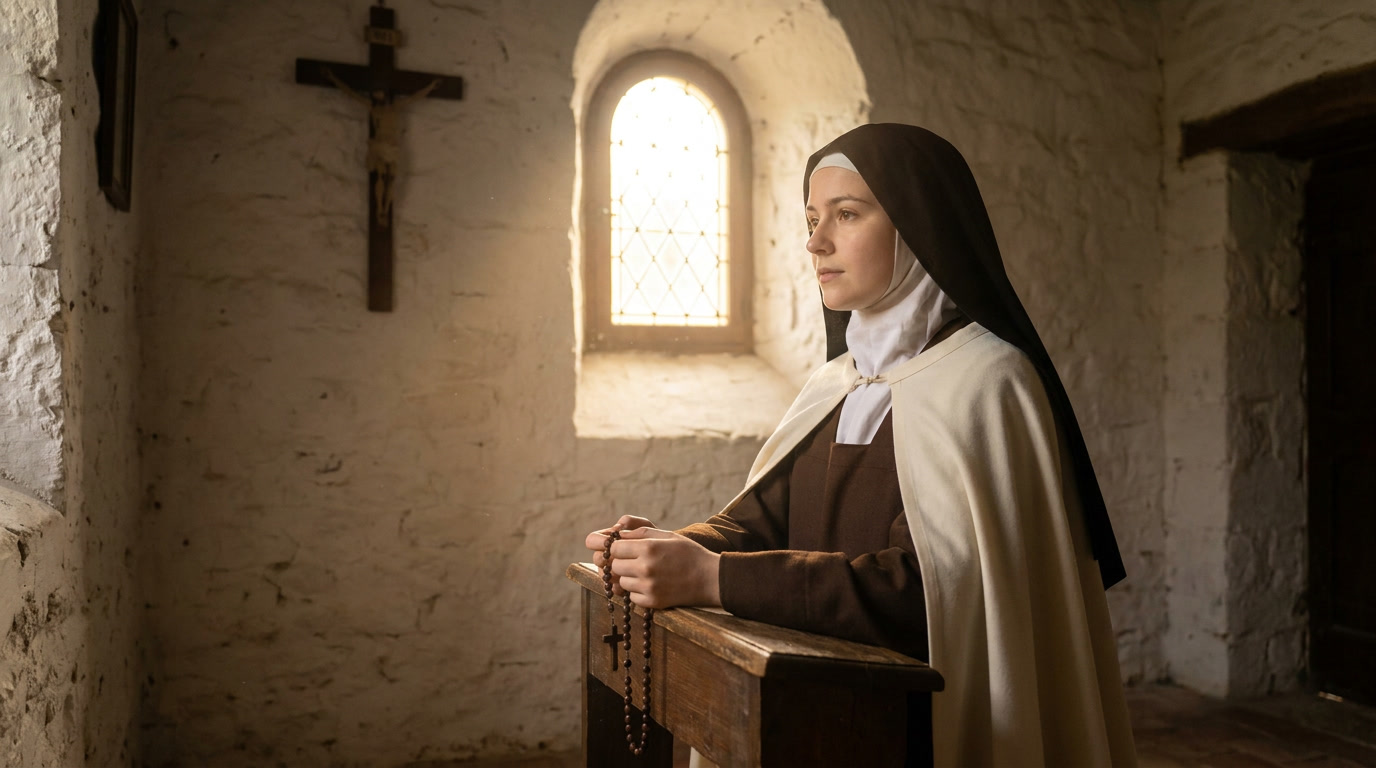
"I have found my heaven on earth, since heaven is God and God is in my soul."
When Christ promises peace that the world cannot give, Saint Elizabeth of the Trinity understood this divine gift with rare depth. Born in 1880, this young Carmelite mystic discovered that true peace comes through complete surrender to the indwelling Trinity. Her profound spirituality of presence and union offers guidance for receiving the peace Christ extends in today's Gospel.
Elizabeth Catez entered the Carmel of Dijon at twenty-one, taking the religious name Sister Elizabeth of the Trinity. In her brief but luminous life—she died at twenty-six—this French mystic plunged into the mystery of God's presence within the soul. Her writings reveal someone who lived deeply united to the Trinity dwelling within her heart.
The Source of Unshakeable Peace
Christ tells his disciples not to let their hearts be troubled or afraid. Saint Elizabeth discovered this peace through what she called "the practice of the presence of God." Unlike worldly peace that depends on circumstances, divine peace flows from recognizing God's constant presence within the soul.
"Let us live in the depths," Elizabeth wrote to her sister. "There we find Him." This interior sanctuary becomes a place of refuge where no external turmoil can penetrate. When anxiety threatens, the soul can retreat to this inner chapel where the Trinity dwells in perfect silence and love.
Love Proved Through Obedience
Christ declares he does exactly as the Father commands, showing love through perfect obedience. Elizabeth embraced this same pathway, seeing every moment as an opportunity to align with God's will. She understood that peace multiplies when the soul stops fighting against divine providence.
"It seems to me that I have found my heaven on earth," she confided, "since heaven is God and God is in my soul." This surrender transforms ordinary moments into encounters with divine love. The soul finds rest not in controlling circumstances but in trusting God's perfect plan.
Living as Praise of Glory
Elizabeth's favorite title for the soul was "praise of glory"—someone who lives so united to God that their entire being becomes worship. This vision transforms how we approach daily struggles and sufferings. Rather than obstacles to peace, difficulties become opportunities to praise God through trust.
The Ignatian method of contemplation can help us enter this Gospel scene and receive Christ's gift of peace more fully. By placing ourselves among the disciples, we too can hear Christ's reassuring words and feel his presence calming our troubled hearts.
Pray in the Spirit of Saint Elizabeth
Elizabeth's prayer life centered on simple presence to the Trinity within. Begin each day by acknowledging God's presence in your soul. When troubles arise, pause and retreat to this interior sanctuary. Remember that you carry within yourself the source of all peace.
Ask Saint Elizabeth to intercede for you, that you might discover the peace Christ promises—not as the world gives, but as gift from the Father who dwells within your heart.
Frequently Asked Questions
What is Saint Elizabeth of the Trinity known for?
Saint Elizabeth of the Trinity is known for her deep mystical spirituality focused on the indwelling Trinity. She taught that the soul can find heaven on earth by recognizing and living in union with God's presence within. Her writings on the practice of God's presence and becoming a "praise of glory" have influenced countless souls seeking deeper prayer life.
How did Saint Elizabeth of the Trinity die?
Saint Elizabeth died of Addison's disease in 1906 at age twenty-six, after five years as a Carmelite nun. Despite her painful illness, she maintained profound peace and joy, seeing her suffering as participation in Christ's passion. She was canonized by Pope Francis in 2016, recognized for her heroic virtue and mystical insights into divine union.