
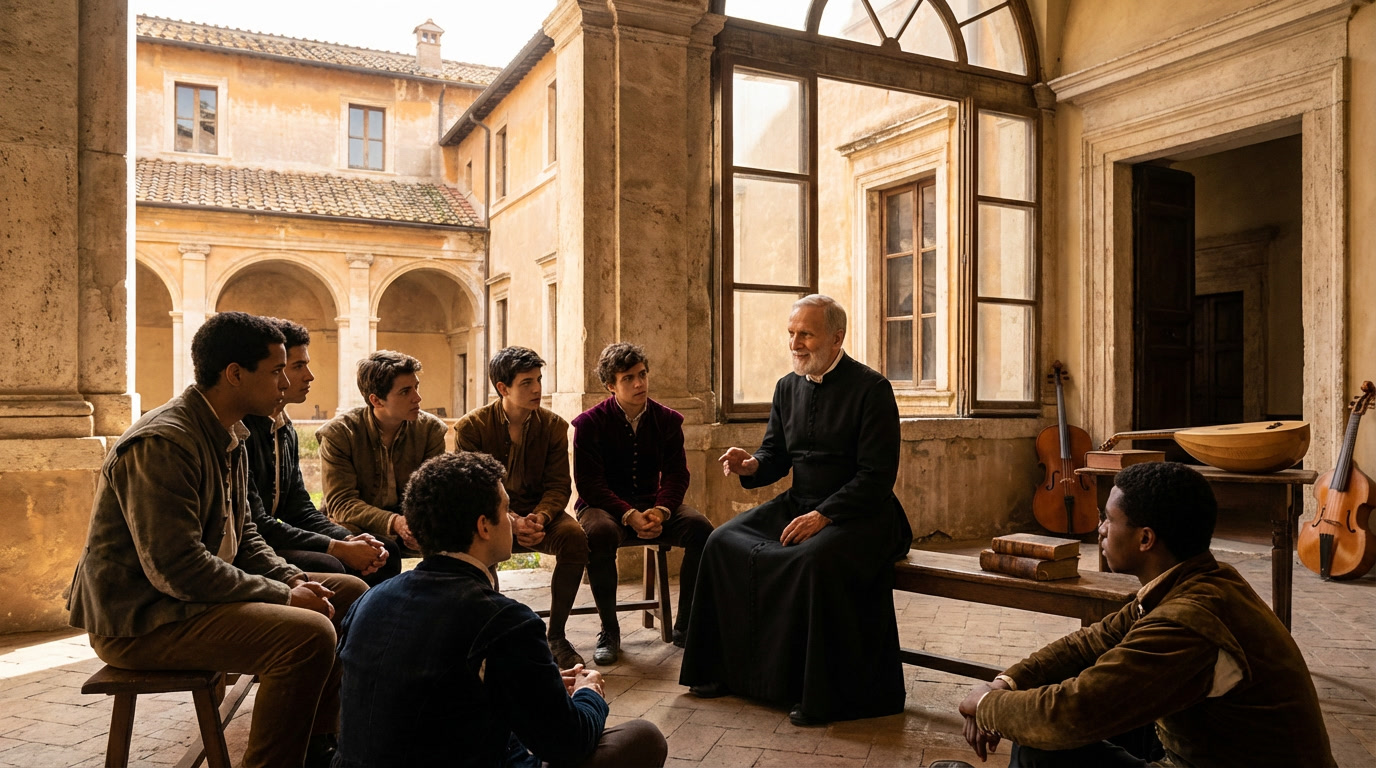
"Cheerfulness strengthens the heart and makes us persevere in a good life. Therefore the servant of God ought always to be in good spirits."— St. Philip Neri
When Philip questioned Jesus about feeding the multitude, he calculated with human reason alone. St. Philip Neri understood this limitation. The sixteenth-century saint who brought joy back to Rome knew that divine providence operates beyond our earthly mathematics.
The Apostle of Joy in Counter-Reformation Rome
Philip Neri arrived in Rome as a young man during turbulent times. The Church faced the Protestant Reformation. Corruption plagued the clergy. Yet Philip chose a different path than stern reformers. He reformed hearts through joy, humor, and genuine holiness.
Founded in 1575, his Congregation of the Oratory became a center of spiritual renewal. Philip attracted cardinals and commoners alike, not through severity, but through his infectious love of God. His motto remained simple: serve God with gladness.
Beyond Human Calculations
Philip the Apostle saw five loaves and two fish. He calculated wages and portions. St. Philip Neri would have smiled at this human tendency to limit God's power through our small vision.
The saint often told his followers to expect miracles in ordinary moments. Just as Jesus transformed a boy's lunch into abundance for thousands, God transforms our meager offerings into grace beyond measure. Philip Neri witnessed this daily in his confessional, where hardened sinners became saints through simple acts of trust.
Joyful Trust in Daily Providence
St. Philip Neri practiced what he called "holy cheerfulness" even in difficulties. When faced with seemingly impossible situations, he would laugh and say, "Lord, I shall do nothing good today unless You help me." This echoes the Gospel's lesson: human resources fail, but divine provision never does.
The saint's approach to prayer reflected this trust. Rather than anxious petitions, he cultivated a spirit of joyful abandonment to God's will. His followers learned to see every moment as an opportunity for grace, much like Ignatian contemplation teaches us to find God in all things.
The Miracle of Small Beginnings
Philip Neri's greatest works began with tiny steps. His Oratory started with informal conversations with young men in the streets. These simple gatherings transformed into a movement that renewed the Church.
Like the boy who offered his small lunch, Philip offered his humble gifts to God. He possessed no advanced degrees, held no high offices, yet became one of Rome's most influential saints. His example shows that God multiplies what we surrender completely to His providence.
Pray in the Spirit of St. Philip Neri
End each day by offering your small contributions to God's hands. When faced with overwhelming needs, remember Philip's words: "Cast all your cares on the Lord, and He will sustain you." Approach prayer with his characteristic joy, trusting that the same God who fed five thousand can transform your limitations into instruments of grace.
Frequently Asked Questions
What is St. Philip Neri known for?
St. Philip Neri is known as the "Apostle of Joy" for bringing spiritual renewal to Rome through cheerfulness and holiness. He founded the Congregation of the Oratory and was famous for his humor, love of music, and ability to convert hearts through gentle joy rather than stern preaching.
How did St. Philip Neri reform the Catholic Church?
St. Philip Neri reformed the Church through personal example and the Oratory, where clergy and laypeople gathered for prayer, spiritual conferences, and sacred music. Unlike harsh reformers, he attracted people through joy and genuine holiness, proving that sanctity could be both serious and cheerful.