
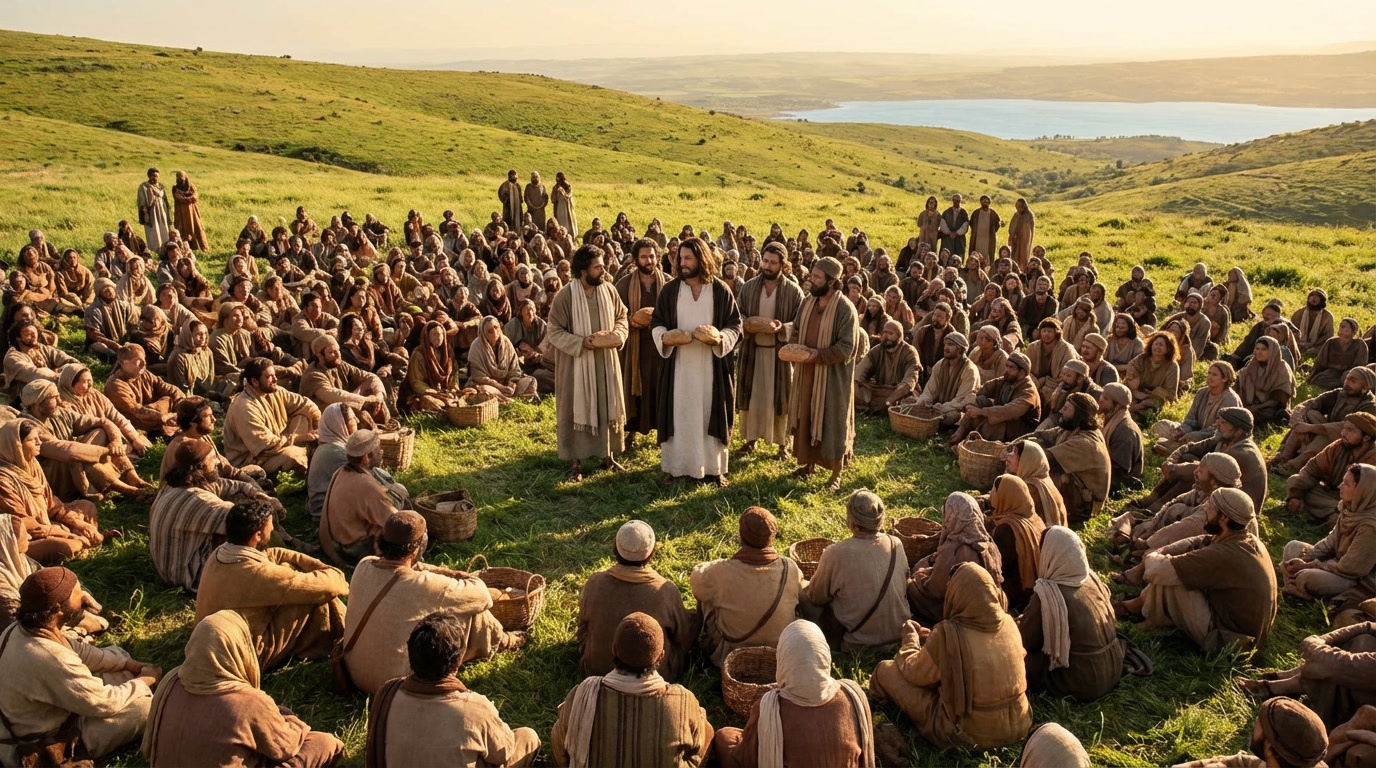
Jesus went across the Sea of Galilee. A large crowd followed him, because they saw the signs he was performing on the sick. Jesus went up on the mountain, and there he sat down with his disciples. The Jewish feast of Passover was near. When Jesus raised his eyes and saw that a large crowd was coming to him, he said to Philip, "Where can we buy enough food for them to eat?" He said this to test him, because he himself knew what he was going to do. Philip answered him, "Two hundred days' wages worth of food would not be enough for each of them to have a little." One of his disciples, Andrew, the brother of Simon Peter, said to him, "There is a boy here who has five barley loaves and two fish; but what good are these for so many?" Jesus said, "Have the people recline." Now there was a great deal of grass in that place. So the men reclined, about five thousand in number. Then Jesus took the loaves, gave thanks, and distributed them to those who were reclining, and also as much of the fish as they wanted. When they had had their fill, he said to his disciples, "Gather the fragments left over, so that nothing will be wasted." So they collected them, and filled twelve wicker baskets with fragments from the five barley loaves that had been more than they could eat. When the people saw the sign he had done, they said, "This is truly the Prophet, the one who is to come into the world." Since Jesus knew that they were going to come and carry him off to make him king, he withdrew again to the mountain alone. — John 6:1-15
The feeding of the five thousand reveals Christ's heart for human need. This miracle in John's Gospel speaks not merely of physical nourishment, but of divine abundance breaking into our limitations.
Christ Tests Our Faith Through Human Need
When Jesus asks Philip where to buy bread, He already knows His plan. This question becomes a test of faith. Philip calculates impossibility—two hundred days' wages would not suffice. His response reveals how quickly rational thinking can eclipse trust in divine power.
Andrew offers a different perspective. He presents the boy's meager offering—five loaves and two fish—while acknowledging its inadequacy. Yet in naming what little exists, Andrew demonstrates the first movement of faith: bringing our poverty to Christ.
Saint John Chrysostom teaches that God often tests us not to discover our weakness, but to reveal His strength. The disciples' calculations matter less than their willingness to place insufficient resources in divine hands.
Small Offerings Transform Through Divine Grace
The boy with five barley loaves embodies generous surrender. His bread was simple, common fare—not the finest wheat but humble barley. His two fish, likely dried or pickled, represented basic sustenance. Nothing impressive by worldly standards.
Yet Christ transforms modest offerings into abundant provision. The multiplication happens not through human effort but through divine blessing. Jesus gives thanks before the miracle, teaching gratitude precedes abundance.
This pattern echoes throughout salvation history. Moses' staff becomes an instrument of liberation. David's stones fell Goliath. A widow's mite outweighs temple treasures. God chooses small things to shame the strong.
Divine Order Amidst Human Chaos
"Have the people recline," Jesus commands. Before the miracle comes organization. The crowd sits on grass in orderly groups. Christ brings structure to chaos, peace to anxiety.
The feeding itself happens through the disciples' hands. They distribute what Christ blesses. This partnership between divine power and human cooperation prefigures the Church's sacramental life. Grace flows through ordinary vessels.
Twelve baskets of fragments remain—one for each apostle. Nothing is wasted in God's economy. Divine abundance exceeds human need while honoring stewardship. The leftovers testify that God's provision surpasses our imagination.
Rejecting False Kingdoms
The crowd's response reveals misplaced priorities. They recognize the Prophet but seek to make Him king by force. They understand the sign but miss its deeper meaning. Physical bread satisfies temporarily; spiritual nourishment endures eternally.
Jesus withdraws to the mountain alone. He refuses earthly kingship because His kingdom transcends political power. The miracle points beyond material provision to the Bread of Life—Christ Himself.
This withdrawal teaches necessary solitude. Even miraculous ministry requires retreat for prayer. The servant of God cannot remain constantly available to human demands without losing connection to divine source.
Pray With This Reading
This Gospel invites contemplation of divine providence in daily life. Consider practicing Surrender Prayer with this passage, placing your own insufficient resources—time, talents, concerns—into Christ's hands.
Alternatively, Ignatian Contemplation allows you to enter the scene imaginatively. Place yourself among the disciples, observing their anxiety transform into wonder as bread multiplies before their eyes.
What does the feeding of the five thousand teach about God's provision?
The miracle demonstrates that God's abundance exceeds human calculation. When we offer our poverty to Christ—like the boy's simple lunch—divine blessing transforms inadequacy into overflowing provision. The twelve baskets of leftovers reveal that God's gifts surpass our needs while teaching careful stewardship.
Why did Jesus withdraw when the crowd wanted to make him king?
Jesus rejected earthly kingship because His kingdom transcends political power. The crowd misunderstood the miracle's purpose, seeking material advantage rather than spiritual nourishment. Christ's withdrawal to the mountain teaches that true authority comes through humble service, not worldly force.
How can we apply this Gospel to our daily spiritual life?
This passage invites us to bring our limitations honestly to God, trusting that small offerings become instruments of grace. Like the disciples, we participate in divine work by sharing what Christ blesses. The Gospel also calls us to recognize Christ as the true Bread of Life, not merely a provider of temporary solutions.