
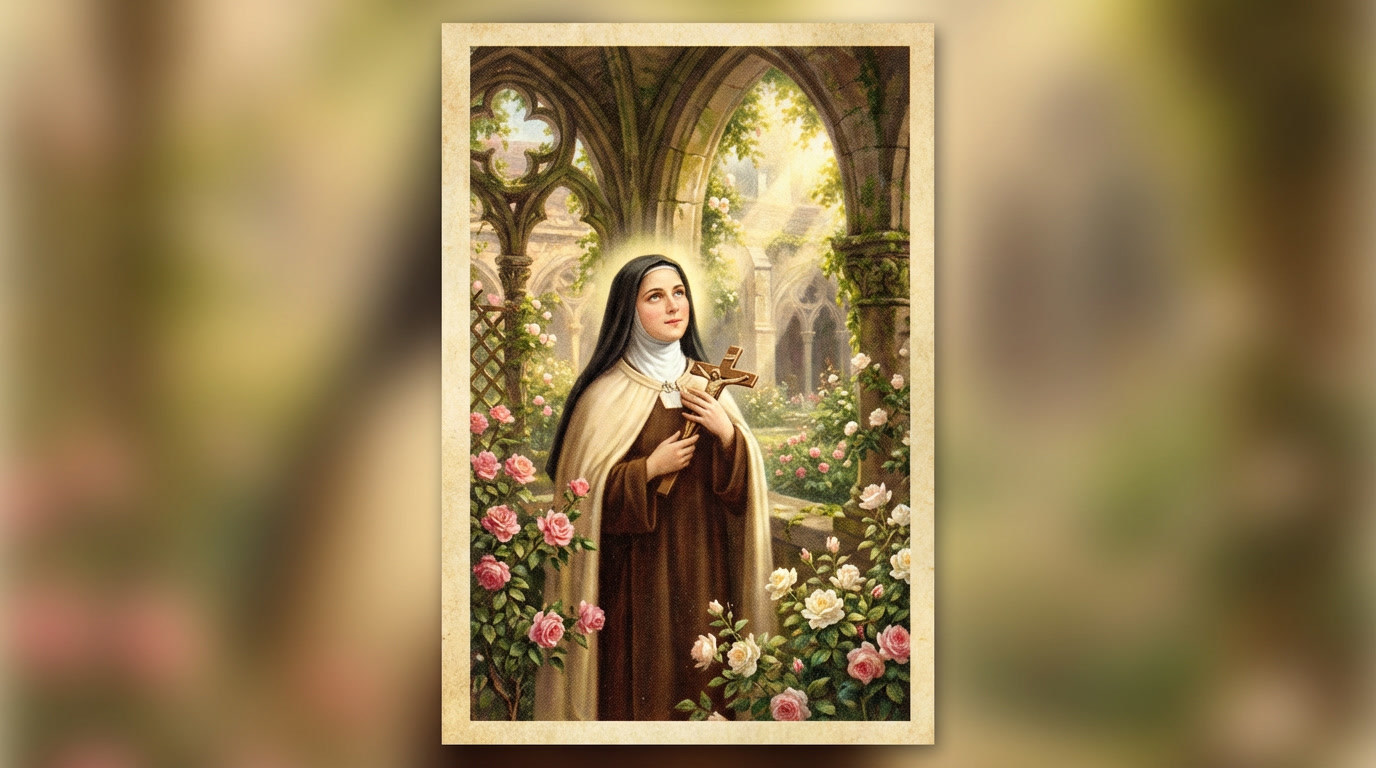
"I will spend my heaven doing good on earth. I will let fall a shower of roses."
When Saint Thérèse of Lisieux proclaimed her desire to shower roses from heaven, she revealed the heart that had already learned to trust completely in divine love. Her words echo Christ's promise in today's Gospel: God so loved the world that he gave his only Son. The Little Flower understood what John's Gospel teaches—that divine love conquers every darkness.
Born Marie-Françoise-Thérèse Martin in 1873, this youngest daughter of Louis and Zélie Martin entered Carmel at fifteen. Death claimed her at twenty-four, yet her spiritual autobiography transformed Catholic spirituality. The Church proclaimed her a Doctor in 1997, recognizing her theological insights into divine mercy and spiritual childhood.
Living the Truth That Comes to Light
Saint Thérèse's Little Way responds directly to Christ's words: "Whoever lives the truth comes to the light." She refused the darkness of spiritual pride, choosing instead radical dependence on God's mercy. Where others might see weakness, Thérèse discovered strength.
"I am too little to perform great actions," she wrote, "and my folly consists in hoping that Your Love will accept me as a victim." This surrender mirrors the Gospel's central truth—salvation comes not through human effort but through believing in the Son whom God sent.
Preferring Light Over Darkness
The Gospel warns that people preferred darkness because their works were evil. Thérèse chose differently. She embraced the light of truth about herself—acknowledging weakness while trusting in infinite mercy. Her spiritual darkness during the final eighteen months of life became a profound sharing in Christ's passion.
"I want to love You as You have never been loved," she declared. This love meant accepting both consolation and desolation, recognizing that God's love remains constant regardless of feelings. Through lectio divina, believers can cultivate this same unwavering trust.
The Confidence of Spiritual Childhood
Thérèse discovered that spiritual childhood opens the heart to receive God's love without reservation. Children trust naturally; they do not calculate worthiness or measure their efforts against others. This Gospel truth—"everyone who believes in him might not perish but might have eternal life"—becomes lived reality through such childlike faith.
Her confidence shocked some contemporaries. How could someone so young claim such certainty about salvation? Thérèse anchored her hope not in personal holiness but in God's promise. She believed the Gospel literally: God desires to save, not condemn.
Pray in the Spirit of Saint Thérèse
Begin each morning by offering yourself as Thérèse did—not as someone great, but as someone beloved. Throughout the day, when darkness threatens to overwhelm, remember her roses. Each small act of love, each moment of trust, each choice to walk in light rather than darkness continues her mission of showering graces upon the earth.
Frequently Asked Questions
What is Saint Thérèse's Little Way?
The Little Way involves complete trust in God's mercy rather than relying on personal spiritual achievements. Saint Thérèse taught that spiritual childhood—acknowledging weakness while trusting divine love—leads to holiness more surely than grand gestures or heroic penances.
Why is Saint Thérèse called the Little Flower?
Thérèse compared herself to a simple flower in God's garden, content to be small while reflecting divine beauty. She chose this image to emphasize that God loves every soul equally, whether they are mighty cedars or humble daisies in the field of the Church.