
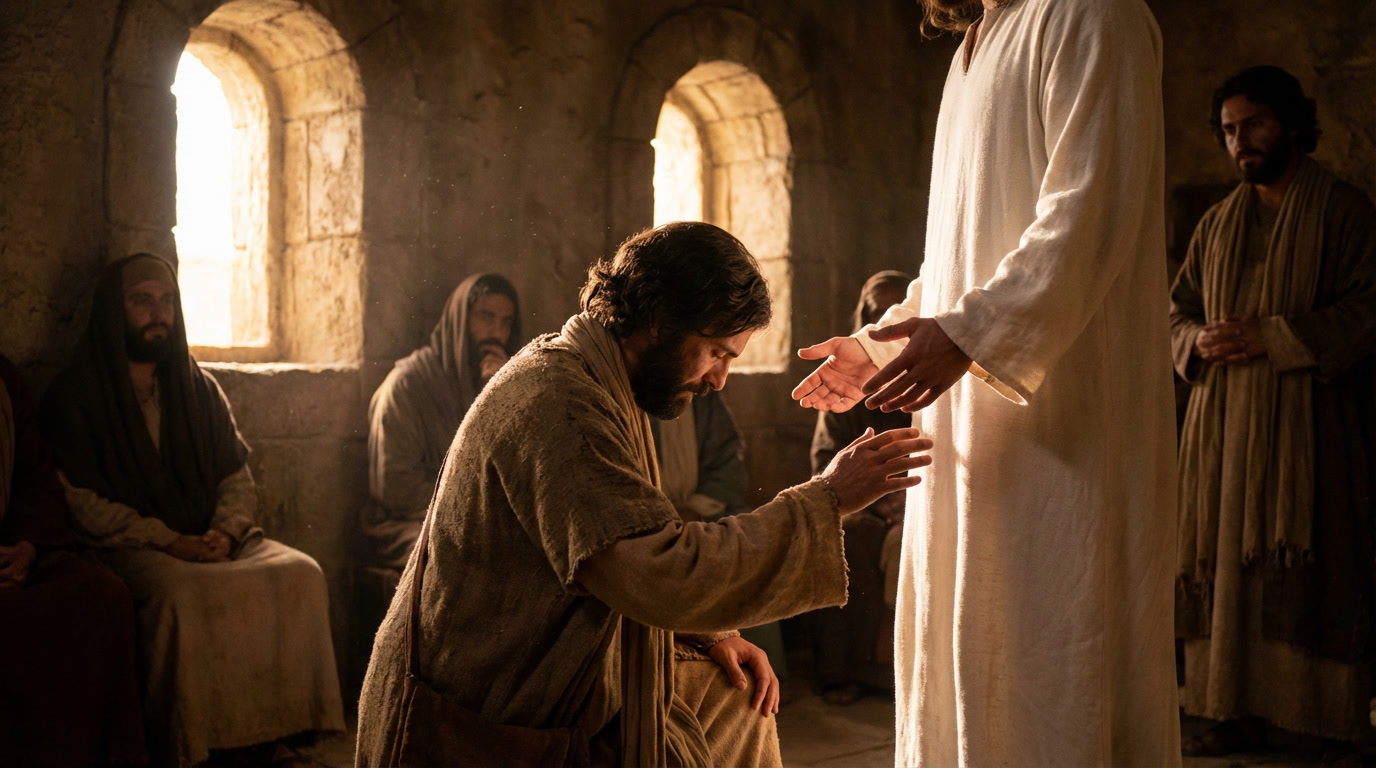
"My Lord and my God!" - St. Thomas the Apostle, upon touching the wounds of the risen Christ
St. Thomas the Apostle understood the disciples' shock in today's Gospel reading. Like them, he struggled to believe that Christ had truly risen from the dead. His journey from doubt to profound faith offers guidance when questions arise in our hearts, just as Jesus addresses in Luke 24:35-48.
Known as "Doubting Thomas," this apostle was actually a man of deep loyalty and courage. When Jesus announced His intention to return to Judea despite danger, Thomas declared, "Let us also go, that we may die with him." After the Resurrection, his honest questioning led to one of Scripture's most powerful declarations of faith.
When Faith Meets Physical Reality
Thomas demanded to touch Christ's wounds before believing. In today's Gospel, Jesus invites the frightened disciples to do exactly that - to touch His hands and feet, to see that He possesses flesh and bones. Christ's patient response to doubt reveals divine understanding of human nature.
St. Thomas teaches that questioning can deepen faith rather than destroy it. His insistence on tangible proof led to a fuller revelation of Christ's glorified body. The Lord who ate fish with His disciples is the same Lord present in every Eucharist.
Recognizing Christ in Daily Encounters
The disciples in today's Gospel had just heard about recognizing Jesus "in the breaking of bread." St. Thomas's later missionary work in India demonstrates how this recognition transforms ordinary life into sacred encounter. He carried the Real Presence to distant lands because he had touched the source.
Thomas reminds us that Christ still shows His wounds to those who seek Him. Every Mass becomes an opportunity to touch the divine through consecrated bread and wine. Lectio Divina can help deepen this recognition as we meditate on His presence in Scripture.
From Fear to Fearless Proclamation
The terrified disciples became bold witnesses after touching the risen Christ. St. Thomas exemplified this transformation, traveling thousands of miles to establish the Church in India. Tradition holds that he died a martyr's death, far from the upper room where he once doubted.
His feast day reminds us that honest questions, brought to Christ, become foundations for unshakeable faith. The apostle who demanded proof became living proof of the Resurrection's power.
Pray in the Spirit of St. Thomas
Ask for the grace to bring your doubts directly to Christ. Let your questions become prayer rather than barriers to belief. Seek Him in the Eucharist with the same urgency that drove Thomas to touch His wounds. Trust that the Lord who welcomed one apostle's skepticism will welcome yours with equal patience and love.
Frequently Asked Questions
Why is St. Thomas called "Doubting Thomas"?
St. Thomas earned this title because he refused to believe in Christ's Resurrection without physical proof. However, his doubt led to a deeper faith when he proclaimed "My Lord and my God" after touching Jesus's wounds.
Where did St. Thomas evangelize after the Resurrection?
According to ancient tradition, St. Thomas traveled to India where he established Christian communities. The Saint Thomas Christians of India trace their origins to his missionary work in the first century.