
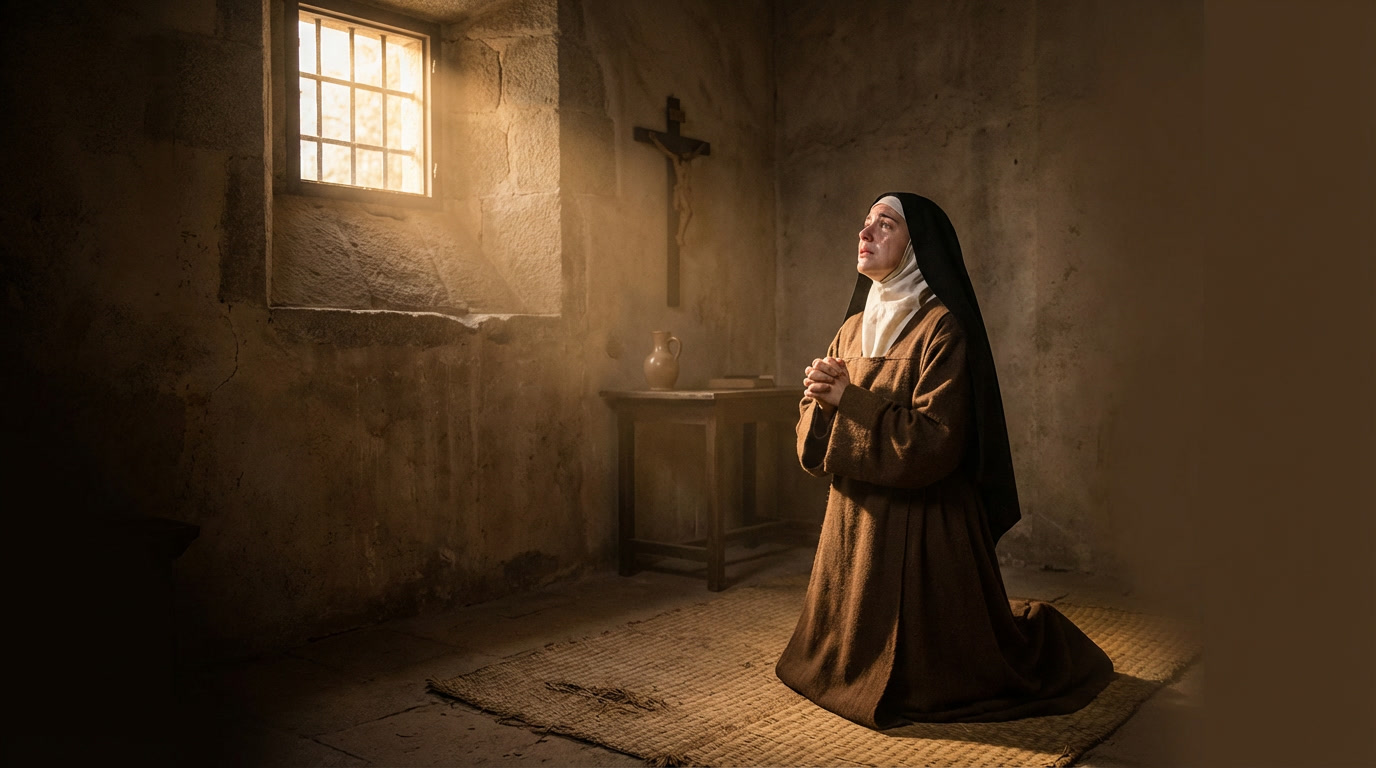
"Let nothing disturb you. All things pass. God does not change. Patience obtains all. Whoever has God lacks nothing. God alone suffices."
The disciples on the road to Emmaus walked with despair clouding their vision. They conversed with the risen Christ yet failed to recognize him until he broke bread. Saint Teresa of Avila understood this spiritual blindness that prevents souls from recognizing Christ's presence in ordinary moments.
Teresa of Cepeda y Ahumada lived in 16th-century Spain, transforming from a worldly young woman into one of Christianity's greatest mystics. Born in 1515 to a noble family in Avila, she entered the Carmelite convent of the Incarnation at twenty. Her journey toward sanctity was gradual, marked by years of spiritual dryness before experiencing profound mystical encounters with Christ.
The Doctor of the Church reformed the Carmelite order, establishing convents dedicated to contemplative prayer and poverty. Her writings, particularly "The Interior Castle" and "The Way of Perfection," remain treasured guides for souls seeking deeper union with God.
When Hearts Burn Within Us
Teresa knew the experience of walking in spiritual darkness before recognizing Christ's nearness. "His Majesty never tires of giving," she wrote, describing how God works persistently to awaken souls to his presence. The Emmaus disciples felt their hearts burn as Jesus explained the scriptures, yet understanding came slowly.
This gradual recognition mirrors Teresa's own spiritual development. She spent nearly twenty years in prayer struggling with distractions and dryness before experiencing the mystical graces that made her famous. Her patience through this desert period teaches souls not to despair when God seems absent.
Breaking Bread and Opening Eyes
The disciples recognized Jesus in the breaking of bread—a moment of intimate revelation that transformed their despair into joy. Teresa understood this pattern of divine hiddenness followed by sudden illumination. She counseled her nuns to persevere in prayer even when feeling abandoned.
"Prayer is nothing else than being on terms of friendship with God," Teresa explained. This friendship develops through faithful presence, even when God seems silent. The Ignatian method of contemplation helps souls enter these Gospel scenes imaginatively, following Teresa's example of intimate prayer.
Living with Expectant Faith
Teresa's reformed Carmelites lived in expectation of encountering Christ in prayer, just as the disciples should have expected to meet their risen Lord. Her convents became schools of contemplation where souls learned to recognize God's presence in silence, scripture, and community life.
The saint's practical wisdom guides modern disciples facing the same challenge as those walking to Emmaus. Christ accompanies every journey, explaining life's mysteries through scripture and revealing himself in the Eucharist. Teresa's life proves that patient perseverance in prayer eventually yields the grace to see clearly.
Pray in the Spirit of Saint Teresa of Avila
Enter prayer expecting to encounter Christ, even when he seems hidden. Bring your questions and disappointments to him as the disciples brought their confusion. Rest in his presence without demanding immediate answers. Allow your heart to burn with love as he speaks through scripture. Trust that recognition will come in his time, often in the simple breaking of bread.
Frequently Asked Questions
What is Saint Teresa of Avila known for?
Saint Teresa of Avila is renowned as a Doctor of the Church who reformed the Carmelite order and wrote classic works on mystical prayer, particularly "The Interior Castle." She experienced profound mystical visions and taught practical methods for deepening one's relationship with God through contemplative prayer.
How did Saint Teresa of Avila experience God's presence?
Saint Teresa experienced God's presence through various stages of mystical prayer, from mental prayer and meditation to ecstatic visions and mystical marriage with Christ. She emphasized that authentic encounters with God transform the soul and bear fruit in acts of love and service to others.