
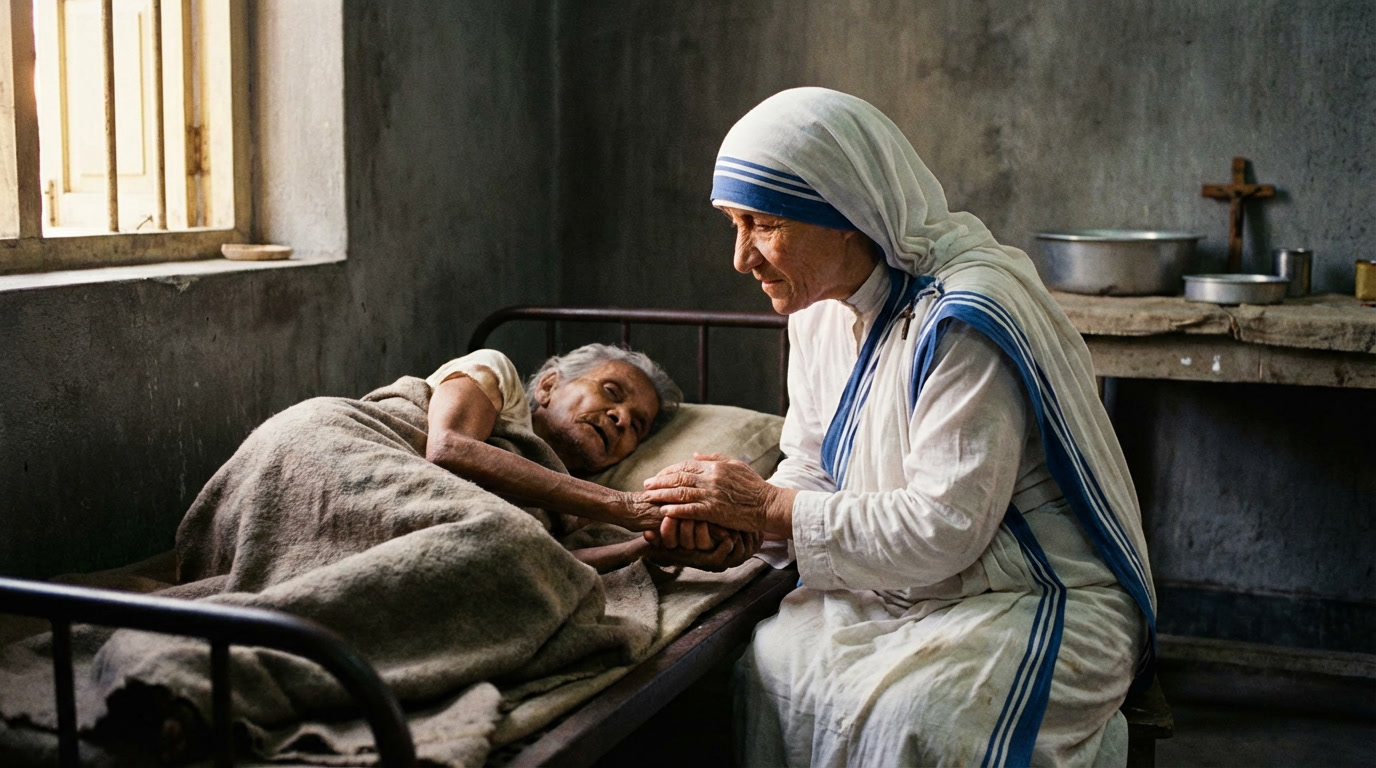
"Let us touch the dying, the poor, the lonely and the unwanted according to the graces we have received and let us not be ashamed or slow to do the humble work."
On this Holy Thursday, as Christ kneels to wash his disciples' feet, the radical humility of St. Teresa of Calcutta illuminates the Gospel's call to service. Her life among Calcutta's dying poor mirrors perfectly Christ's own self-emptying love in John's account of the Last Supper.
Born Agnes Gonxha Bojaxhiu in 1910, this Albanian nun felt called at eighteen to serve Christ among the poorest of the poor in India. For decades, she lived in Calcutta's slums, caring for those society had abandoned. Her hands, like Christ's on this sacred night, touched what others considered untouchable.
The Call to Wash Feet in the Modern World
Teresa understood that humble service to others was not optional for followers of Christ. When Jesus girds himself with a towel, he establishes service as the mark of his disciples. Teresa's work with the dying in Calcutta's gutters was her literal washing of feet.
"What I am doing you do not know now, but afterward you will understand," Jesus tells Peter. Teresa often spoke of this mystery—how serving the poorest revealed Christ himself. Each leper, each dying child, each abandoned elder became the face of the crucified Lord.
Finding Christ in Distressing Disguise
Teresa called the poor "Christ in distressing disguise." This vision transformed every act of service into prayer, every touch into worship. Her spirituality flowed directly from tonight's Gospel—recognizing that Christ comes to us in the least expected forms.
The basin and towel become symbols not just of service, but of recognition. When we kneel to serve others, especially those society overlooks, we participate in Christ's own self-gift. Teresa's example shows how Catholic service spirituality transforms both giver and receiver.
Embracing the Poverty of Service
Like Christ laying aside his garments, Teresa embraced radical poverty to serve more freely. She owned nothing, kept nothing, yet her hands multiplied mercy across Calcutta's streets. This Gospel teaches that true greatness comes through self-emptying love.
Teresa's approach to contemplative prayer through Scripture always led back to action. She found Christ in the Eucharist and immediately sought him in suffering humanity. This Holy Thursday pattern—worship leading to service—defined her entire apostolate.
Pray in the Spirit of St. Teresa of Calcutta
Tonight, as the Church remembers Christ's washing of feet, ask for Teresa's eyes to see Christ in the overlooked. Let her courage to touch the untouchable inspire your own response to suffering. Her simple prayer captures this Gospel's essence: "Jesus, help me to spread your fragrance everywhere I go."
Consider where Christ calls you to kneel in service. Like Teresa, find him waiting in distressing disguise.
Frequently Asked Questions
How did St. Teresa of Calcutta serve the poor?
St. Teresa established homes for the dying, orphanages, and clinics throughout Calcutta. She personally cared for those with leprosy, tuberculosis, and HIV/AIDS, seeing Christ in each suffering person she served.
What was St. Teresa of Calcutta's spiritual mission?
Her mission centered on serving the "poorest of the poor" as a direct response to Christ's call. She believed that touching the poor was touching Christ himself, making every act of service a form of prayer and worship.