
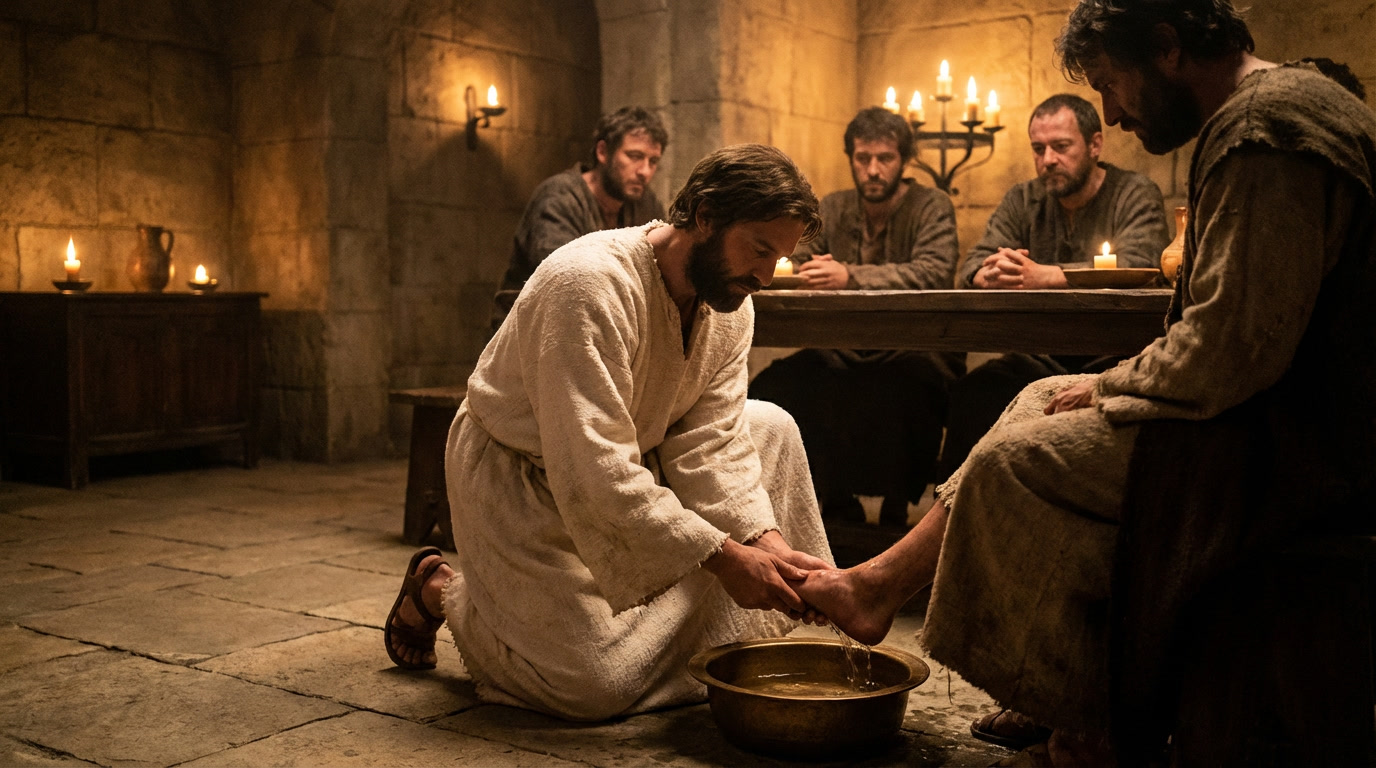
"Now before the feast of the Passover, when Jesus knew that his hour had come to depart out of this world to the Father, having loved his own who were in the world, he loved them to the end. And during supper... Jesus, knowing that the Father had given all things into his hands, and that he had come from God and was going to God, rose from supper, laid aside his garments, and girded himself with a towel." - John 13:1-15
On this Holy Thursday evening, the Gospel of John presents the most startling reversal in human history. The Word made flesh, knowing His divine origin and destiny, chooses the posture of a servant. This washing of the disciples' feet reveals the heart of the Christian mystery: God's love descends to the lowest place.
The Knowledge That Transforms Action
John emphasizes what Jesus knew: His hour had come, the Father had given all things into His hands, He came from God and was going to God. This divine knowledge does not make Christ withdraw from human need. Instead, it propels Him toward greater service.
The paradox strikes deep. Perfect knowledge of divine authority leads to perfect humility. When Peter protests, "You shall never wash my feet," he misunderstands the nature of Christ's kingship. The King serves. The Teacher kneels. The Lord washes.
Saint Augustine observed that Christ "laid aside His garments" as He would lay aside His life—both acts of deliberate self-emptying. The basin and towel become instruments of salvation, as powerful as the wood of the cross.
Love to the End
"Having loved his own who were in the world, he loved them to the end." The Greek phrase "eis telos" means both "to the end" and "to the uttermost." Christ's love knows no limits, no boundaries, no stopping point.
Even knowing Judas would betray Him, Jesus washes the betrayer's feet. Love extends to the unworthy, the confused, the fearful. Peter's initial refusal transforms into enthusiastic acceptance when he understands what is at stake: "If I do not wash you, you have no part in me."
This washing prefigures Baptism and anticipates the Eucharist. The feet that carry the Gospel must first be cleansed by the Gospel's Author. We cannot share His mission without sharing His purification.
The Command to Serve
"If I then, your Lord and Teacher, have washed your feet, you also ought to wash one another's feet." Christ's action becomes our mandate. The foot-washing is not merely symbolic—it establishes a pattern for Christian living.
The saints understood this literally and spiritually. Saint Teresa of Calcutta saw Christ in the poorest of the poor. Saint Francis kissed lepers. Saint Vincent de Paul organized care for abandoned children. Each recognized that serving others serves Christ Himself.
This Gospel challenges every form of Christian triumphalism. Those who follow the Crucified King cannot seek earthly glory. The path to greatness runs through service, through bending down, through taking up the towel.
Pray With This Reading
This passage invites deep contemplation through Ignatian Contemplation. Place yourself in the upper room. Feel the shock of seeing Jesus kneel before you. Allow the scene to unfold in your imagination, noting your emotional responses to Christ's radical humility.
Consider how the Lord might be calling you to wash feet today. What towel is He placing in your hands? What basin of service awaits your attention?
Frequently Asked Questions
What does the foot washing symbolize in John 13?
The foot washing symbolizes Christ's complete self-emptying in service to humanity. It prefigures His death on the cross and establishes the Christian pattern of humble service to others, especially the poor and marginalized.
Why did Peter refuse to let Jesus wash his feet?
Peter's refusal reflects his incomplete understanding of Christ's mission. He could not reconcile divine authority with humble service. His protest reveals our own tendency to resist God's ways when they challenge our expectations of power and status.
How should Christians practice foot washing today?
While some churches practice literal foot washing, the deeper call is to embody Christ's servant leadership in daily life. This means prioritizing the needs of others, serving without seeking recognition, and treating the humble work of love as sacred duty.