
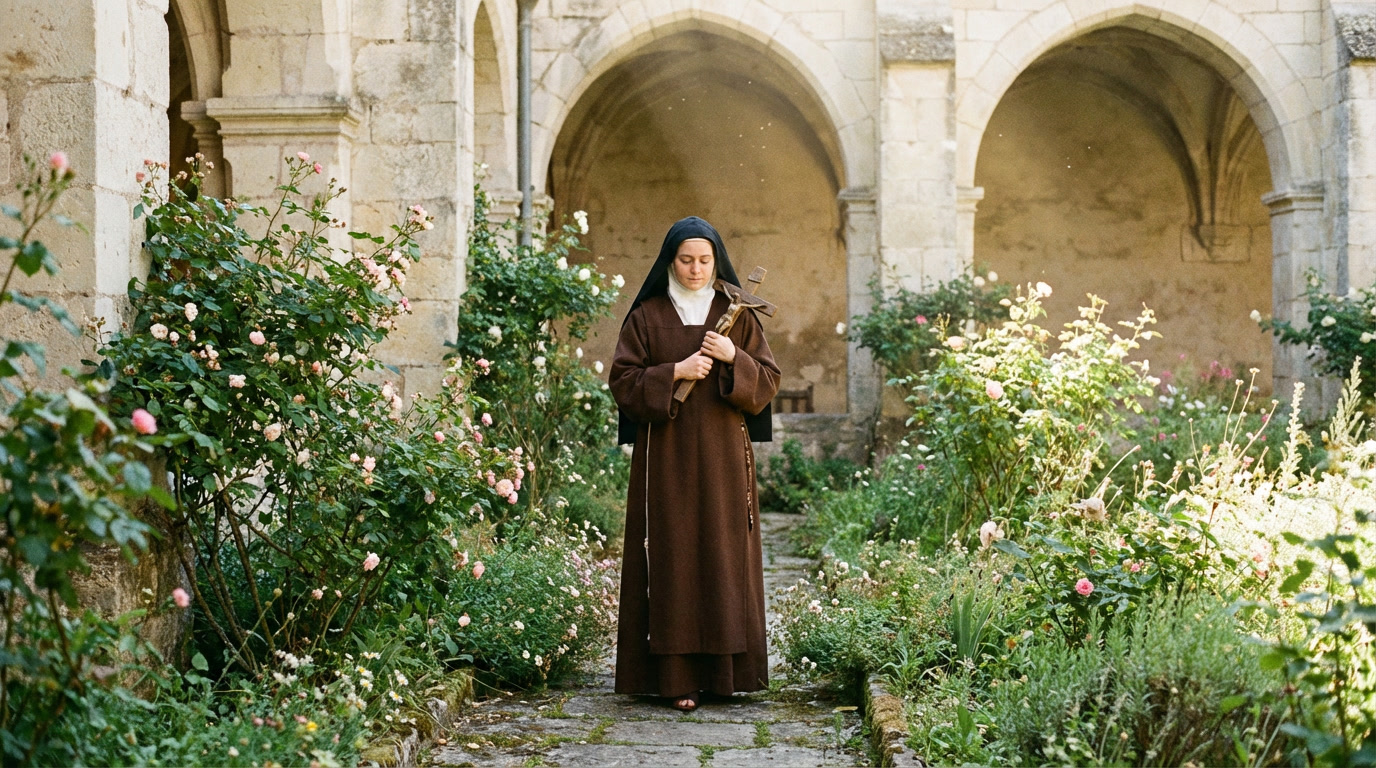
"I will spend my heaven doing good on earth. I will let fall a shower of roses."
— Saint Thérèse of Lisieux
In today's Gospel from John 7:40-53, we witness division and fear paralyzing even those who recognized Christ's truth. The Pharisees mock the guards who returned empty-handed, while Nicodemus timidly offers a single word of defense. Saint Thérèse of Lisieux understood this tension between human respect and Gospel courage, showing us through her Little Way how to stand firm in truth with childlike confidence.
Marie-Françoise-Thérèse Martin entered the Carmelite convent of Lisieux at fifteen, dying at twenty-four in 1897. Though her life appeared unremarkable, her spiritual autobiography revealed a soul of extraordinary depth. The Church proclaimed her a Doctor in 2012, recognizing her profound theological insights despite her youth and simple background.
When Authorities Question Our Faith
The Pharisees in today's Gospel dismissed Christ because the crowd believed in Him. "Have any of the authorities or the Pharisees believed in him?" they scoffed. Thérèse knew this pressure intimately. Her desire to enter Carmel at fifteen faced opposition from church authorities who deemed her too young. Yet she persisted, even approaching Pope Leo XIII directly during a papal audience.
Her confidence came not from human approval but from trust in God's will. "The good God would not inspire desires which cannot be realized," she wrote. This saint's example teaches us that defending truth sometimes requires moving beyond human respect to divine trust.
Small Acts, Great Courage
Nicodemus offered only a hesitant defense: "Does our law condemn a person before it first hears him?" His words seem weak, yet they planted seeds of justice in hostile ground. Thérèse understood this principle of small faithfulness. Her Little Way emphasized doing ordinary things with extraordinary love rather than seeking grand gestures.
In the convent, she defended unpopular sisters, offered silent service to difficult community members, and wrote encouraging letters to missionaries. These acts appeared insignificant but flowed from the same courage that led Nicodemus to eventually help bury Christ's body. Sometimes defending truth begins with the smallest step forward.
Living the Little Way in Daily Division
The Gospel shows how Christ divides people not through harshness but through the demands of truth itself. Thérèse faced similar divisions within her own religious community. Some sisters found her confidence presumptuous; others questioned her rapid spiritual growth. Yet she remained steadfast in her simple approach to holiness.
Her method can guide us when facing opposition to our faith today. Rather than arguing or defending ourselves with human wisdom, we can follow her path of humble persistence, trusting that God's truth will shine through our faithful witness. Consider deepening this trust through Franciscan Prayer, which emphasizes simple, heartfelt communion with God.
Pray in the Spirit of Saint Thérèse
Like the guards who returned amazed by Christ's words, let us approach prayer with wonder rather than analysis. Thérèse taught that we need not understand everything to trust completely. In times when our faith faces questioning or ridicule, we can follow her example of confident simplicity, knowing that God delights in using the humble to confound the wise.
Frequently Asked Questions
What is Saint Thérèse of Lisieux's Little Way?
Saint Thérèse's Little Way is a spiritual path emphasizing trust, surrender, and doing small things with great love rather than seeking grand spiritual achievements. She taught that spiritual childhood—complete dependence on God—leads to sanctity more surely than elaborate spiritual practices.
Why is Saint Thérèse called the Little Flower?
Saint Thérèse called herself "the little flower of Jesus," symbolizing her desire to remain small and hidden while bringing joy to God through simple faithfulness. She believed that just as God creates both mighty cedars and tiny flowers, He delights in souls who embrace their littleness before His greatness.