
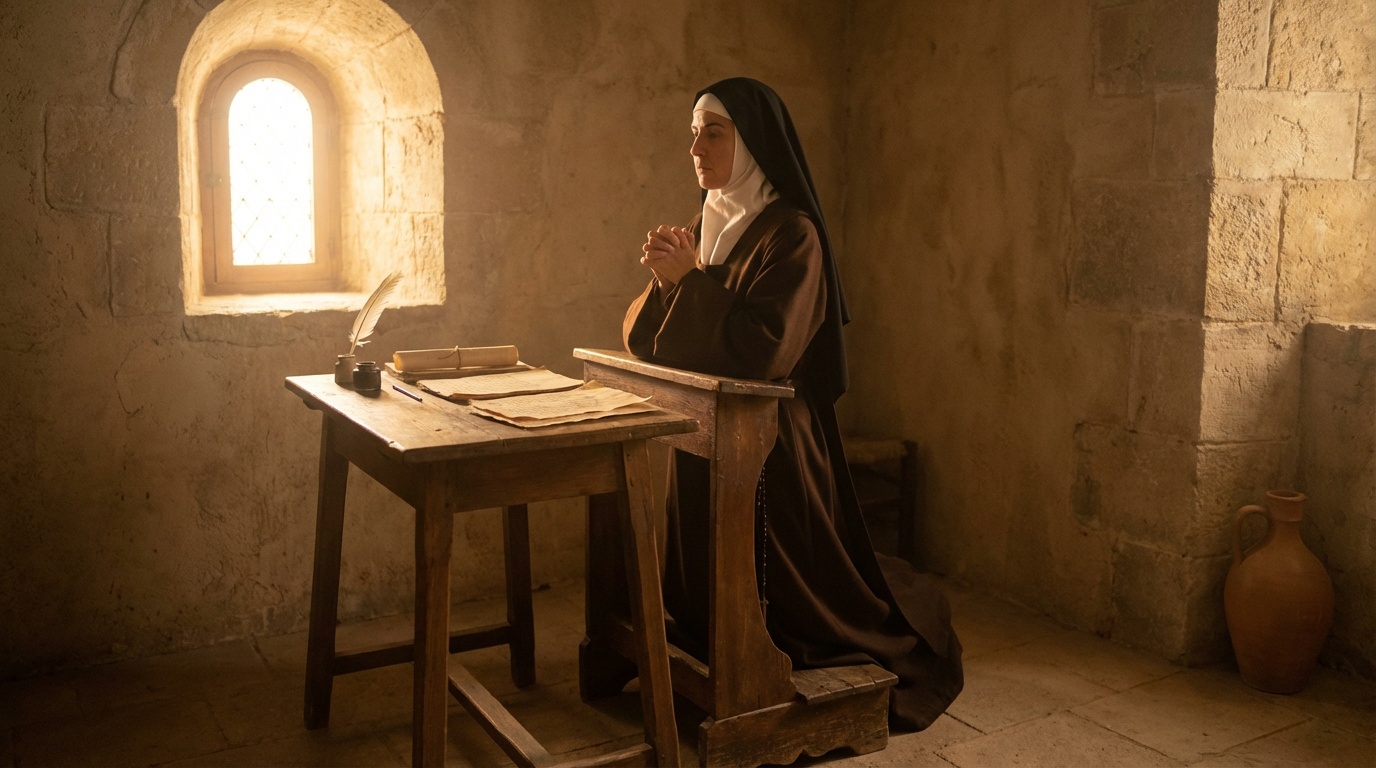
"Let nothing disturb you. All things pass. God does not change. Patience obtains all. Whoever has God lacks nothing. God alone suffices."
Saint Teresa of Avila understood the paradox Christ presents in today's Gospel: the tension between hiddenness and revelation. Like Jesus moving secretly through Galilee while teaching openly in the temple, Teresa's mystical journey revealed how God conceals himself to draw souls deeper into divine intimacy.
Born Teresa Sánchez de Cepeda y Ahumada in 1515, this Spanish mystic and Doctor of the Church transformed from a worldly young woman into one of Christianity's greatest contemplatives. Her writings on prayer and mystical experience guide countless souls seeking authentic encounter with Christ. Teresa founded reformed Carmelite convents and worked alongside Saint John of the Cross to renew religious life in sixteenth-century Spain.
The Mystery of Divine Hiddenness
Teresa's spiritual autobiography reveals God's gradual self-disclosure through years of patient seeking. In the Gospel, the Jerusalem crowds question Christ's origins: "We know where he is from." Yet Jesus declares they know neither him nor the Father who sent him. Teresa experienced this same divine mystery. God remained hidden even as he drew her into deeper union.
Through decades of prayer, Teresa learned that divine hiddenness serves love's purposes. God conceals himself not to frustrate seekers but to purify their desire. "His Majesty wants the soul to desire him," she writes. The very hiddenness that troubled the Jerusalem crowds becomes the invitation to seek more earnestly.
Speaking Truth Despite Opposition
Jesus taught openly despite threats from religious authorities. Teresa faced similar opposition when she began reforming Carmelite convents and writing about mystical prayer. Male theologians questioned a woman's authority to teach about divine matters. Civil and religious officials resisted her reforms.
Yet Teresa persisted, guided by divine commission rather than human approval. "Let nothing disturb you," her famous prayer reminds us. Like Christ in the temple, Teresa spoke divine truth whether welcome or not. Her courage emerged from intimate knowledge of the One who sent her.
Encountering Christ in Interior Prayer
Teresa's Interior Castle maps the soul's journey toward divine union. Like Jesus revealing himself gradually to sincere seekers, God discloses himself through deepening prayer. Teresa identified seven mansions within the soul's castle, each representing closer intimacy with Christ.
This progressive revelation mirrors today's Gospel. Those who seek Christ with pure hearts recognize his voice, while others remain confused by his origins and authority. Teresa's contemplative prayer method offers practical guidance for this interior journey toward divine encounter.
Pray in the Spirit of Saint Teresa
Enter your interior castle today. Choose a quiet space and recall Christ's words: "You know me and also know where I am from." Ask Teresa to guide your prayer as you seek deeper knowledge of Jesus. Let divine hiddenness draw you inward rather than discourage you. Trust that patient seeking will yield authentic encounter with the living Christ.
Frequently Asked Questions
What is Saint Teresa of Avila known for?
Saint Teresa of Avila is known for being a Spanish mystic, Doctor of the Church, and founder of the reformed Carmelite order. Her writings on mystical prayer and contemplation, especially "The Interior Castle," remain influential guides for spiritual seekers worldwide.
How did Saint Teresa of Avila experience visions?
Saint Teresa experienced various types of mystical visions throughout her prayer life, including intellectual visions, imaginative visions, and ecstatic experiences. She carefully discerned these experiences with spiritual directors and wrote detailed accounts that help distinguish authentic mystical phenomena from psychological states.