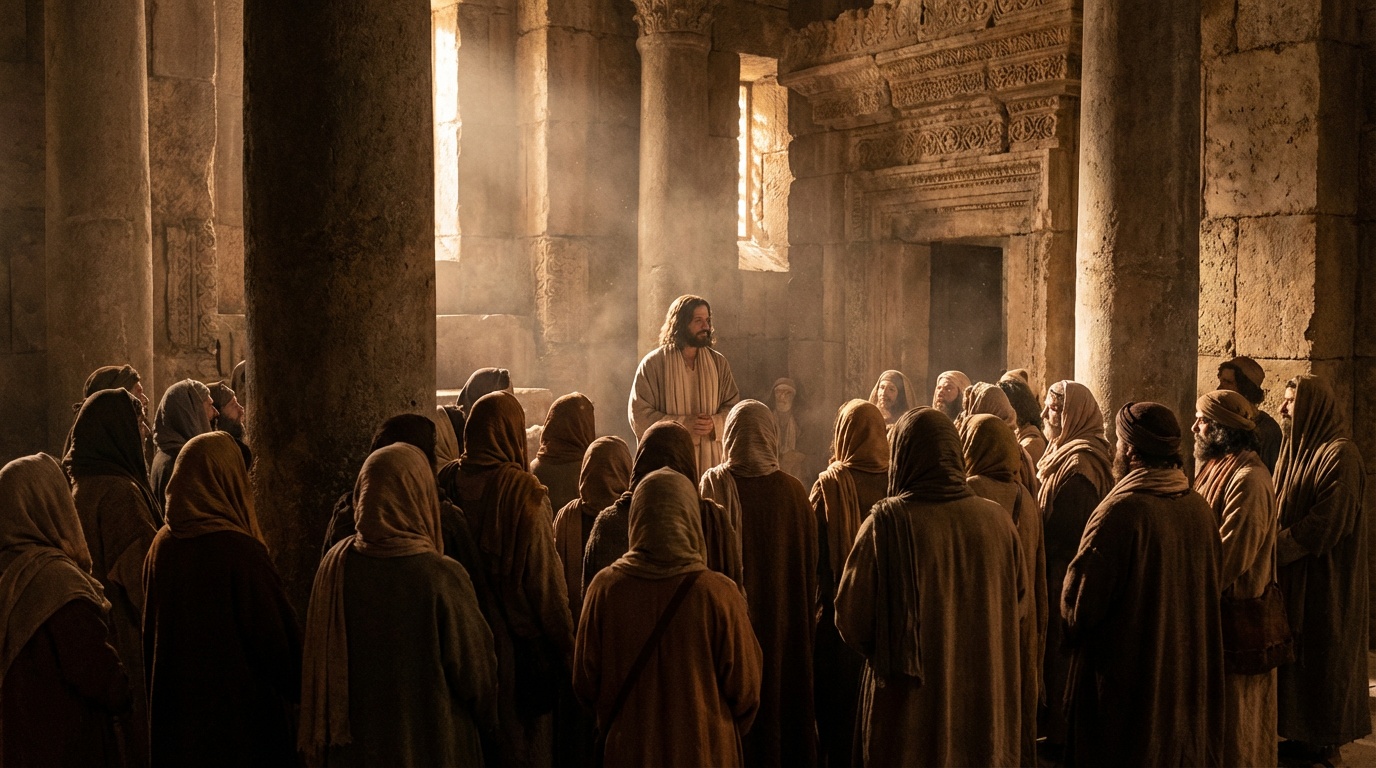
Jesus moved about within Galilee; he did not wish to travel in Judea, because the Jews were trying to kill him. But the Jewish feast of Tabernacles was near. But when his brothers had gone up to the feast, he himself also went up, not openly but as it were in secret. Some of the inhabitants of Jerusalem said, "Is he not the one they are trying to kill? And look, he is speaking openly and they say nothing to him. Could the authorities have realized that he is the Christ? But we know where he is from. When the Christ comes, no one will know where he is from." So Jesus cried out in the temple area as he was teaching and said, "You know me and also know where I am from. Yet I did not come on my own, but the one who sent me, whom you do not know, is true. I know him, because I am from him, and he sent me." So they tried to arrest him, but no one laid a hand upon him, because his hour had not yet come.— John 7:1-2, 10, 25-30
The tension builds in John's Gospel as Jesus moves between concealment and revelation. This passage from John 7 presents a divine dance of hiddenness and bold proclamation that speaks to the heart of Christian discipleship during Lent.
The Wisdom of Divine Timing
"His hour had not yet come." These words echo throughout John's Gospel like a sacred refrain. Jesus demonstrates perfect submission to the Father's timing, even when human logic suggests urgency or retreat.
The feast of Tabernacles called, yet Jesus waited. His brothers departed openly while He traveled in secret. This was not fear—this was obedience to a divine schedule that transcends human understanding.
Saint John Chrysostom reminds us that Christ's apparent delays serve a greater purpose. Every moment unfolds according to God's eternal plan, not our impatient desires.
Hidden in Plain Sight
The crowds debate Jesus' identity with tragic irony. "We know where he is from," they claim, yet they understand nothing of His true origin. They see Nazareth but miss heaven. They recognize the carpenter's son but fail to see the Word made flesh.
This blindness persists today. The world encounters Christ in Scripture, in the Eucharist, in the poor, yet often fails to recognize Him. Lent calls us to purify our vision, to see beyond surface appearances.
The mystic Saint John of the Cross wrote extensively about this divine hiddenness. God often works most powerfully when His presence seems most absent. Through contemplative prayer like St. John of the Cross Method, we learn to recognize Christ in darkness and silence.
Bold Proclamation in the Temple
Jesus breaks His silence with startling directness. "You know me and also know where I am from." His words carry both challenge and invitation. He confronts their shallow knowledge while offering deeper truth.
The temple becomes the stage for this divine drama. Sacred space amplifies His message: "The one who sent me, whom you do not know, is true." Every word pierces the religious pretense of those who claimed to serve God while rejecting His Son.
This tension between hiddenness and revelation mirrors our own spiritual journey. Sometimes God calls us to quiet faithfulness. Other moments demand courageous witness. Discerning the difference requires deep prayer and surrender to divine will.
The Mystery of Divine Protection
"No one laid a hand upon him." Despite their murderous intent, Jesus' enemies remain powerless. Not human cleverness but divine sovereignty protects Him. The Father's hand shields His Son until the appointed hour.
This same protection surrounds every Christian who walks in God's will. Not immunity from suffering—Christ's passion proves otherwise—but assurance that nothing can separate us from divine love.
The martyrs understood this paradox. Saint Polycarp, Saint Thomas More, Saint Maximilian Kolbe—all faced death with peace because they trusted in God's ultimate protection of the soul.
Pray With This Reading
This passage invites deep contemplation of God's timing and ways. Consider engaging with this Gospel through Ignatian Contemplation, placing yourself among the crowds in the temple. Listen to Jesus' bold proclamation. Notice your own reactions to His words about divine sending and authority.
Ask Christ to help you recognize Him more clearly in your daily life, especially in the hidden moments where His presence seems distant but His love remains constant.
Why did Jesus travel to Jerusalem secretly?
Jesus traveled secretly not from fear but from wisdom. He submitted to the Father's perfect timing, knowing that His public ministry had a divinely appointed schedule. His secrecy protected both His mission and His disciples until the appointed hour for His passion.
What does "his hour had not yet come" mean in John's Gospel?
In John's Gospel, Jesus' "hour" refers to His passion, death, and resurrection—the climactic moment of His earthly mission. This phrase emphasizes God's sovereign timing over human attempts to force or prevent divine plans. Everything unfolds according to the Father's perfect schedule.
How can we recognize Jesus in our daily lives like the people in Jerusalem should have?
Recognition requires spiritual sight beyond physical appearance. Through prayer, Scripture study, and reception of the sacraments, we develop eyes to see Christ in the Eucharist, in our neighbors, and in life's ordinary moments. Lenten practices of fasting, prayer, and almsgiving help purify this vision.