
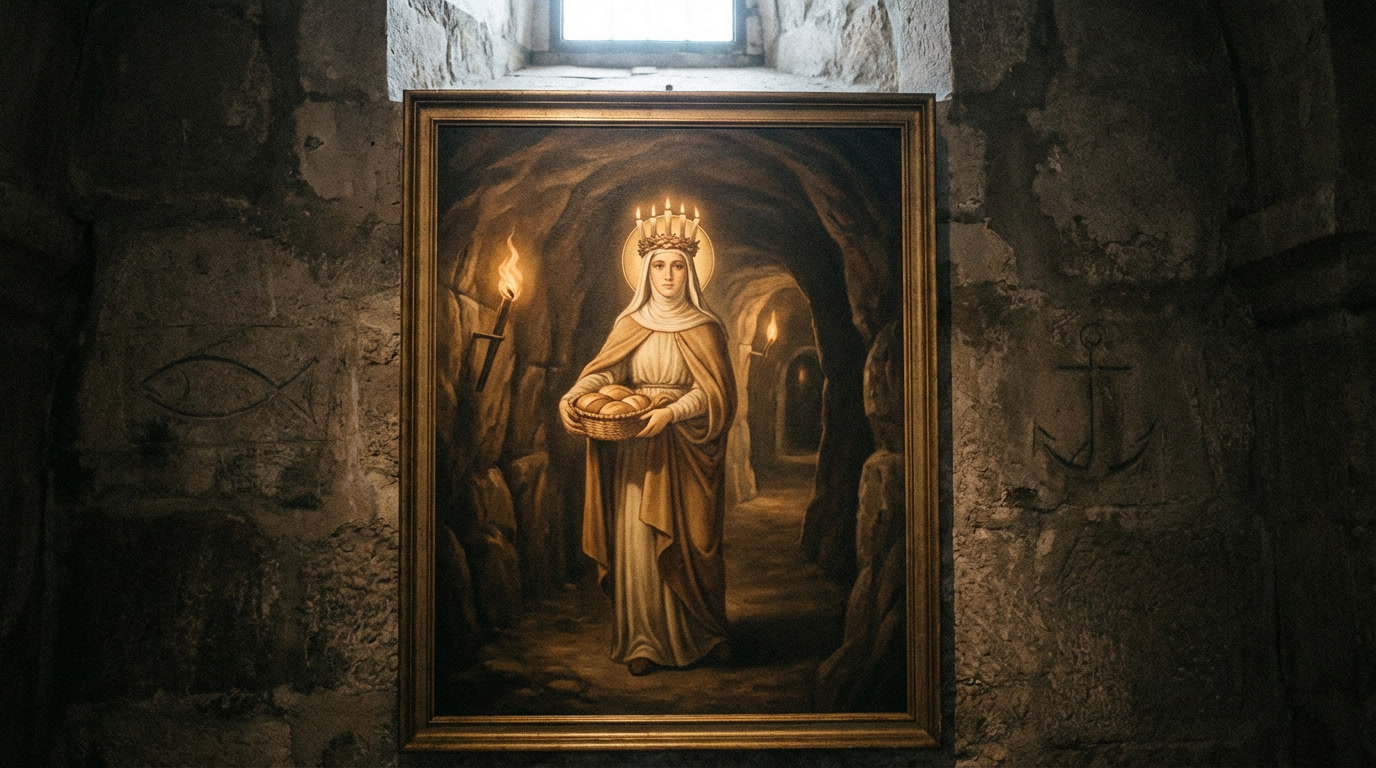
"The light of the body is the eye, and the light of the soul is the mind enlightened by truth."
St. Lucy of Syracuse understood the profound connection between physical sight and spiritual illumination. Her martyrdom in 304 AD during Diocletian's persecution reveals how God's light penetrates even the darkest moments of human suffering. Like the man born blind in today's Gospel, Lucy's story demonstrates that divine purpose often emerges through what appears to be tragedy.
Born to a wealthy Christian family in Sicily, Lucy dedicated her life and fortune to serving the poor. When she refused marriage to preserve her virginity for Christ, her rejected suitor denounced her as a Christian. The prefect ordered her eyes torn out, yet Lucy continued to see and prophesy until her death. Her name itself means "light," marking her as patron saint of the blind and those with eye troubles.
When Darkness Serves God's Greater Plan
Jesus tells His disciples that the man's blindness exists "so that the works of God might be made visible through him." This challenges our natural tendency to view suffering as punishment or cosmic mistake. St. Lucy embraced this truth in her final moments, understanding that her physical torment would illuminate Christ's power for generations.
The saint's willingness to lose her sight for her faith mirrors the blind man's obedience to wash in the Pool of Siloam. Both trusted God's purpose beyond their immediate circumstances. Lucy's feast day on December 13th—originally the longest night before calendar reforms—celebrates light conquering darkness.
Seeing Beyond Physical Limitations
Lucy's patronage of the blind extends beyond physical ailments to spiritual blindness. She intercedes for those struggling to recognize God's presence in their trials. Her wisdom teaches that true sight comes not through our eyes but through faith that perceives divine purpose in suffering.
The Pharisees in John's Gospel demonstrate this spiritual blindness, refusing to acknowledge the miracle before them. They possessed physical sight but remained unable to see Christ's divinity. Lucy's example shows how surrendering our limited vision opens us to God's infinite perspective.
Living with Illuminated Faith Today
St. Lucy's witness challenges us to examine what blinds us to God's work in our lives. Perhaps disappointment clouds our spiritual vision, or fear prevents us from recognizing opportunities to serve. The saint's intercession helps us move beyond surface-level understanding to deeper faith.
When facing our own moments of darkness—illness, loss, uncertainty—Lucy's example reminds us that God can transform our struggles into beacons of hope for others. Her light continues to guide those who feel lost in suffering's confusion.
Consider practicing Lectio Divina with today's Gospel, allowing St. Lucy's wisdom to illuminate Christ's words about spiritual sight and divine purpose.
Pray in the Spirit of St. Lucy
"St. Lucy, patron of light and spiritual sight, intercede for us when darkness threatens to overwhelm our faith. Help us trust that God works through all circumstances, even our deepest sufferings. Grant us eyes to see His purpose unfolding in ways we cannot yet understand. May our lives reflect Christ's light as yours did, illuminating hope for others walking in darkness. Amen."
Frequently Asked Questions About St. Lucy
Why is St. Lucy the patron saint of the blind?
St. Lucy became patron of the blind after her eyes were torn out during her martyrdom in 304 AD. Despite losing her physical sight, she continued to see and prophesy, demonstrating that spiritual sight transcends physical limitations. Her name means "light," connecting her to Christ as the light of the world.
How did St. Lucy help the poor during persecution?
St. Lucy used her family's wealth to secretly feed Christians hiding in Rome's catacombs during Diocletian's persecution. She wore a wreath of candles on her head to light her way while carrying food through dark tunnels, keeping her hands free to serve those in need.