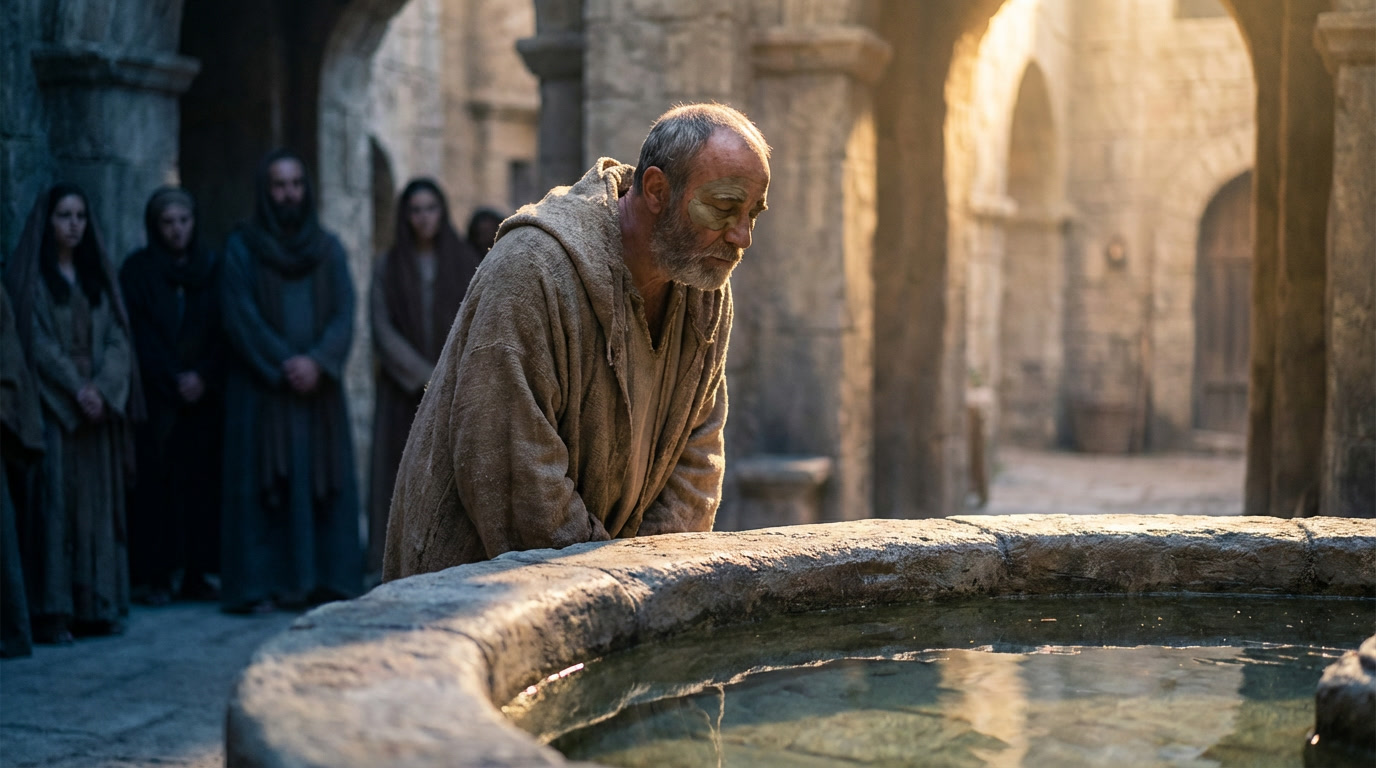
"As Jesus passed by he saw a man blind from birth. His disciples asked him, 'Rabbi, who sinned, this man or his parents, that he was born blind?' Jesus answered, 'Neither he nor his parents sinned; it is so that the works of God might be made visible through him.'" - John 9:1-3
The man born blind encounters Christ on an ordinary day. His neighbors have passed him countless times. The disciples see him as a theological puzzle. But Jesus sees him as the Father's beloved, chosen for glory.
This Fourth Sunday of Lent presents the healing of the man born blind, a passage rich with layers of sight and blindness, judgment and mercy. The Gospel of John 9:1-41 unfolds not merely as miracle but as revelation of who Christ is—the light of the world piercing human darkness.
Beyond Physical Healing: The Works of God Made Visible
The disciples' question reveals our human tendency to assign blame for suffering. Who sinned? Whose fault? Jesus sweeps away such calculations. This man's blindness exists "so that the works of God might be made visible through him."
The clay mixed with saliva echoes Genesis—God forming man from dust. Jesus recreates what was incomplete from birth. Yet the physical restoration points to something deeper. Each healing reveals the Father's desire to restore what sin has broken in creation.
The Pool of Siloam means "Sent." The man must go to the place of sending, just as Jesus himself is sent from the Father. Obedience to Christ's word brings sight. The same pattern governs our spiritual healing—trust, obedience, restoration.
Progressive Recognition: From Jesus to Lord
Watch how the man's understanding deepens through interrogation. First, "the man called Jesus." Then, "a prophet." Finally, after Jesus reveals himself, "Lord, I believe"—and he worships.
The Pharisees' persistent questioning unwittingly becomes catechesis. Each challenge forces the man to articulate more clearly what Christ has done. His parents, fearful of excommunication, distance themselves. But the healed man grows bolder in testimony.
This progression mirrors our own journey with Christ. Initial encounter leads to gradual recognition. Challenges to our faith can deepen rather than diminish conviction—if met with honesty and courage.
The Irony of Spiritual Blindness
Those who claim to see remain in darkness. The Pharisees possess Scripture, religious authority, social standing. Yet they cannot recognize the Light of the World standing before them.
Their blindness stems from presumption—"We are disciples of Moses." Past revelation becomes an obstacle to present grace. They know where Christ comes from, geographically. They miss where he comes from, eternally.
The man born blind, possessing nothing but experience of Christ's mercy, sees more clearly than the learned religious leaders. Humility opens eyes. Pride closes them.
Light and Judgment
"For judgment I came into this world," Christ declares, "so that those who do not see might see, and those who do see might become blind." The coming of light exposes what darkness concealed.
Christ's presence forces decision. The light reveals truth—about God, about ourselves, about reality. Those who welcome this revelation receive sight. Those who reject it choose deeper darkness.
The Gospel confronts our comfortable blindness. What do we refuse to see in our lives? Where does pride masquerade as wisdom? The light of Christ illuminates not to condemn but to heal.
Pray With This Reading
This passage invites deep contemplation through Ignatian Contemplation. Place yourself in the scene. Feel the clay on closed eyelids. Walk to Siloam in faith. Experience the first moment of sight—physical and spiritual.
Alternatively, Lectio Divina with verses 35-38 can deepen our response to Christ's self-revelation. Let Jesus' question "Do you believe in the Son of Man?" echo in prayer.
What does it mean that Jesus is the light of the world?
Christ as light reveals truth, exposes falsehood, and guides the way forward. He illuminates the Father's love, our true identity as beloved children, and the path to eternal life. Physical light enables sight; Jesus enables spiritual sight—the ability to see reality as God sees it.
Why did Jesus heal on the Sabbath?
Jesus demonstrates that mercy transcends religious regulations. The Sabbath exists for human flourishing, not rigid rule-following. By healing on the Sabbath, Christ reveals that works of love and restoration always align with God's will, regardless of human religious calculations.
How can we overcome spiritual blindness?
Spiritual sight requires humility—acknowledging our need for God's grace. Like the blind man, we must trust Christ's word, even when it challenges our assumptions. Prayer, Scripture study, and honest self-examination help remove the obstacles pride places before divine revelation.