
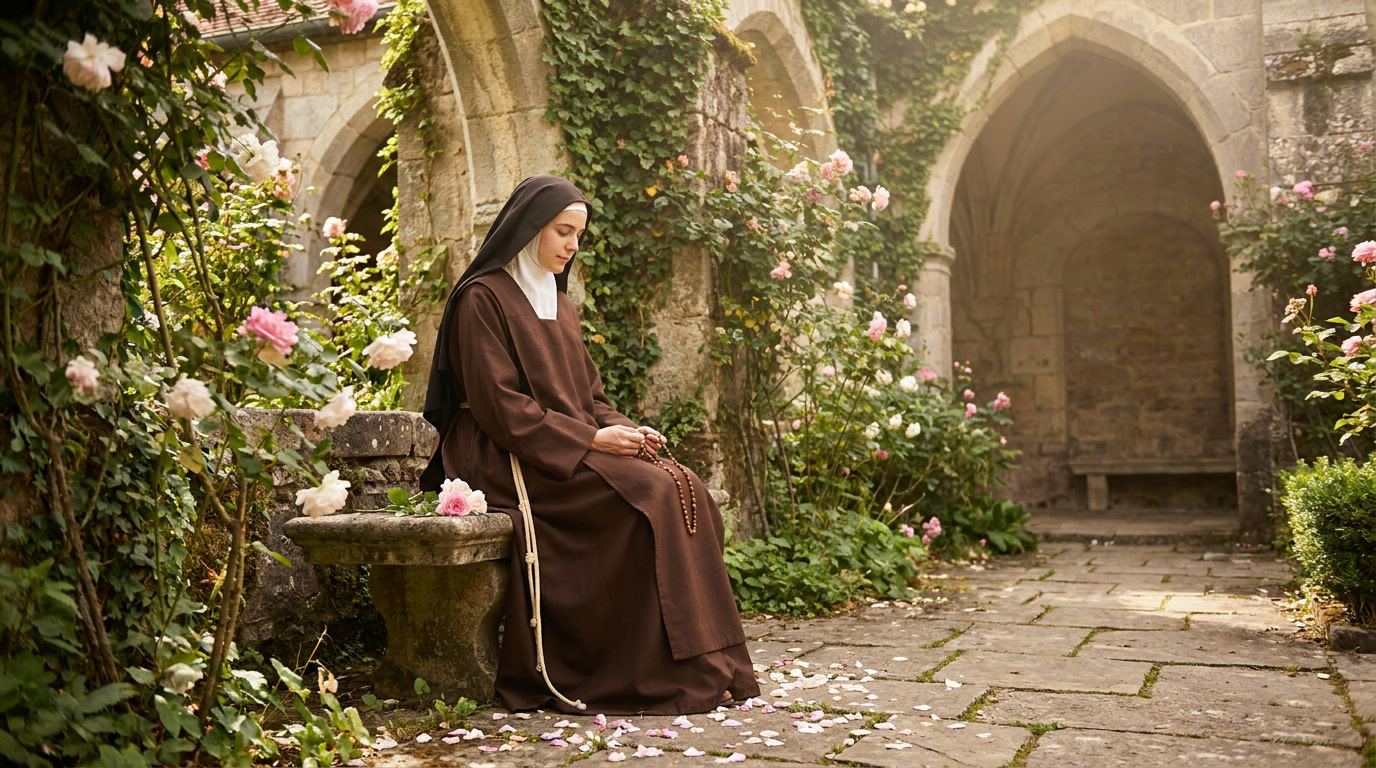
"I will spend my heaven doing good on earth. I will let fall a shower of roses."
When Jesus calls the weary to find rest in His Sacred Heart, He reveals the path of spiritual childhood that Saint Thérèse of Lisieux would later call the Little Way. This young Carmelite saint understood deeply what Christ meant when He said His yoke is easy and His burden light.
Born Marie-Françoise-Thérèse Martin in 1873, Thérèse entered the Carmelite convent at Lisieux at age fifteen. Despite her youth, she grasped profound spiritual truths that seasoned theologians struggled to comprehend. Her "Little Way" became a revolutionary approach to holiness—one that embraces smallness, trust, and complete dependence on God's mercy.
The Wisdom of Spiritual Childhood
Thérèse discovered what Jesus reveals in Matthew's Gospel: God hides His mysteries from the wise and learned, revealing them instead to little ones. She wrote, "The good God would not inspire unattainable desires. I can, then, in spite of my littleness, aspire to holiness."
This saint's genius lay in understanding that spiritual childhood means accepting our limitations without despair. Where others saw weakness, Thérèse found strength. Her approach mirrors Christ's invitation to those who labor and are burdened—not to strive harder, but to rest in divine love.
Taking Christ's Easy Yoke
The Sacred Heart calls us to learn meekness and humility. Thérèse embodied this teaching through her doctrine of confidence and abandonment. She never sought extraordinary penances or mystical experiences. Instead, she found holiness in small acts performed with great love.
"I prefer the monotony of obscure sacrifice to all ecstasies," she declared. This preference reflects Christ's teaching that His yoke is easy—not because the Christian life lacks difficulty, but because love transforms every burden into gift.
Those seeking to deepen their relationship with the Sacred Heart might find solace in Franciscan Prayer, which emphasizes simplicity and trust, much like Thérèse's approach.
Rest for the Weary Soul
Thérèse understood that true rest comes not from the absence of struggle, but from complete trust in God's providential care. She faced tuberculosis, spiritual dryness, and temptations against faith with remarkable peace. Her secret was surrendering everything to the merciful love of the Sacred Heart.
"What matters in life," she taught, "is not great deeds, but great love." This wisdom transforms how we approach daily challenges. Instead of measuring ourselves by achievements, we can rest in the knowledge that love sanctifies every moment.
Pray in the Spirit of Saint Thérèse
Saint Thérèse invites us to approach the Sacred Heart as beloved children approaching a tender father. Her prayer was simple: "My God, I love You!" This directness cuts through complicated spiritual techniques to reach the heart of relationship with Christ.
Following her example, we can offer each day's small sacrifices and joys to the Sacred Heart, trusting that divine love transforms everything. The Little Way teaches us that holiness lies not in extraordinary feats, but in extraordinary love applied to ordinary moments.
Frequently Asked Questions
What is Saint Thérèse's Little Way?
The Little Way is Saint Thérèse's spiritual path of trust and complete surrender to God. It emphasizes spiritual childhood, recognizing our smallness before God while maintaining absolute confidence in His merciful love. This approach makes sanctity accessible to everyone, regardless of their circumstances or abilities.
How did Saint Thérèse die so young yet become a Doctor of the Church?
Saint Thérèse died of tuberculosis at age 24, but her profound spiritual insights, recorded in her autobiography "Story of a Soul," revealed extraordinary wisdom about God's mercy and the path to holiness. Pope John Paul II declared her a Doctor of the Church in 1997, recognizing her unique contribution to Catholic spirituality through the Little Way.