
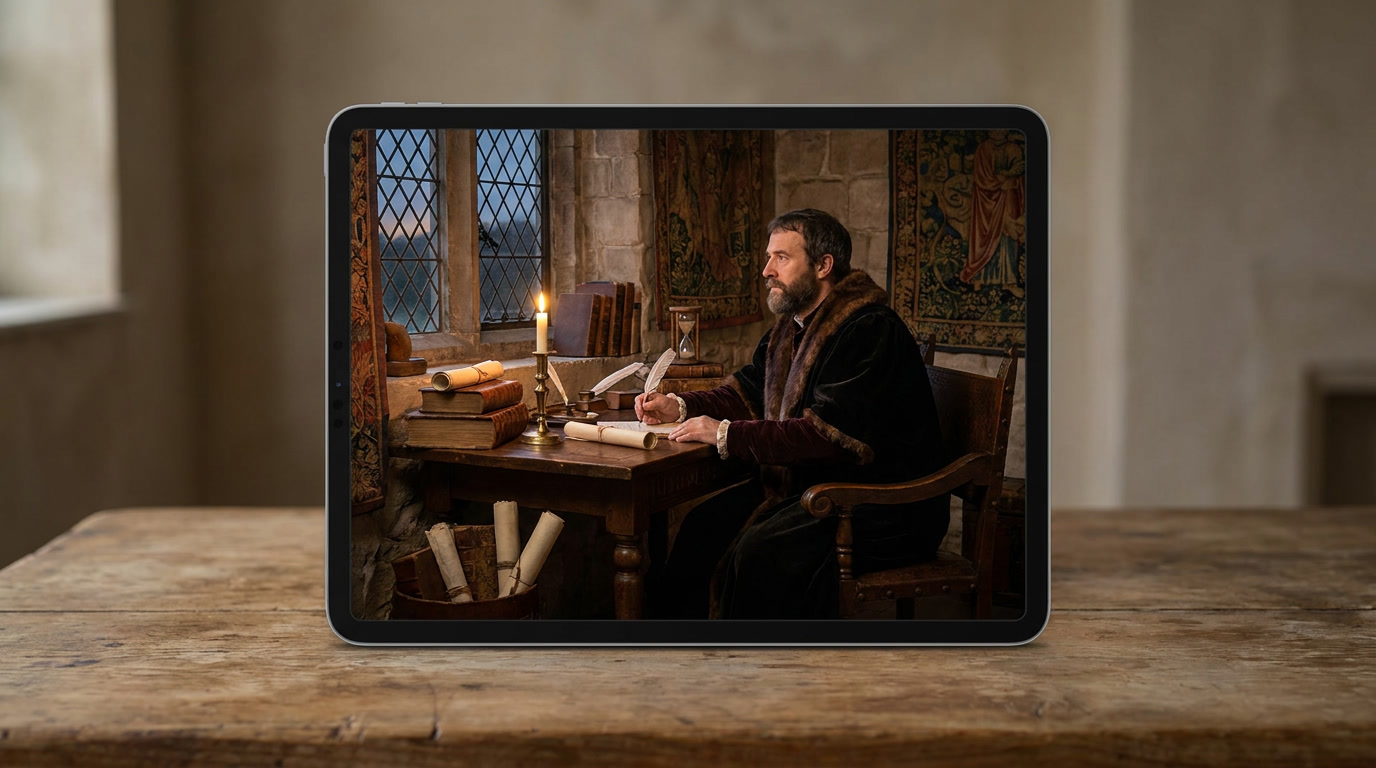
"I die the King's good servant, but God's first."
St. Thomas More faced the ultimate test when earthly law collided with divine commandment. His final words on the scaffold echo Christ's declaration in today's Gospel that divine law remains unchanging until heaven and earth pass away. More's witness illuminates how faithful conscience navigates the tension between human authority and God's eternal precepts.
Thomas More served as Lord Chancellor of England under Henry VIII, a brilliant lawyer and humanist scholar who wrote Utopia. When the king demanded recognition as head of the English Church, More chose silence rather than compromise his Catholic faith. His refusal to take the Oath of Supremacy led to his execution in 1535. The Church canonized him in 1935 as a martyr for religious freedom and moral integrity.
The Law Written on the Heart
Christ tells his disciples that not even the smallest letter will pass from the law until all is fulfilled. St. Thomas More understood this permanence deeply. He distinguished between human laws, which change with political winds, and divine law, which remains constant. When Henry's laws contradicted Catholic teaching on marriage and papal authority, More recognized an unbridgeable divide.
More's legal training taught him that just laws reflect eternal principles. Unjust laws, he believed, carry no binding force on conscience. His refusal to swear the oath stemmed not from political defiance but from recognition that some commandments admit no compromise.
Teaching Through Example
Today's Gospel warns that whoever breaks the least commandment and teaches others to do so will be called least in the Kingdom. More faced enormous pressure to provide theological cover for the king's actions. His position as Chancellor gave him influence to shape public opinion and justify the royal divorce.
Instead, More chose resignation rather than scandal. He would not use his authority to diminish God's law or lead others astray. His silence became its own teaching, demonstrating that some truths cannot be negotiated away for earthly advantage.
Living Faithful Conscience Today
Modern Catholics face their own moments when cultural pressure conflicts with Church teaching. St. Thomas More's example offers guidance for navigating these challenges with integrity. His approach combined careful discernment with unwavering commitment to truth.
More shows us that faithfulness sometimes requires sacrifice. Career advancement, social acceptance, or financial security may demand compromises that conscience cannot make. The saint's witness reminds us that temporal losses pale beside eternal consequences.
Through Ignatian Contemplation, we can place ourselves in More's prison cell, listening for God's voice amid external pressures and internal fears.
Pray in the Spirit of St. Thomas More
Ask St. Thomas More to intercede for the grace of faithful conscience. Pray for courage to uphold God's commandments when worldly wisdom counsels compromise. Seek his guidance in discerning between legitimate authority and demands that contradict divine law.
More's martyrdom reminds us that Christ's law endures beyond earthly kingdoms. What seems like defeat may be the truest victory when conscience remains intact before God.
Frequently Asked Questions
Why did St. Thomas More refuse to take the Oath of Supremacy?
St. Thomas More refused the Oath of Supremacy because it required acknowledging Henry VIII as head of the English Church, contradicting Catholic teaching on papal authority and the indissolubility of marriage. More believed this oath violated divine law and his conscience as a Catholic.
How is St. Thomas More the patron saint of lawyers and politicians?
St. Thomas More became patron saint of lawyers and politicians because he exemplified integrity in public service, refusing to compromise his faith for political advancement. His legal expertise combined with moral courage makes him a model for those in positions of authority and influence.