
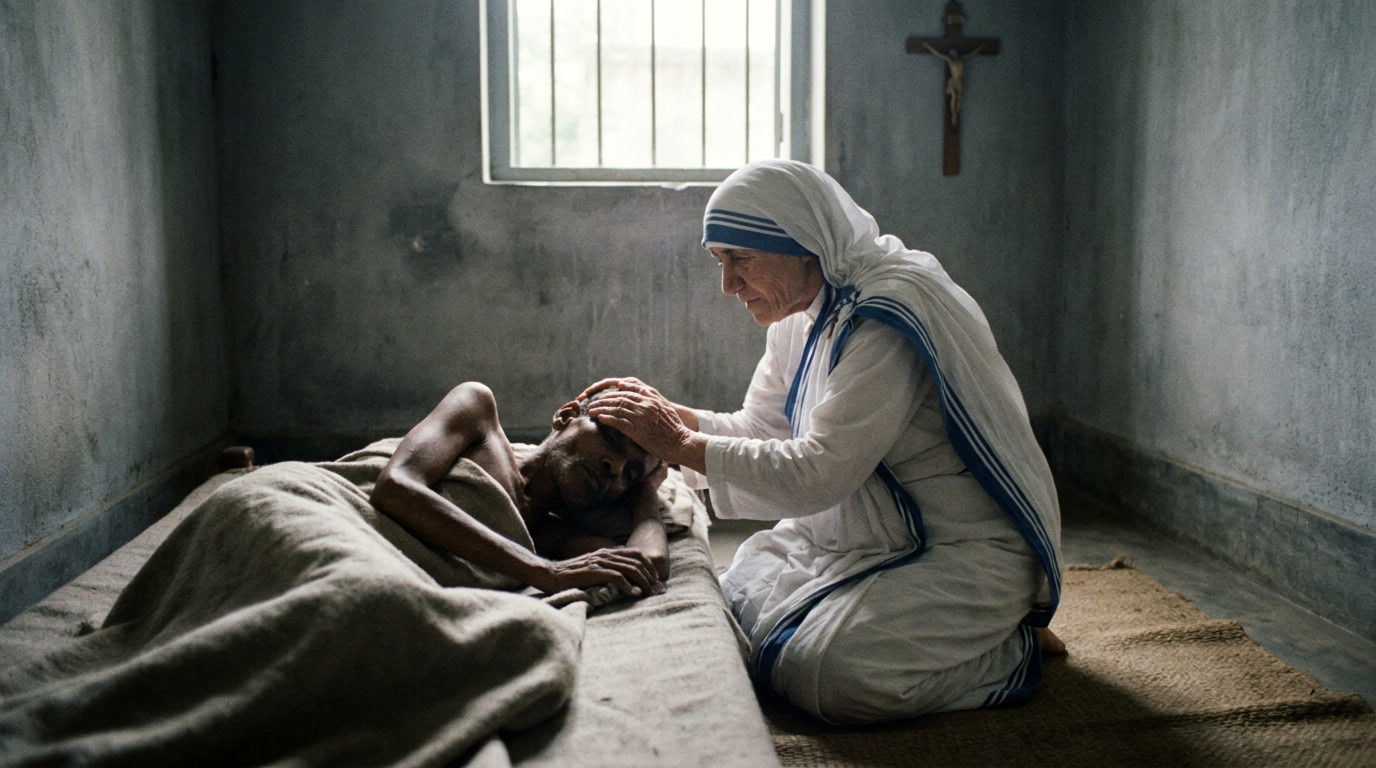
"Give, but give until it hurts."
Saint Teresa of Calcutta understood the widow's mite in the depths of her soul. This Gospel passage about generosity from poverty and true sacrifice echoed through every moment of her ministry among the dying poor of Calcutta. The scribes Jesus condemned sought honor and comfort, while the widow gave everything. Mother Teresa chose the widow's path.
Born Agnes Bojaxhiu in 1910, she answered God's call to serve the "poorest of the poor" in India's slums. For decades, she ministered to those society had forgotten—the dying, the abandoned, the untouchable. Her work earned global recognition, but she remained focused on the individual soul before her. She died in 1997 and was canonized by Pope Francis in 2016.
The Poverty That Enriches Others
Mother Teresa grasped what Jesus revealed through the widow: spiritual poverty opens the heart to radical giving. The scribes gave from their abundance and pride. The widow gave from her need. "The poor give us much more than we give them," Mother Teresa often said. She saw Christ in the face of each suffering person.
This saint's life demonstrates that authentic generosity flows not from excess but from emptiness—an emptiness filled only by God's love. The widow's two coins represented her complete trust in divine providence. Mother Teresa's entire existence became such an offering.
Beyond Material Giving to Self-Donation
The widow's sacrifice transcends money. She gave her livelihood, her security, her future. Mother Teresa understood this total self-gift. "It is not how much we do," she taught, "but how much love we put in the doing."
Every Catholic faces this same invitation. The Gospel calls each believer to examine what constitutes true generosity. Do we give from our surplus, keeping ourselves comfortable? Or do we risk genuine sacrifice for love of God and neighbor?
Consider practicing Franciscan prayer to deepen your understanding of holy poverty and its connection to generous love.
Finding Christ in the Forgotten
Jesus positioned himself opposite the treasury, watching hearts more than coins. Mother Teresa positioned herself among the dying poor, seeing hearts more than circumstances. Both recognized that God dwells with those whom society overlooks.
The scribes sought recognition in marketplaces and synagogues. Mother Teresa sought Christ in the gutters of Calcutta. Her service to the poor flowed from contemplation, not activism. Prayer sustained her radical availability to human suffering.
Pray in the Spirit of Saint Teresa of Calcutta
Saint Teresa of Calcutta, you recognized Christ in the poorest of the poor. Help us see beyond surface appearances to the dignity of every human soul. Teach us the widow's generosity—giving not from our abundance but from our hearts. Grant us courage to serve without counting the cost, to love without measuring the return. Through your intercession, may we discover that in giving everything to God, we receive everything we need. Amen.
Frequently Asked Questions
What is Saint Teresa of Calcutta known for?
Saint Teresa of Calcutta is known for her lifelong service to the dying poor in the slums of Calcutta, India. She established the Missionaries of Charity and dedicated her life to caring for those society had abandoned, seeing Christ in each suffering person.
How does Mother Teresa's work connect to today's Gospel?
Mother Teresa embodied the widow's radical generosity by giving her entire life to serve the poor. Like the widow who gave everything, Mother Teresa chose poverty and self-sacrifice over comfort and recognition, demonstrating true Christian generosity.