
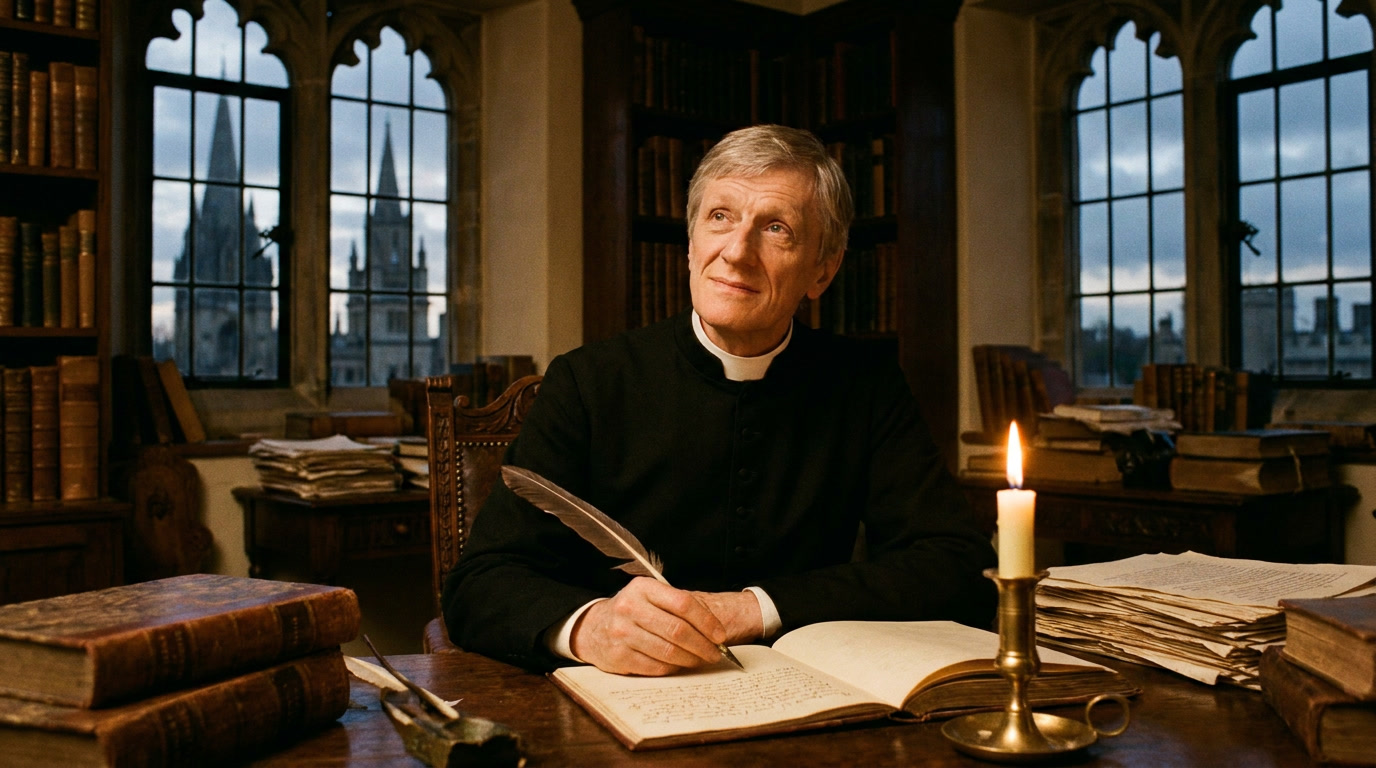
"God has created me to do Him some definite service. He has committed some work to me which He has not committed to another."
In today's Gospel, Christ speaks of departure and promise. Saint John Henry Newman understood this mystery of divine hiddenness—how God's greatest works often unfold when visible support seems to withdraw. Newman's journey from Anglican priest to Catholic cardinal mirrors the disciples' bewilderment when Christ announced His departure.
John Henry Newman lived from 1801 to 1890, navigating the turbulent religious landscape of Victorian England. As a brilliant Oxford scholar and preacher, he led the Oxford Movement before his controversial conversion to Catholicism in 1845. This decision cost him his university position, many friendships, and social standing. Yet Newman recognized that authentic spiritual growth requires such moments of apparent loss.
When Certainties Crumble
Newman knew the disciples' confusion intimately. His own theological certainties dissolved during years of prayer and study. "To live is to change," he wrote, "and to be perfect is to have changed often." The disciples grieved Christ's departure because they could not yet perceive how the Advocate would work through seeming absence.
Newman's Grammar of Assent explores how faith transcends logical proof. Like the disciples, we often demand visible evidence of God's presence. Newman discovered that the Holy Spirit operates most powerfully when our human securities fade. His conversion illustrates Christ's promise that departure enables the Advocate's deeper work.
The Spirit's Quiet Conviction
Christ promises the Advocate will "convict the world in regard to sin and righteousness." Newman experienced this divine conviction throughout his spiritual evolution. The Spirit gradually revealed truths that his intellect initially resisted. Newman learned to distinguish between human reasoning and the Spirit's gentle persistence.
This conviction operates not through force but through what Newman called the "illative sense"—an intuitive perception that recognizes truth beyond mere argument. The Spirit works similarly in our daily choices, quietly revealing sin's emptiness and righteousness's beauty. Newman trusted this inner voice even when it challenged his established beliefs.
Embracing Divine Timing
Newman's patient acceptance of God's timing reflects Christ's assurance that departure serves a greater purpose. Newman waited decades before his contributions gained recognition. The Church beatified him in 2010 and canonized him in 2019—nearly 130 years after his death.
This perspective transforms how we approach life's transitions and losses. Newman's wisdom suggests that apparent setbacks often prepare ground for the Spirit's deeper work. When practicing Lectio Divina with today's Gospel, Newman's example encourages patient trust in God's hidden timing.
Pray in the Spirit of Saint John Henry Newman
Newman's Lead Kindly Light captures his surrender to divine guidance: "Lead, kindly Light, amid th' encircling gloom, Lead Thou me on! The night is dark, and I am far from home, Lead Thou me on!" This prayer embodies Newman's trust in God's providence during uncertain seasons.
Ask Newman's intercession when facing difficult transitions. His life demonstrates that the Spirit's advocacy often works through apparent departures and endings. Newman learned to see God's hand in every circumstance, even bewildering ones.
Frequently Asked Questions
What is Saint John Henry Newman known for?
Saint John Henry Newman is known for his conversion from Anglicanism to Catholicism, his theological writings including "The Idea of a University," and his development of doctrine theory. He was a prominent leader in the Oxford Movement and later became a Catholic cardinal.
How did Saint John Henry Newman influence Catholic education?
Newman profoundly shaped Catholic higher education through his work founding the Catholic University of Ireland and his influential writings on university education. His vision emphasized the integration of faith and reason, liberal arts education, and the formation of the whole person.