
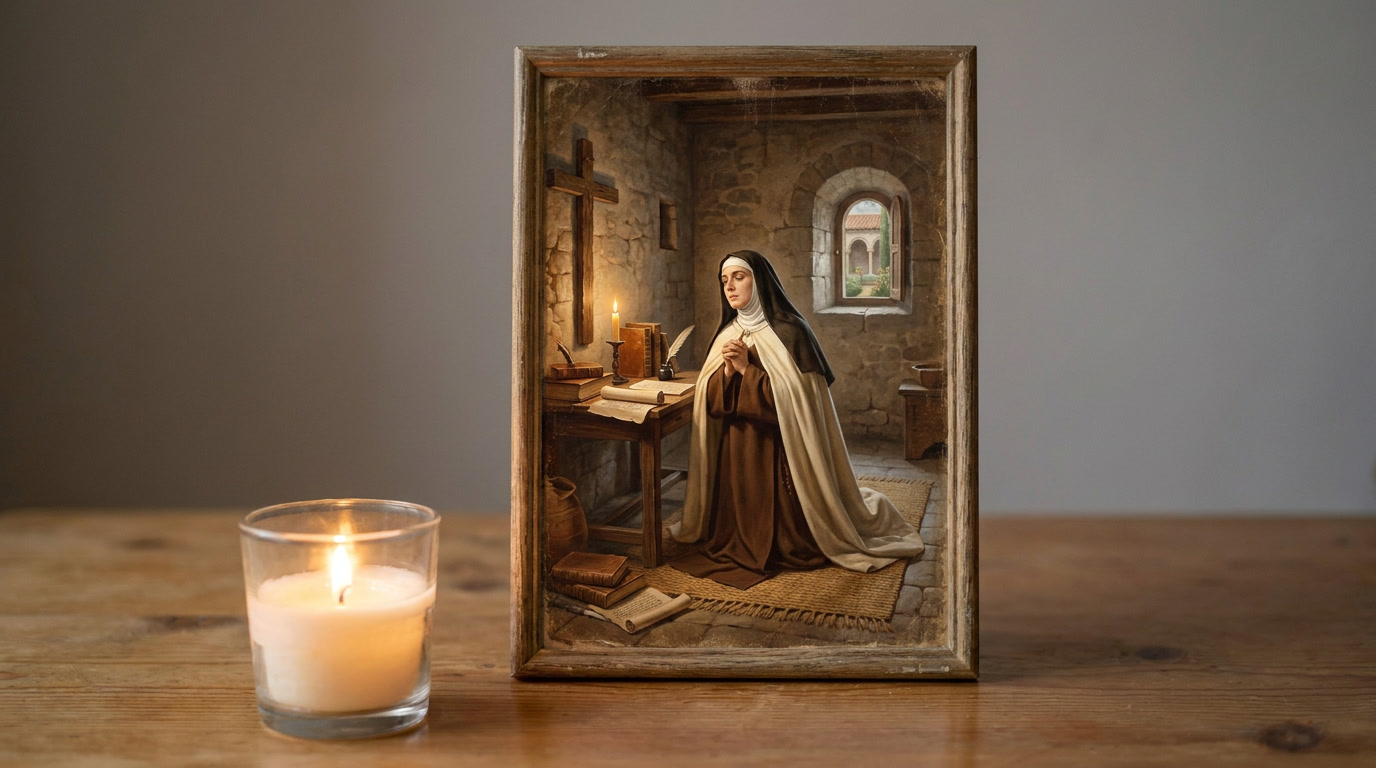
"Let nothing disturb you. All things pass. God does not change. Patience obtains all. Whoever has God lacks nothing. God alone suffices."— Saint Teresa of Avila
When Jesus declares "I am the way and the truth and the life" in today's Gospel, Saint Teresa of Avila understood this not as distant theology, but as intimate invitation. The great mystic of sixteenth-century Spain spent decades mapping the interior path to union with Christ, discovering that the way to the Father leads through the dwelling places of the soul.
Teresa de Cepeda y Ahumada entered the Carmelite convent of the Incarnation in Avila at twenty years old. For nearly two decades, she struggled with lukewarm prayer and worldly attachments. Then, at thirty-nine, encountering an image of the wounded Christ, she experienced profound conversion. The remaining twenty-seven years of her life blazed with mystical prayer, monastic reform, and spiritual direction that would guide souls for centuries.
The Interior Castle of Many Dwelling Places
Christ speaks of "many dwelling places" in the Father's house. Teresa mapped these dwelling places within the human soul itself. Her masterwork, "The Interior Castle," describes seven mansions through which the soul journeys toward union with God. Like the disciples who did not understand where Jesus was going, Teresa recognized that most souls wander in the outer rooms of their own hearts, unaware of the treasures within.
Each mansion represents deeper surrender, greater intimacy with Christ. The path requires what Teresa called "determined determination" — a resolute will to follow Christ regardless of consolation or desolation. She understood that Jesus himself is both the destination and the guide, the way and the goal.
Troubled Hearts and Divine Peace
"Do not let your hearts be troubled," Jesus tells his anxious disciples. Teresa knew such trouble intimately. She faced severe illness, opposition to her reforms, spiritual dryness, and misunderstanding from religious authorities. Yet she discovered that peace comes not from absence of difficulty, but from presence of Christ.
In her Book of Her Life, Teresa describes how mental prayer — simple conversation with Christ — transforms the troubled heart. "Mental prayer is nothing else than an intimate sharing between friends; it means taking time frequently to be alone with him who we know loves us." This contemplative approach to Scripture allows Jesus to speak personally to each soul.
Knowing the Father Through Union with Christ
Philip's request — "show us the Father" — echoes through every seeking heart. Teresa learned that knowledge of God comes not through theological study alone, but through experiential union with Christ. In the seventh mansion of her Interior Castle, the soul experiences what she called "spiritual marriage" — such complete identification with Christ that the Father's love flows unobstructed.
This mystical union transforms ordinary life. Teresa founded seventeen reformed Carmelite convents while maintaining deep contemplative prayer. She proved that intimacy with God enhances rather than escapes engagement with the world. The way to the Father leads through radical availability to divine will in concrete circumstances.
Pray in the Spirit of Saint Teresa
Teresa's path to Christ requires patient cultivation of interior silence. Begin with her counsel: "Let your desire be to see God; your fear, that you might lose him; your sorrow, that you are not enjoying him; your joy, that he can bring you to himself." Even ten minutes daily of wordless presence before Christ can open the first dwelling places of the soul.
Like the disciples in today's Gospel, trust that Christ himself is both the way to seek and the destination sought. Teresa assures us that "the Lord walks among the pots and pans" of ordinary life, making every moment an opportunity for divine encounter.
FAQ: Saint Teresa of Avila
What is Saint Teresa of Avila known for?
Saint Teresa of Avila is known for her mystical writings, particularly "The Interior Castle," and for reforming the Carmelite order. She was the first woman declared a Doctor of the Church, recognized for her profound spiritual wisdom and her mapping of the soul's journey to God through contemplative prayer.
How can Saint Teresa of Avila help with prayer life?
Saint Teresa teaches that prayer is intimate friendship with Christ, not complicated ritual. Her writings offer practical guidance for deepening contemplative prayer, overcoming spiritual dryness, and recognizing God's presence in daily life. She emphasizes perseverance and surrender as keys to spiritual growth.