
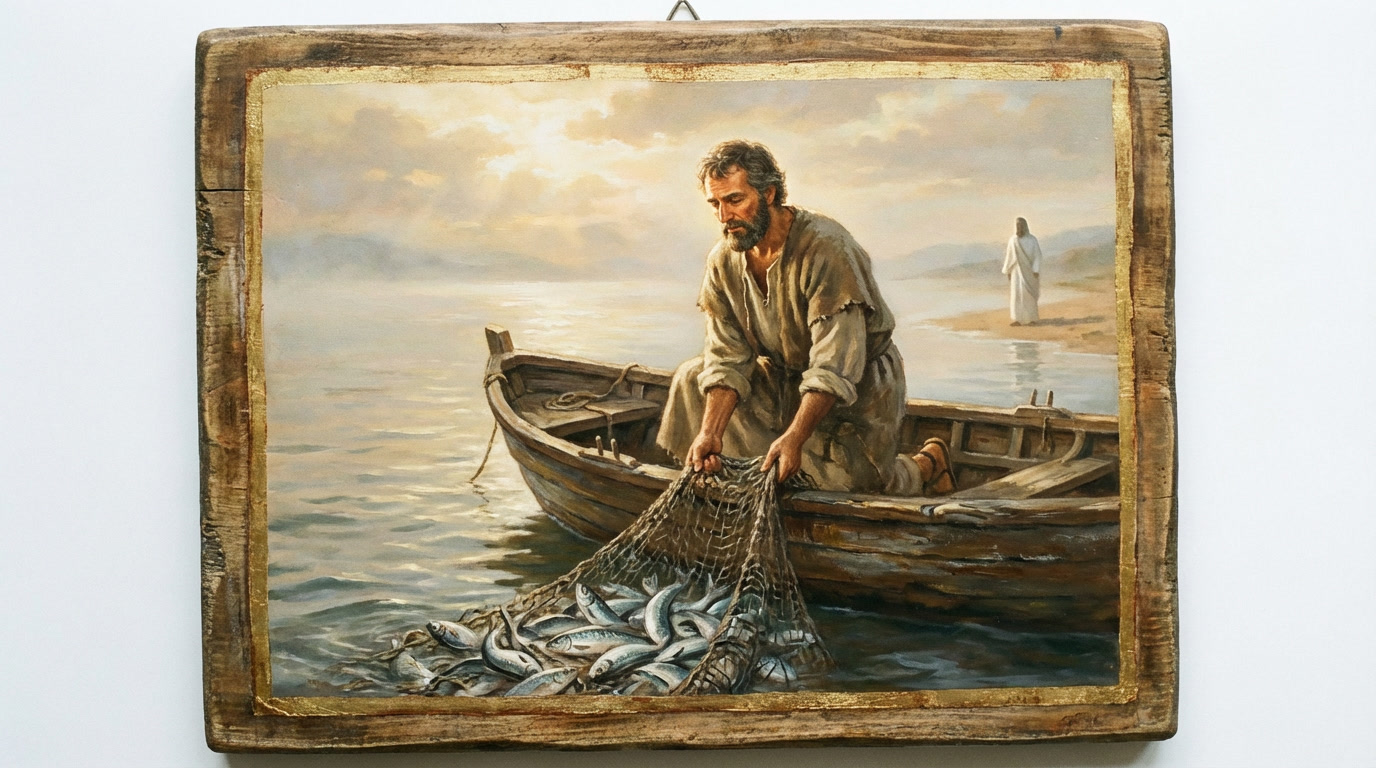
"Lord, you know everything; you know that I love you." - Saint Peter (John 21:17)
Saint Peter and the disciples return to fishing after the Resurrection, their nets empty through the night. Yet Christ stands on the shore, calling them to cast their nets once more. In this moment, Peter discovers how the Risen Lord transforms both failure and familiar work into grace.
The Prince of the Apostles
Simon Peter, the fisherman from Bethsaida, became the rock upon which Christ built His Church. His impetuosity led him to walk on water and deny Christ three times. After Pentecost, this same Peter preached with such power that three thousand souls entered the Church in a single day. He died a martyr's death in Rome, crucified upside down at his own request, deeming himself unworthy to die as his Master had died.
The Church honors Peter as the first Pope, the keeper of the keys of heaven. His feast day, June 29th, celebrates both his authority and his humanity—the saint who knew both divine revelation and personal failure.
When Empty Nets Meet Divine Providence
Peter's return to fishing reveals a profound spiritual truth. After witnessing the Resurrection, the disciples retreat to familiar work. Their empty nets mirror our own seasons of spiritual dryness, when prayer feels hollow and faith seems distant.
Christ's instruction to "cast the net over the right side" speaks to divine timing. The same waters that yielded nothing at night overflow with abundance at dawn. Saint Peter teaches us that God's providence often works through our ordinary labor, transforming routine into revelation.
The miraculous catch becomes a symbol of evangelization—the nets full of souls that Peter would gather for Christ's kingdom. What appears as mere fishing becomes a preview of apostolic ministry.
Recognition and Restoration at the Shore
"It is the Lord!" John's recognition sparks Peter's characteristic leap into the water. This moment echoes Peter's earlier attempt to walk to Jesus across the waves. Where fear once made him sink, love now makes him swim.
The charcoal fire on the shore carries deep significance. The same type of fire where Peter denied Christ becomes the place of his restoration. Jesus asks three times, "Do you love me?"—once for each denial. Peter's triple affirmation heals the wound of his triple betrayal.
This pattern of fall and restoration defines Peter's sanctity. He shows us that our failures need not define us when met with repentance and divine mercy. Through prayerful reflection on Scripture, we too can encounter Christ's transforming presence in our disappointments.
Pray in the Spirit of Saint Peter
Saint Peter invites us to bring our failures to Christ with honest confession. Like the apostle who wept bitterly after his denials, we can trust that our Lord transforms even our deepest regrets into instruments of grace.
In moments when our efforts seem fruitless—when our prayers feel empty and our work bears no fruit—remember Peter's night of fishing. Dawn comes. Christ stands on the shore. The invitation to cast our nets once more echoes across the waters of our daily life.
Let Peter's boldness inspire your own leap toward Christ. Whether swimming through doubt or walking on the waters of trust, the Risen Lord calls each soul by name.
Frequently Asked Questions
What is Saint Peter known for in Catholic tradition?
Saint Peter is known as the first Pope and the Prince of the Apostles. Christ gave him the keys to the kingdom of heaven and called him the rock upon which the Church is built. He is also remembered for his human weaknesses, including his denial of Christ, which makes him a patron saint for those seeking forgiveness and restoration.
Why did Saint Peter return to fishing after the Resurrection?
After the traumatic events of the Passion and the confusion following the Resurrection appearances, Peter returned to his familiar trade of fishing. This likely represented both a need for practical income and a retreat to what he knew best during an uncertain time. Christ used this ordinary moment to teach profound lessons about divine providence and apostolic calling.