
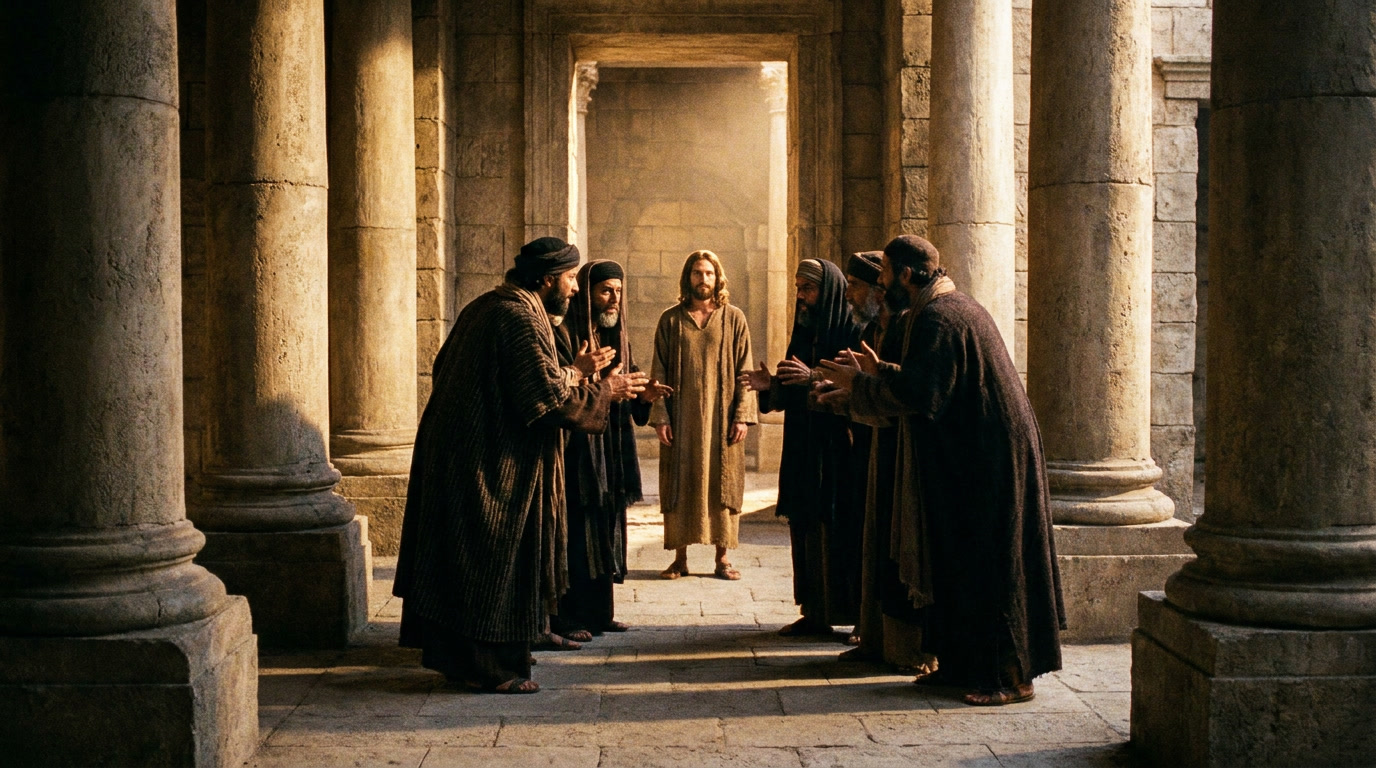
Jesus and his disciples returned once more to Jerusalem. As he was walking in the temple area, the chief priests, the scribes, and the elders approached him and said to him, "By what authority are you doing these things? Or who gave you this authority to do them?" Jesus said to them, "I shall ask you one question. Answer me, and I will tell you by what authority I do these things. Was John's baptism of heavenly or of human origin? Answer me." They discussed this among themselves and said, "If we say, 'Of heavenly origin,' he will say, 'Then why did you not believe him?' But shall we say, 'Of human origin'?"—they feared the crowd, for they all thought John really was a prophet. So they said to Jesus in reply, "We do not know." Then Jesus said to them, "Neither shall I tell you by what authority I do these things." — Mark 11:27-33
The temple courts echo with tension. Religious leaders corner Christ with a question designed to trap Him. Their challenge about divine authority reveals hearts hardened against God's voice, even when it speaks clearly before them.
When Religious Leaders Challenge Divine Authority
The chief priests, scribes, and elders held earthly power over temple worship. They demanded credentials from Jesus, expecting Him to submit to their human systems of validation. Their question masked deeper fears: this carpenter's son was overturning their carefully constructed religious order.
Christ's authority flows from the Father, not from human institutions. The religious leaders sought external validation while missing the divine presence standing before them. Their blindness warns against confusing religious position with spiritual discernment.
Saint John Chrysostom observed that these leaders questioned Christ's authority while refusing to acknowledge John the Baptist's mission. They rejected God's messengers while claiming to serve God's house.
The Wisdom of Christ's Counter-Question
Jesus responds with divine wisdom, asking about John the Baptist's authority. This question exposes the leaders' duplicity. They knew John spoke with heavenly authority yet refused to believe his testimony about Christ.
The religious leaders find themselves trapped by their own dishonesty. Acknowledging John's divine mission would validate Jesus, whom John proclaimed. Denying it would anger the crowds who revered John as a prophet.
Christ's method teaches us to discern the hearts of those who question faith. Sometimes the questioner seeks genuine understanding. Sometimes they seek to trap or discredit. Divine wisdom distinguishes between sincere inquiry and malicious challenge.
Fear of Truth and Public Opinion
The leaders' private discussion reveals their spiritual poverty. They calculate public opinion rather than seeking truth. Fear of the crowd guides their response, not love of God or desire for understanding.
This passage exposes how religious authority can become corrupted when it serves human approval rather than divine truth. The leaders who should have recognized God's voice became deaf to it through pride and political calculation.
Their answer, "We do not know," represents willful ignorance. They possessed the knowledge to recognize both John's and Jesus' divine mission but chose blindness to protect their position.
Authority That Flows from God
Christ's refusal to answer their original question demonstrates perfect justice. Those who reject clear evidence of divine authority forfeit the right to demand further proof. God's authority becomes self-evident to hearts prepared to receive it.
The Son's authority rests in His unity with the Father, confirmed through signs, wonders, and the witness of John the Baptist. No human institution can grant or revoke what flows from the divine nature itself.
This encounter foreshadows the ultimate confrontation between earthly and heavenly authority. The religious leaders who questioned Christ's credentials would soon collaborate in His crucifixion, unknowingly fulfilling divine purposes beyond their understanding.
Pray With This Reading
This Gospel passage calls us to examine our own relationship with divine authority. St. John of the Cross Method offers a pathway to encounter Christ's authority through contemplative prayer, moving beyond intellectual questioning to heart-level recognition of His divine nature.
Frequently Asked Questions
What does Jesus mean by asking about John the Baptist's authority?
Christ's question reveals that recognizing John's divine mission leads logically to accepting Jesus' authority. John testified that Jesus was the Messiah, so acknowledging John's prophetic calling requires believing his testimony about Christ.
Why didn't Jesus directly answer the religious leaders' question?
Jesus refuses to cast pearls before swine. The leaders had already witnessed His miracles and heard John's testimony. Their question arose from malice, not genuine seeking. Direct answers to dishonest questions often enable further manipulation.
How can we recognize divine authority today?
Divine authority manifests through consistency with Scripture, the teaching of the Church, fruits of the Spirit, and inner witness of the Holy Spirit. Unlike human authority, God's authority serves love and truth rather than self-interest or control.