
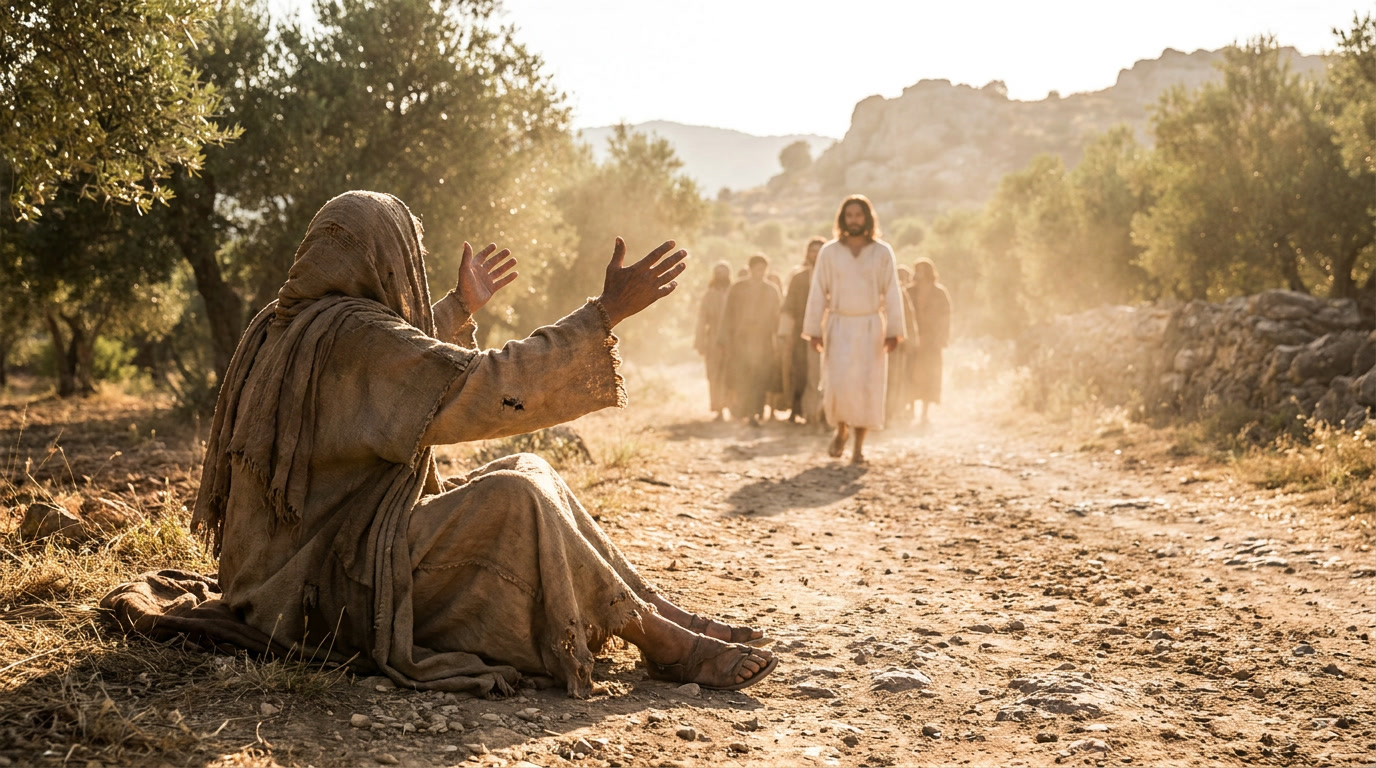
"As Jesus was leaving Jericho with his disciples and a sizable crowd, Bartimaeus, a blind man, the son of Timaeus, sat by the roadside begging. On hearing that it was Jesus of Nazareth, he began to cry out and say, 'Jesus, son of David, have pity on me.' And many rebuked him, telling him to be silent. But he kept calling out all the more, 'Son of David, have pity on me.' Jesus stopped and said, 'Call him.' So they called the blind man, saying to him, 'Take courage; get up, Jesus is calling you.' He threw aside his cloak, sprang up, and came to Jesus. Jesus said to him in reply, 'What do you want me to do for you?' The blind man replied to him, 'Master, I want to see.' Jesus told him, 'Go your way; your faith has saved you.' Immediately he received his sight and followed him on the way."— Mark 10:46-52
The roadside near Jericho becomes a theater of faith where Bartimaeus demonstrates the persistence that moves heaven. His cry pierces through social barriers and religious propriety, reaching the heart of Christ. This encounter reveals the radical nature of faith — urgent, undignified, and utterly dependent on divine mercy.
The Persistence of Desperate Faith
Bartimaeus refuses to be silenced. The crowd's rebuke only intensifies his plea. His physical blindness sharpens his spiritual vision; he recognizes Jesus as the Messiah when others see only a traveling teacher. The title "Son of David" carries messianic weight, revealing faith that transcends mere hope for healing.
Saint John of the Cross understood this persistence in prayer. When darkness clouds our spiritual sight, we must call out with greater intensity, not less. The saints teach that obstacles to prayer often signal we stand on holy ground. Bartimaeus models the prayer that refuses to accept "no" as God's final answer.
What Do You Want Me to Do for You?
Jesus asks Bartimaeus the same question He posed to James and John earlier in Mark's Gospel. The contrast is stark. The disciples sought glory; the blind beggar seeks sight. Jesus honors honest, humble requests while challenging self-serving ambition.
This question echoes through every prayer. Christ desires to hear our deepest need, not our surface wants. Bartimaeus asks for one thing: "Master, I want to see." His request is simple, direct, and rooted in genuine need. The Little Way of St. Thérèse embraces this childlike directness in approaching God.
The Cloak Cast Aside
When Jesus calls, Bartimaeus throws aside his cloak and springs up. This detail matters. The cloak was his security, his blanket for sleeping rough, his only possession of value. He abandons it without hesitation, trusting that Jesus offers something infinitely better.
Every encounter with Christ requires this casting aside of what seems essential but actually hinders. Fear, pride, comfortable sins — these cloaks must be thrown off to reach Jesus. Bartimaeus teaches that faith moves with urgency when Jesus calls.
Your Faith Has Saved You
Jesus attributes the healing to Bartimaeus's faith, not His own power. Faith becomes the conduit for divine mercy. This faith persists through opposition, responds immediately to invitation, and asks for what matters most.
The passive voice in "he received his sight" suggests grace received rather than power grasped. Healing flows from the encounter, but relationship with Jesus becomes the greater gift. Bartimaeus follows Christ on the way — the path toward Jerusalem and the cross.
Ignatian contemplation invites us to place ourselves in this scene, feeling the dust of the road and hearing the crowd's noise. What blocks our spiritual sight? What persistent cry rises from our heart?
Pray With This Reading
The healing of Bartimaeus calls us into surrender prayer. Like the blind beggar, we come to Jesus with empty hands and urgent hearts. This method helps us cast aside whatever prevents clear spiritual vision and respond with Bartimaeus's simple faith: "Master, I want to see."
Frequently Asked Questions
What does Bartimaeus symbolize in Mark's Gospel?
Bartimaeus represents the ideal disciple who recognizes Jesus as Messiah, responds with persistent faith, and follows Christ despite obstacles. His physical blindness contrasts with the spiritual sight that faith provides.
Why did the crowd tell Bartimaeus to be quiet?
The crowd viewed a blind beggar as socially insignificant and spiritually unworthy of Jesus's attention. Their rebuke reflects human prejudice that Jesus consistently overturns by welcoming the marginalized.
What is the significance of casting aside his cloak?
The cloak represented Bartimaeus's security and identity as a beggar. Throwing it aside shows complete trust in Jesus and willingness to abandon his old life for whatever Christ offers. It symbolizes the radical abandonment faith requires.