
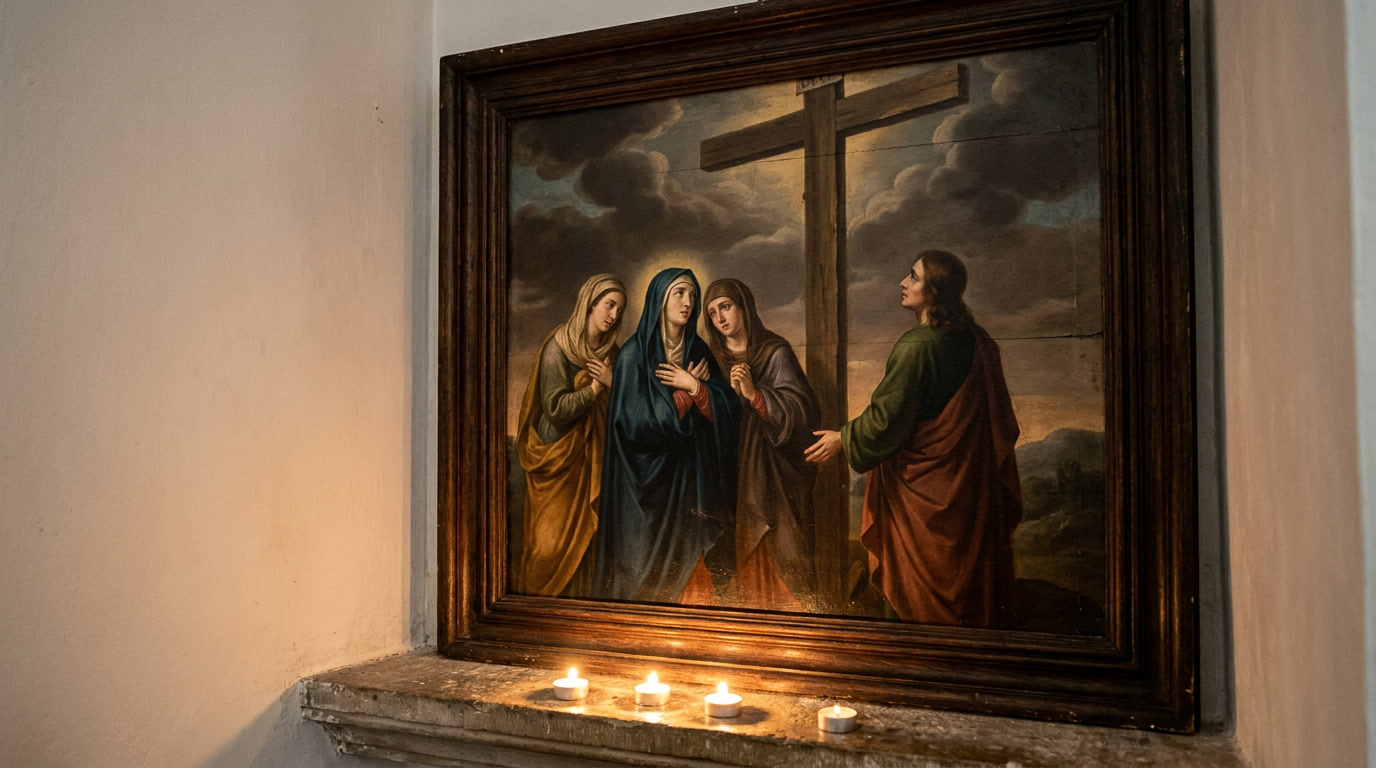
Standing by the cross of Jesus were his mother and his mother's sister, Mary the wife of Clopas, and Mary of Magdala. When Jesus saw his mother and the disciple there whom he loved, he said to his mother, "Woman, behold, your son." Then he said to the disciple, "Behold, your mother." And from that hour the disciple took her into his home. - John 19:25-27
In the darkness of Calvary, Christ establishes the heart of His Church. Mary, the Mother of the Church, receives her universal motherhood not in triumph, but in the depths of suffering. This memorial celebrates the profound moment when maternal love becomes the foundation of Christian community.
The Faithful Women at the Cross
While the apostles fled, the women remained. Mary of Nazareth, Mary of Clopas, and Mary Magdalene stood firm beneath the cross. Their presence reveals the constancy of love that characterizes the Mother of the Church and her spiritual daughters.
Saint John Chrysostom observed that these women showed greater courage than the apostles. They embody the Church's call to remain faithful in darkness, to stand with Christ even when understanding fails. The Mother of the Church leads by example, teaching the faithful to stay close to the Cross.
"Behold, Your Son" - Mary's Universal Motherhood
Christ's words to His mother establish her role as Mother of the Church for all generations. "Woman, behold, your son" extends far beyond the beloved disciple to embrace every believer. Mary receives spiritual children in exchange for her only Son.
This exchange transforms Mary's natural motherhood into supernatural motherhood. As Mother of the Church, she cares for Christ's mystical body with the same love she showed the infant Jesus. The Catechism teaches that Mary's maternal role continues throughout salvation history.
The address "Woman" recalls Genesis and the wedding at Cana. Mary is the New Eve, mother of all the living in grace. Her fiat at the Annunciation finds its fulfillment at Calvary, where she becomes mother to the redeemed.
The Blood and Water of New Birth
From Christ's pierced side flows blood and water, symbols of the sacraments that give birth to the Church. The Mother of the Church witnesses this mystical birth just as she witnessed Christ's natural birth in Bethlehem.
The Fathers saw in this flow the birth of the Church from Christ's side, as Eve came from Adam's rib. Mary stands as mother to this new creation, nurturing the Church's children through grace. The blood represents the Eucharist; the water, Baptism - the sacraments that form the Church's life.
Saint Augustine wrote that the Church was born from the sleeping Christ as Eve from the sleeping Adam. Mary, present at this birth, becomes the Church's mother and model. Her maternal heart embraces all who are born from Christ's sacrificial love.
Living Under Mary's Motherly Care
"From that hour the disciple took her into his home." This receiving of Mary into our spiritual homes means accepting her guidance as Mother of the Church. She forms Christ in believers' hearts as she formed Him in her womb.
The Mother of the Church intercedes constantly for her children, leading them to her Son. Her presence in the upper room at Pentecost reveals her role in the Church's ongoing mission. Through prayer and example, she continues to mother the faithful into holiness.
Contemplating this scene through Ignatian Contemplation allows the heart to experience Mary's maternal love personally. Placing ourselves at Calvary, the soul can hear Christ's words addressed to each believer.
Pray With This Reading
This Gospel invites deep contemplative prayer, especially through Lectio Divina. Begin by slowly reading Christ's words to Mary and the beloved disciple. Allow the scene to unfold in prayer, noticing Mary's silence and strength. Rest in her maternal presence, asking her to form Christ within your heart as Mother of the Church.
Frequently Asked Questions
Why is Mary called Mother of the Church?
Christ's words at Calvary establish Mary's universal motherhood over all believers. As the beloved disciple represents all Christians, Mary becomes spiritual mother to the entire Church, caring for Christ's mystical body with maternal love.
What does it mean to take Mary into our home?
Taking Mary into our home means accepting her as spiritual mother and allowing her to guide our relationship with Christ. It involves devotion, imitation of her virtues, and trust in her intercession as Mother of the Church.
How does Mary continue to mother the Church today?
Mary continues her maternal role through intercession, appearing in approved apparitions, and forming Christ in believers' hearts. The Mother of the Church guides the faithful to her Son through prayer, example, and spiritual protection.