
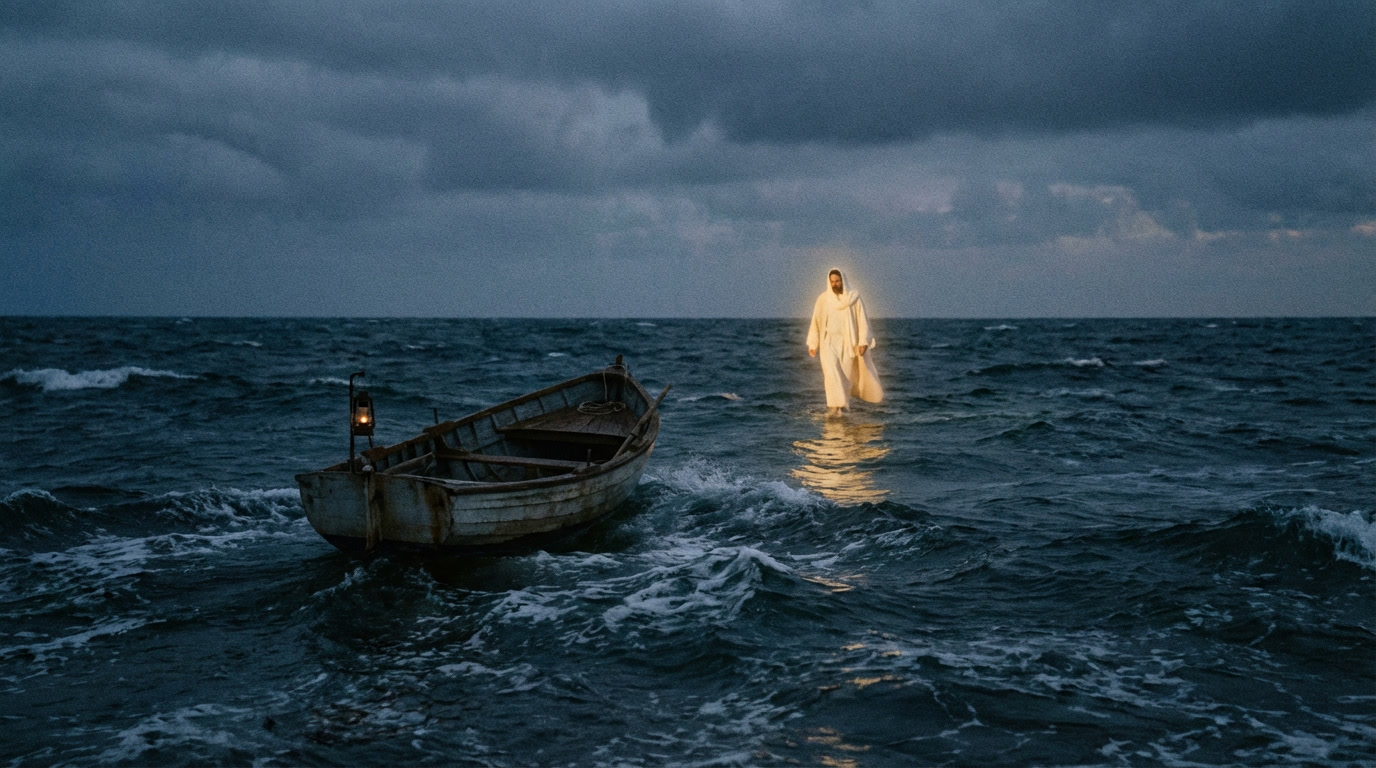
When it was evening, the disciples of Jesus went down to the sea, embarked in a boat, and went across the sea to Capernaum. It had already grown dark, and Jesus had not yet come to them. The sea was stirred up because a strong wind was blowing. When they had rowed about three or four miles, they saw Jesus walking on the sea and coming near the boat, and they began to be afraid. But he said to them, "It is I. Do not be afraid." They wanted to take him into the boat, but the boat immediately arrived at the shore to which they were heading.
— John 6:16-21
The disciples find themselves alone on troubled waters, rowing against fierce winds in the darkness. This scene from John's Gospel speaks to every soul who has felt abandoned in life's storms. Yet Christ's approach across the waves reveals a profound truth about His presence in our struggles.
When Jesus Seems Absent
The disciples embarked expecting Jesus to join them. Instead, darkness fell and strong winds arose. How often do we begin our spiritual journeys with clear expectations, only to find ourselves in unexpected difficulties?
Saint John Chrysostom teaches that Christ's apparent absence serves a purpose. The disciples needed to experience their own limitations before witnessing His divine power. Their struggle prepared their hearts to receive His presence more fully.
This pattern echoes throughout Scripture. The Israelites wandered in the desert before entering the Promised Land. Job endured suffering before experiencing God's restoration. Our seasons of spiritual dryness often precede deeper intimacy with Christ.
Christ Approaches in Unexpected Ways
Jesus comes to His disciples not through conventional means, but walking on water. His approach defies natural law, revealing His mastery over creation itself. The very element that troubled the disciples becomes the path for their salvation.
Fear grips the apostles when they witness this miracle. Their hearts, already strained by the storm, cannot immediately comprehend this manifestation of divinity. Yet Christ's first words address their deepest need: "It is I. Do not be afraid."
Saint Teresa of Avila reminds us that God often works in ways that surpass human understanding. When we face overwhelming circumstances, Christ may approach through means we never anticipated. The key lies in recognizing His voice amidst the chaos.
The Power of Recognition
"It is I" — these simple words transform everything. The storm remains, but Christ's presence changes the disciples' entire situation. Recognition of His identity brings immediate peace to their troubled hearts.
This moment invites us to consider how we recognize Christ in our own storms. Do we hear His voice in the counsel of faithful friends? Do we sense His presence in the Eucharist during difficult seasons? Recognition requires spiritual attentiveness, cultivated through consistent prayer.
The practice of Lectio Divina trains the heart to recognize Christ's voice in Scripture. Through careful listening to God's word, we develop the spiritual sensitivity needed to perceive His presence in life's storms.
Immediate Arrival at Safety
The Gospel records a final miracle: the boat immediately reaches shore when the disciples welcome Jesus aboard. Their long struggle against the winds ends in an instant. Christ's presence not only calms their fears but completes their journey.
This supernatural arrival points to the eschatological hope that sustains every Christian. Our earthly struggles, however prolonged, find their resolution in Christ. The storms that seem endless from our human perspective are but brief moments in the eternal scope of God's plan.
Saint Thérèse of Lisieux understood this truth deeply. Her "Little Way" embraces both suffering and joy as paths to union with Christ. When we surrender our struggles to His care, He guides us to safety with divine efficiency.
Pray With This Reading
This passage invites contemplative prayer that places us in the boat with the frightened disciples. Ignatian Contemplation allows us to experience this scene through all our senses — feeling the wind, hearing the waves, seeing Christ approach across the water.
Enter the scene slowly. Notice your own reactions to the storm, to Christ's unexpected approach, to His words of comfort. Let this Gospel speak to your current circumstances, trusting that the same Christ who walked on water continues to approach you in your struggles.
What does Jesus walking on water teach us about His divinity?
Christ's mastery over the natural elements reveals His divine nature as the Word through whom all creation was made. This miracle demonstrates that no force in creation — whether physical storms or spiritual trials — can prevent Him from reaching those He loves.
Why were the disciples afraid when they saw Jesus?
The disciples' fear reflects the natural human response to encountering the divine. Their minds, already strained by the storm, could not immediately process this supernatural manifestation. Fear often accompanies genuine encounters with God's power.
How can this passage help during difficult times?
This Gospel reminds us that Christ approaches us precisely in our moments of greatest struggle. His presence transforms our perspective on difficulties, and His voice brings peace that transcends circumstances. Recognition of His nearness is the key to finding hope in any storm.