
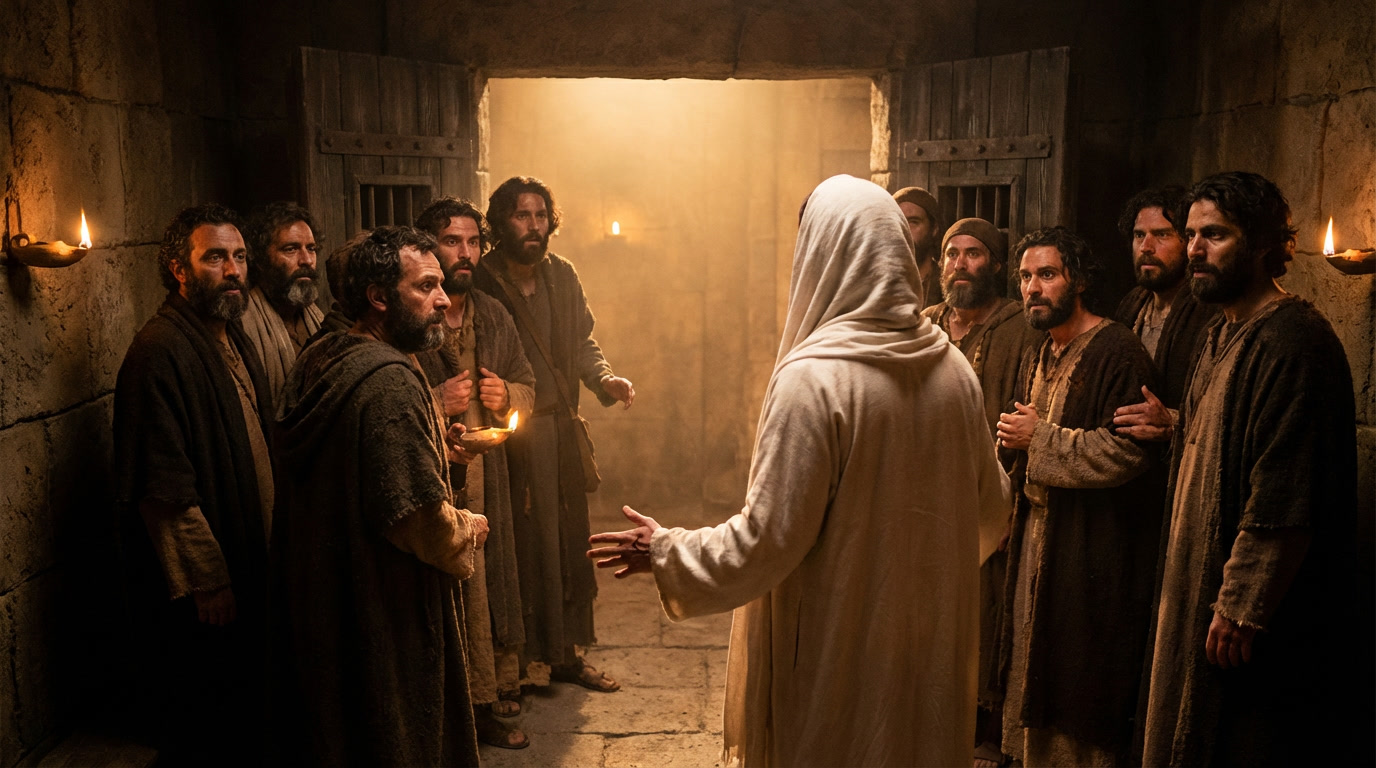
"On the evening of that first day of the week, when the doors were locked, where the disciples were, for fear of the Jews, Jesus came and stood in their midst and said to them, 'Peace be with you.' When he had said this, he showed them his hands and his side. The disciples rejoiced when they saw the Lord... Thomas answered and said to him, 'My Lord and my God!'" — John 20:19-31
The locked doors tell the whole story. Fear had imprisoned the disciples in that upper room, just as doubt would soon imprison Thomas. Yet Christ enters both spaces — the room barred against enemies, the heart barred against hope. On this Divine Mercy Sunday, John 20:19-31 reveals how the Risen Lord meets us precisely where our faith falters.
Behind Locked Doors: When Fear Paralyzes Faith
The disciples had witnessed the crucifixion. They had seen their hopes die with Christ on Calvary. Now they huddled behind locked doors, not yet grasping that death could not contain their Lord. Fear creates its own prisons.
Christ's first words pierce through their terror: "Peace be with you." Not condemnation for their cowardice. Not reproach for their abandonment. Peace. The very peace Isaiah promised would have no end. He shows them his wounds — not to shame them, but to prove his identity. Love bears the marks of what it has endured.
Saint Augustine reminds us that Christ could have risen without scars. He chose to keep them. The wounds become windows into divine mercy, permanent signs of love's victory over death.
Thomas and the Gift of Sacred Doubt
Thomas was absent when Christ first appeared. Scripture doesn't explain his whereabouts, but perhaps he was walking the streets of Jerusalem, wrestling with grief too raw for company. When the others proclaimed "We have seen the Lord," Thomas demanded proof.
The Church has sometimes been harsh with Thomas, calling him "Doubting Thomas" as though questioning were sin. Yet Christ himself invites the questions. A week later, he returns specifically for Thomas, offering exactly what the apostle requested: the wounds, the proof, the encounter.
Thomas's doubt was not defiance but honesty. He would not pretend to believe what he had not yet experienced. Christ honors this integrity by meeting Thomas exactly where he stood — in uncertainty.
My Lord and My God: From Doubt to Declaration
When Thomas encounters the Risen Christ, his response surpasses that of every other apostle in the Gospels. "My Lord and my God!" No other disciple makes such a complete Christological declaration. The one who doubted most deeply believes most fully.
This pattern appears throughout salvation history. Jacob wrestles with God and receives a new name. Job questions divine justice and hears God speak from the whirlwind. Mary asks "How can this be?" and becomes the Mother of God. Honest questions often precede profound encounters.
Christ's final words in this passage offer comfort to all who come after: "Blessed are those who have not seen and have believed." Yet he does not diminish Thomas's need to see. Both paths — seeing and not seeing — lead to the same destination: faith.
Divine Mercy and the Ministry of Wounds
John's Gospel ends this passage by stating its purpose: "that you may come to believe that Jesus is the Christ, the Son of God, and that through believing you may have life in his name." The entire Gospel serves as an extended invitation to faith.
The wounded hands of Christ become instruments of blessing. The pierced side becomes the source of sacraments. What Satan meant for destruction, God transforms into redemption. This is the essence of Divine Mercy — love that enters our deepest wounds and transforms them into sources of grace.
Saint Faustina, whose visions gave us the Feast of Divine Mercy, saw Christ with rays of mercy streaming from his wounded heart. The very marks of his passion become channels of his compassion.
Pray With This Reading
This passage invites us into Ignatian Contemplation, placing ourselves in that locked room with the frightened disciples. Picture the scene: the barred doors, the whispered conversations, the sudden appearance of Christ. What would you have felt? What questions would you have asked?
Allow yourself to experience both the disciples' initial fear and Thomas's honest doubt. Christ welcomes both responses. He comes not to condemn but to offer peace, not to shame but to show mercy.
Frequently Asked Questions
Why did Thomas doubt when the other disciples believed?
Thomas was absent when Christ first appeared to the disciples. He had not witnessed the resurrection encounter that convinced the others. His request for physical proof reflected not spiritual weakness but honest human nature. Christ honored his need for tangible evidence.
What does "Blessed are those who have not seen and have believed" mean?
This beatitude refers to all future believers who would come to faith without physical encounters with the Risen Christ. It includes every Christian since the apostolic age. Christ affirms that faith based on testimony and the Spirit's witness is equally blessed as faith based on sight.
How does Divine Mercy Sunday connect to this Gospel reading?
Divine Mercy Sunday, established by Saint John Paul II, falls on the Second Sunday of Easter and draws directly from this Gospel passage. Christ's words "Peace be with you" and his display of merciful wounds to Thomas embody the divine mercy that Saint Faustina experienced in her visions. The feast celebrates God's infinite compassion for human doubt and weakness.