
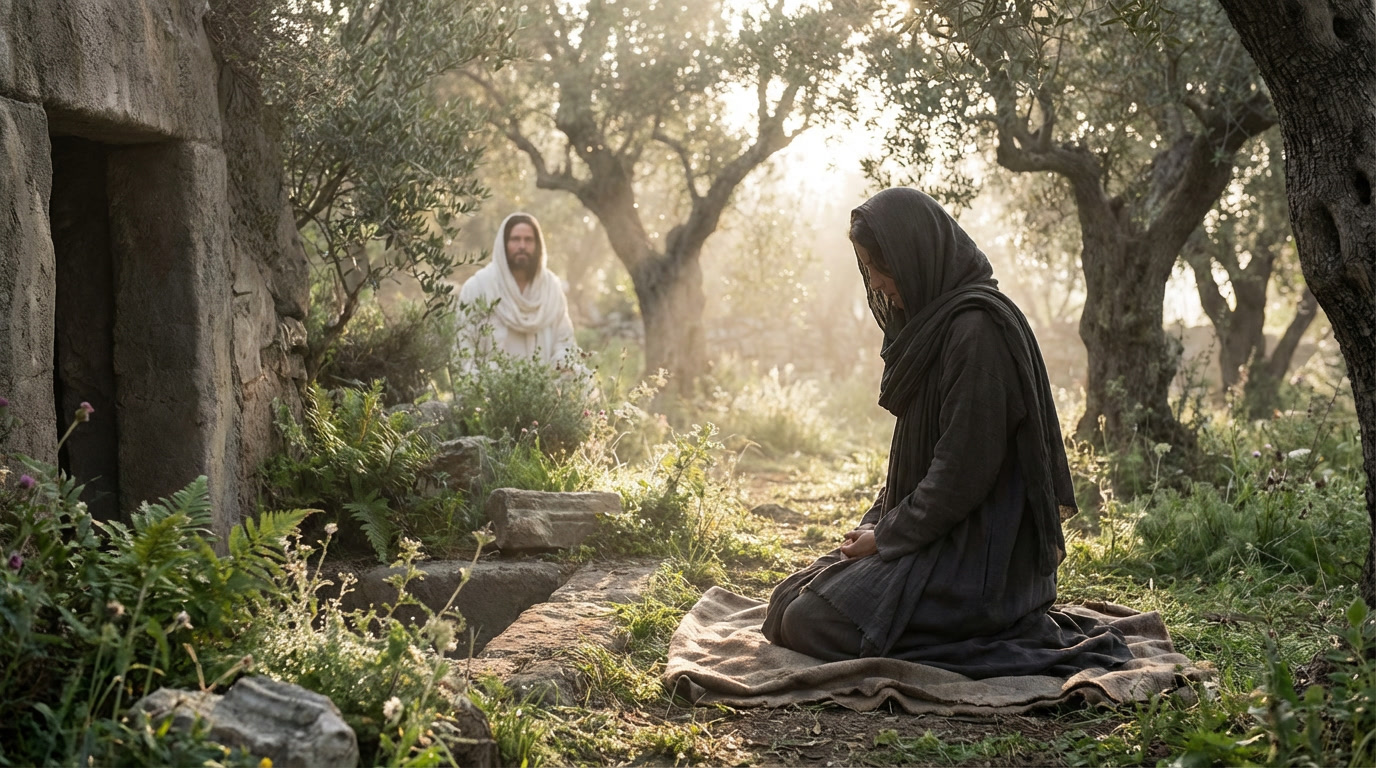
Mary Magdalene stayed outside the tomb weeping. And as she wept, she bent over into the tomb and saw two angels in white sitting there, one at the head and one at the feet where the Body of Jesus had been. And they said to her, "Woman, why are you weeping?" She said to them, "They have taken my Lord, and I don't know where they laid him." When she had said this, she turned around and saw Jesus there, but did not know it was Jesus. Jesus said to her, "Woman, why are you weeping? Whom are you looking for?" She thought it was the gardener and said to him, "Sir, if you carried him away, tell me where you laid him, and I will take him." Jesus said to her, "Mary!" She turned and said to him in Hebrew, "Rabbouni," which means Teacher. Jesus said to her, "Stop holding on to me, for I have not yet ascended to the Father. But go to my brothers and tell them, 'I am going to my Father and your Father, to my God and your God.'" Mary went and announced to the disciples, "I have seen the Lord," and then reported what he had told her.
— John 20:11-18
In the dim light of Easter morning, Mary Magdalene's Gospel encounter reveals the tender way Christ meets us in our deepest sorrow. Her tears at the empty tomb become the setting for recognition, transformation, and mission. This passage from John 20:11-18 offers profound insights into how the risen Lord calls each soul by name and sends us forth as witnesses.
The Sacred Nature of Grief and Seeking
Mary's weeping outside the tomb speaks to the human heart's need to lament what appears lost. Even angels cannot console her grief. She seeks the body of her beloved Teacher, not yet understanding that death has been conquered.
Saint John Chrysostom observed that Mary's persistence in seeking, even through tears, prepared her heart for the greatest revelation. Her sorrow was not faithlessness but love expressing itself through loss. The empty tomb becomes a classroom where grief learns to recognize resurrection.
Scripture often shows how God honors our searching, even when confusion clouds our vision. Mary's question "Where have you laid him?" echoes every soul's cry when the presence of God seems absent from daily life.
Recognition: When Jesus Calls Your Name
The turning point arrives with a single word: "Mary!" Not "woman" as the angels addressed her, but her own name spoken with infinite tenderness. Recognition floods her heart. The Risen Christ does not reveal Himself through explanations but through the intimacy of personal calling.
This moment reflects Jesus's words in John 10:3: "He calls his own sheep by name." The Good Shepherd's voice penetrates confusion and transforms sorrow into wonder. Mary's response—"Rabbouni"—acknowledges both Teacher and Lord.
Saint Teresa of Avila wrote that in prayer, we learn to recognize Christ's voice calling our name above the noise of worldly concerns. Like Mary, we turn from seeking what we think we need to receiving what Christ offers: His living presence.
The Challenge of Letting Go
"Stop holding on to me." These words from the Gospel of John reveal a profound spiritual principle. Mary's instinct to grasp the familiar form of Jesus reflects our own tendency to limit Christ to our expectations and past experiences.
The risen Lord cannot be contained or possessed. He invites relationship, not ownership. This letting go prepares Mary for a greater intimacy—not physical presence but spiritual communion with the ascended Christ who dwells with the Father.
Through Surrender Prayer, we learn this same spiritual detachment. We release our grip on how we think God should work and open ourselves to His actual presence and plan.
From Grief to Mission
Jesus transforms Mary from mourner to messenger. "Go to my brothers," He commands. The first witness to the resurrection becomes the first evangelist, carrying news of the Lord's victory to the fearful disciples.
The message she carries—"I am going to my Father and your Father, to my God and your God"—reveals the new relationship established through Christ's death and resurrection. The barrier between divine and human, Creator and creation, has been bridged.
Saint Mary Magdalene's feast day (July 22) celebrates her as "Apostle to the Apostles." Her encounter at the tomb shows that Christ chooses the least expected messengers to carry His greatest truths. Grief qualified her for joy. Loss prepared her for mission.
Pray With This Reading
This Gospel passage invites us into contemplative prayer where Christ speaks our name with love. Consider praying with this text through Ignatian Contemplation, placing yourself in the garden scene. Listen for the moment when Jesus calls your name. Feel the shift from seeking to recognition, from holding on to letting go, from receiving to sharing.
Frequently Asked Questions
Why didn't Mary recognize Jesus immediately?
The Gospel suggests Mary's grief clouded her recognition, and the risen Christ's appearance was somehow different. Spiritually, this teaches that our expectations can prevent us from seeing God's actual presence in our lives. Recognition comes not through sight alone but through the heart responding to Christ's voice.
What does "stop holding on to me" mean in this passage?
Jesus teaches Mary that the resurrection establishes a new kind of relationship—not based on physical presence but on spiritual communion. This phrase challenges us to move from possessive love to trusting love, from grasping to receiving, from past experience to present reality.
How can we hear Jesus calling our name like Mary did?
Through prayer, Scripture meditation, and attention to God's movement in daily life, we develop the spiritual sensitivity to recognize Christ's voice. Like Mary, we must persist in seeking even through confusion and be willing to turn when our name is called.