
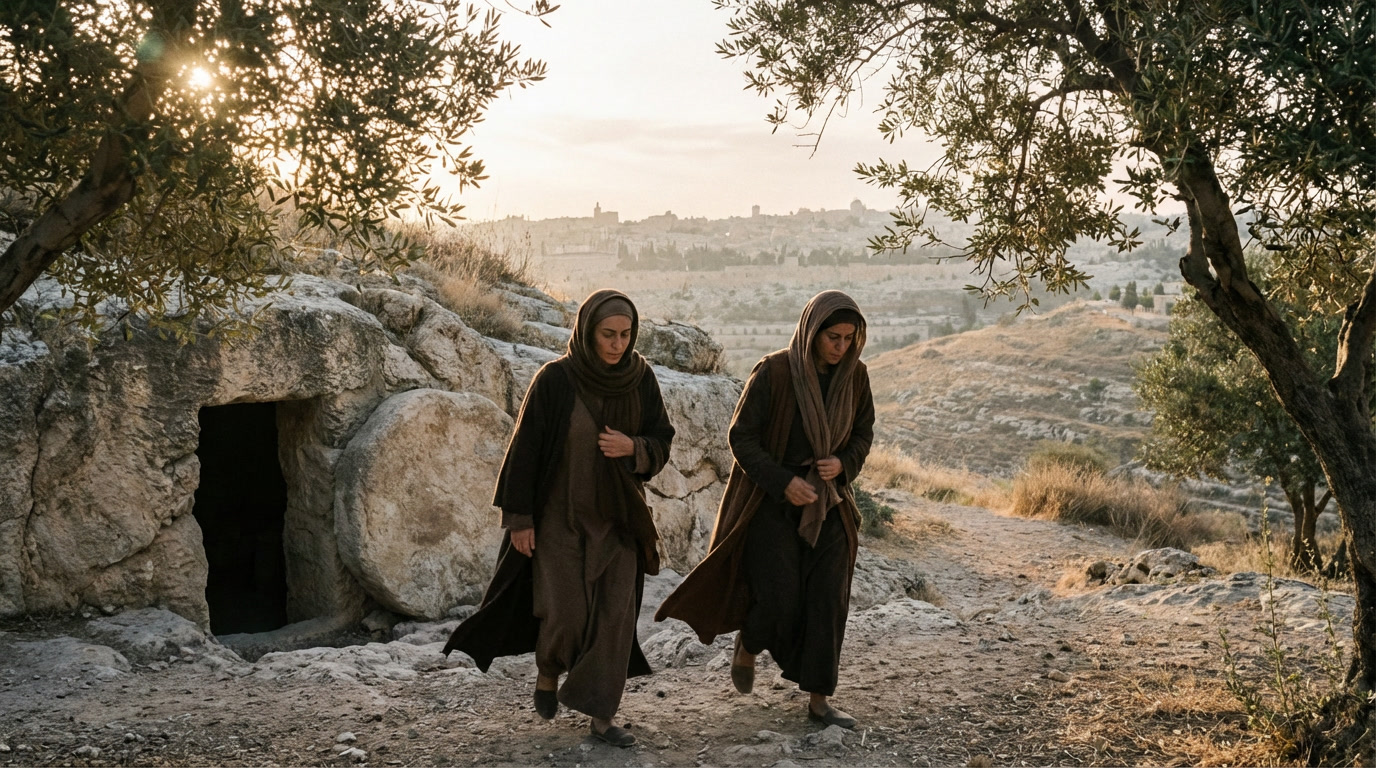
Mary Magdalene and the other Mary went away quickly from the tomb, fearful yet overjoyed, and ran to announce the news to his disciples. And behold, Jesus met them on their way and greeted them. They approached, embraced his feet, and did him homage. Then Jesus said to them, "Do not be afraid. Go tell my brothers to go to Galilee, and there they will see me." — Matthew 28:8-15
The women who encountered the risen Christ carried within themselves a profound contradiction: fear and joy dwelling side by side. This Easter Monday Gospel reading from Matthew 28:8-15 captures the raw human response to divine mystery. Their quick steps away from the empty tomb mirror our own tentative movements toward hope after loss.
The Paradox of Easter Emotions
Scripture does not shy away from the complexity of resurrection faith. The women experienced "fearful yet overjoyed" hearts—a tension that marks authentic spiritual encounters. Fear acknowledges the magnitude of what has occurred. Joy recognizes the gift.
Saint John Chrysostom observed that this fear was not terror but reverence before the incomprehensible. The empty tomb had shattered their understanding of death's finality. Yet joy bubbled up from depths they could not name. This emotional paradox becomes the birthplace of evangelization.
The women ran to tell others not because they had resolved their confusion, but because love compelled them forward despite uncertainty. Their witness emerged from encounter, not explanation.
Christ's Gentle Presence on the Path
Jesus met them "on their way." He did not wait for them to arrive at perfect understanding or complete courage. The risen Lord comes to disciples in motion, even when that movement is marked by bewilderment.
His first words—"Do not be afraid"—echo through every resurrection appearance. This phrase appears more than any other in Scripture's divine encounters. Fear dissolves not through human effort but through Christ's reassuring presence.
The women's response was immediate and physical: they embraced his feet and worshiped him. Touch confirmed what their hearts dared to hope. In this gesture, we find permission to bring our whole selves—doubt, wonder, confusion, and love—to the risen Christ.
Truth Confronts Deception
While the women carried authentic witness, religious authorities constructed lies. The chief priests and elders chose deliberate falsehood over uncomfortable truth. Their careful conspiracy—complete with bribed guards and prepared explanations—reveals the lengths to which spiritual blindness will go.
This contrast illuminates two responses to resurrection: honest bewilderment that leads to faith, or calculated rejection that hardens into deception. The women's fearful joy proves more truthful than the authorities' confident lies.
Matthew notes that "this story has circulated among the Jews to the present day." False narratives persist, but they cannot diminish the power of authentic witness. The women's testimony, carried through generations of believers, outlasts every attempt at suppression.
From Witness to Mission
Christ transforms the women from recipients of news to bearers of it. "Go tell my brothers," he commands, elevating them to apostolic messengers. The risen Lord entrusts the most important announcement in human history to those who moments before wrestled with fear and wonder.
Their mission was specific: direct the disciples to Galilee. Not to Jerusalem's temple or palace, but to the ordinary region where Jesus had first called them. Resurrection life begins again in familiar places, among known faces, through simple obedience to Christ's direction.
Ignatian contemplation invites us into the women's experience, allowing imagination to grasp what logic cannot fully contain.
Pray With This Reading
The emotional complexity of this passage makes it particularly suited for lectio divina. Allow the words "fearful yet overjoyed" to rest in your heart. Notice how these emotions might coexist in your own spiritual journey.
Spend time with Christ's gentle greeting to the women. Let his words "Do not be afraid" address whatever fears accompany your own encounters with the divine. Like the women, trust that confusion need not delay obedience when Christ calls you forward.
Frequently Asked Questions
Why were the women both afraid and joyful?
The women experienced fear because they encountered divine mystery beyond human comprehension. Joy arose from recognizing that death had been defeated. This emotional paradox marks authentic spiritual experiences where human limitations meet divine power.
What does Jesus mean by telling them to go to Galilee?
Galilee represents the place of first calling and ordinary life. Jesus directs his followers back to familiar territory, showing that resurrection faith is lived out in everyday circumstances, not just mountaintop moments.
Why did the religious authorities create a false story?
The chief priests chose deception because accepting the resurrection would require acknowledging their error in condemning Jesus. Pride and institutional power often resist truth that threatens established authority, preferring comfortable lies to uncomfortable transformation.