
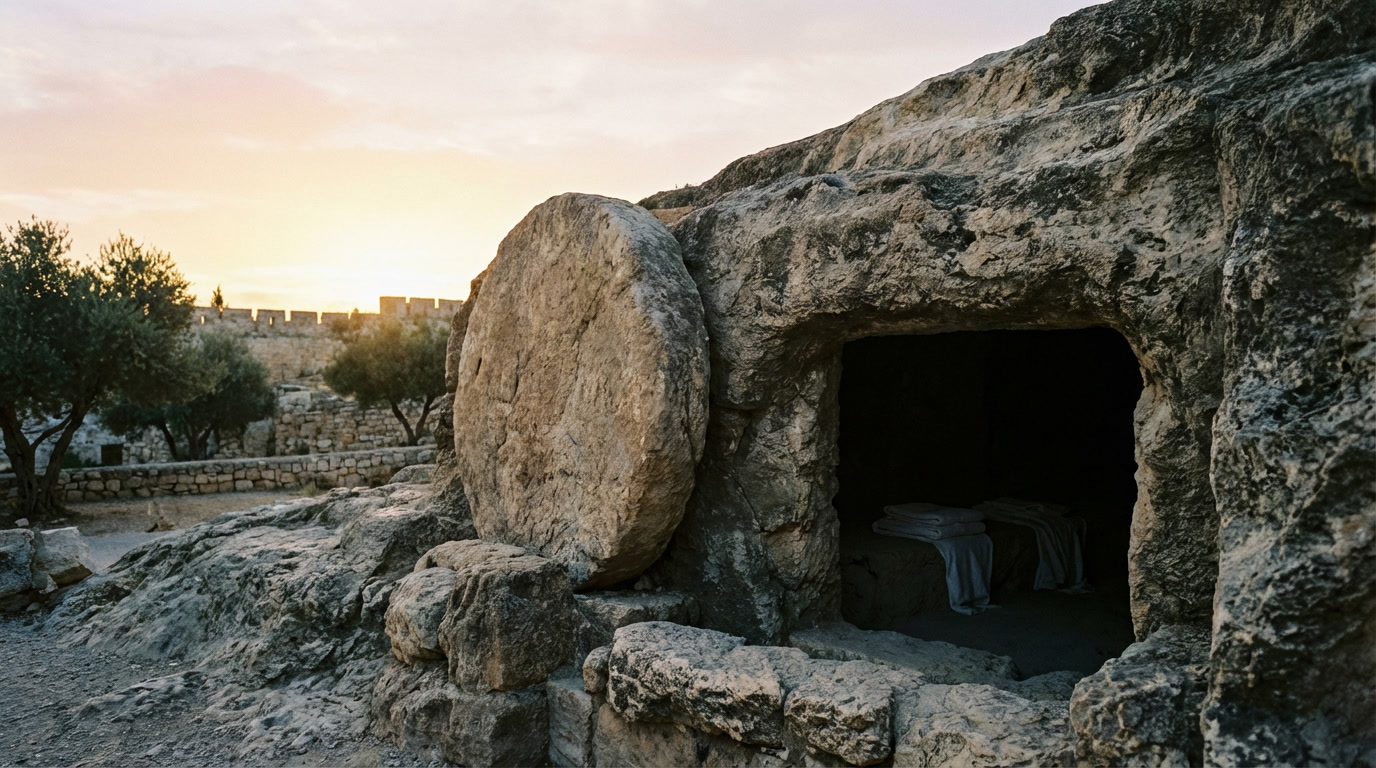
On the first day of the week, Mary of Magdala came to the tomb early in the morning, while it was still dark, and saw the stone removed from the tomb. So she ran and went to Simon Peter and to the other disciple whom Jesus loved, and told them, "They have taken the Lord from the tomb, and we don't know where they put him." So Peter and the other disciple went out and came to the tomb. They both ran, but the other disciple ran faster than Peter and arrived at the tomb first; he bent down and saw the burial cloths there, but did not go in. When Simon Peter arrived after him, he went into the tomb and saw the burial cloths there, and the cloth that had covered his head, not with the burial cloths but rolled up in a separate place. Then the other disciple also went in, the one who had arrived at the tomb first, and he saw and believed. For they did not yet understand the Scripture that he had to rise from the dead.— John 20:1-9
The Easter Gospel begins in darkness. Mary Magdalene walks through the pre-dawn shadows, carrying spices and sorrow. Her discovery of the empty tomb sparks a chain reaction that changes everything. The stone has been rolled away. Death itself has been overturned.
Mary Magdalene's Morning Discovery
Mary comes while it is still dark—a detail John includes with intention. The darkness represents more than the hour. It mirrors the confusion and grief that has settled over the disciples since Friday's crucifixion. Yet Mary persists in her love, arriving early to tend to Jesus' body.
Her immediate response reveals both panic and devotion. She runs to tell Peter and John, assuming grave robbers have stolen the body. Mary cannot yet imagine resurrection. Like the disciples, she does not yet understand the Scripture that Christ must rise from the dead.
Saint Augustine reminds us that Mary's love, though clouded by misunderstanding, draws her closer to the truth. Her faithfulness in grief becomes the doorway to joy.
The Race Between Peter and John
Two disciples run toward the tomb, but their approaches differ. John arrives first but hesitates at the entrance. Peter characteristically rushes in immediately. Both see the same evidence: burial cloths lying undisturbed, the head cloth folded separately.
These details matter. Grave robbers would not have unwrapped the body carefully. The orderly arrangement suggests something unprecedented. The cloth that covered Christ's head lies "rolled up in a separate place"—a sign of deliberate action, not hurried theft.
John enters after Peter and "saw and believed." The Greek word for "saw" here is different from Peter's seeing. John perceives the significance of what lies before them. Faith dawns in the empty tomb.
When Faith Meets the Unexpected
The disciples did not expect resurrection. Their faith had to stretch to accommodate God's surprising action. The empty tomb challenges their assumptions about death, defeat, and divine power.
This Easter morning teaches us that faith often begins with confusion. The disciples' initial bewilderment mirrors our own struggles to recognize God's work in circumstances that seem impossible. Resurrection rarely looks like what we expect.
Saint John Chrysostom notes that the disciples' gradual understanding reflects the human journey toward faith. God meets us in our confusion and slowly reveals the truth our hearts long to grasp.
Pray With This Reading
The Easter Gospel invites contemplative prayer that places us in the scene. Consider approaching this passage through Ignatian Contemplation, imagining yourself walking with Mary in the pre-dawn darkness or running alongside Peter and John.
Picture the empty tomb. Notice the burial cloths. Feel the mixture of confusion and growing hope. Allow yourself to experience the gradual movement from darkness to light, from fear to faith.
What does the empty tomb symbolize for Christians?
The empty tomb symbolizes Christ's victory over death and the promise of eternal life. It represents God's power to transform what seems final into new beginning. For believers, it offers hope that death is not the end of the story.
Why did John believe when he saw the empty tomb?
John's belief came from recognizing the signs of resurrection in the orderly arrangement of the burial cloths. His faith was not based on seeing Jesus alive but on understanding that only divine power could explain what he witnessed in the tomb.
How can we find faith in confusing circumstances?
Like the disciples, we can begin by staying close to Jesus even when events make no sense. Faith often grows through our willingness to run toward mystery rather than away from it. Prayer and Scripture help us recognize God's presence in unexpected places.