
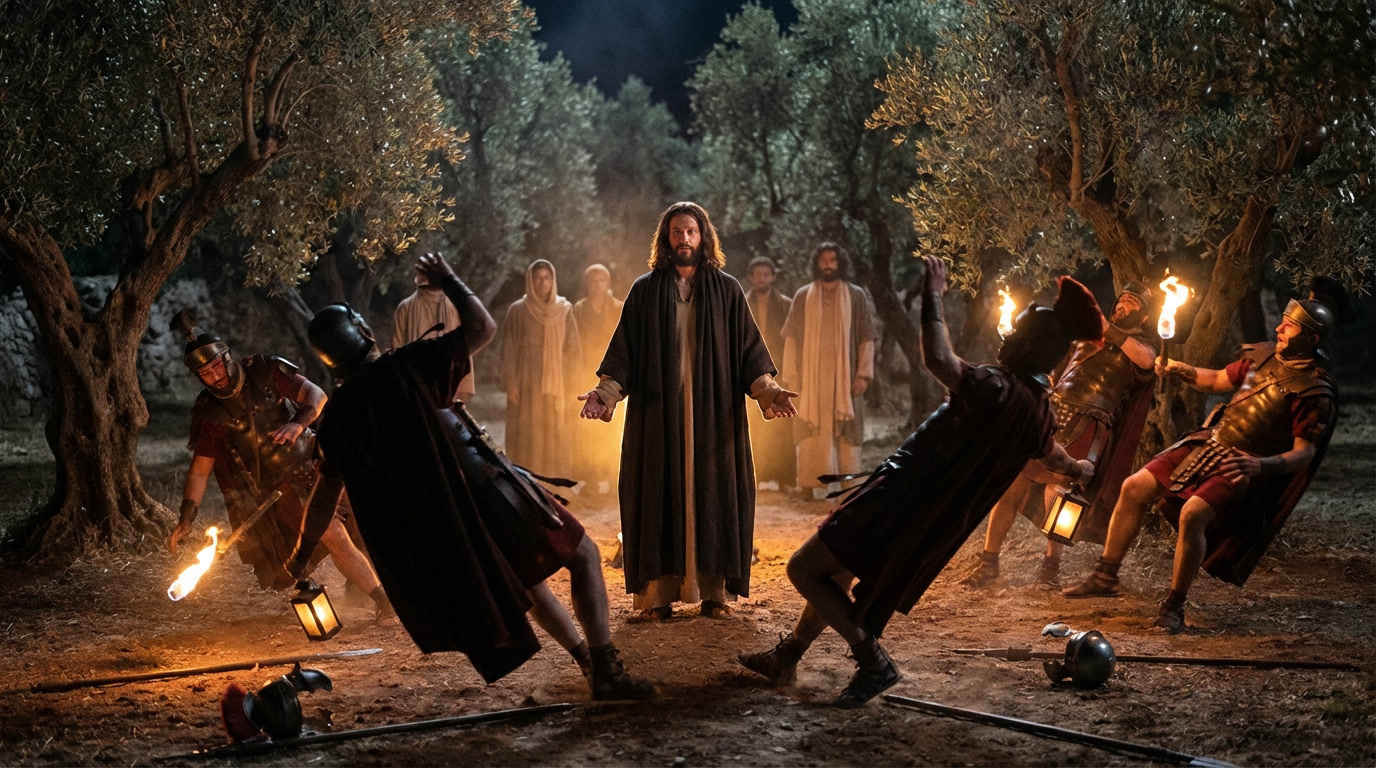
"Jesus, knowing everything that was going to happen to him, went out and said to them, 'Whom are you looking for?' They answered him, 'Jesus the Nazorean.' He said to them, 'I AM.'" — John 18:4-5
The Passion according to John reveals Christ's divine authority even in His darkest hour. When soldiers come to arrest Him in the garden, Jesus speaks the sacred name of God: "I AM." This moment transforms our understanding of the Good Friday Gospel reading, showing us a Savior who chooses suffering rather than succumbs to it.
The Sacred Name That Fells Soldiers
"I AM" — ego eimi in Greek — echoes the divine name revealed to Moses at the burning bush. When Christ speaks these words, armed soldiers fall backward to the ground. This is no accident of narrative. John shows us that even in apparent defeat, Jesus remains sovereign.
The guards seek "Jesus the Nazorean," a man from a forgotten town. They find instead the eternal Word made flesh. His divine nature blazes through human vulnerability, reminding us that the cross reveals God's power, not His powerlessness.
Drinking the Cup the Father Gave
Peter draws his sword to defend his Master, cutting off the ear of Malchus. Christ's response cuts deeper than any blade: "Shall I not drink the cup that the Father gave me?" Here lies the heart of redemption — willing acceptance of suffering for love.
This cup imagery runs throughout Scripture, from the Psalms to the Garden of Gethsemane. Christ drinks what Adam refused: complete surrender to the Father's will. Where the first man grasped at divinity, the Son of God empties Himself unto death.
The High Priest's Unconscious Prophecy
Caiaphas had declared it better for one man to die than for the whole people to perish. Unknowing, he spoke the deepest truth of salvation. Christ's death becomes the source of life for all nations.
This irony threads through John's Passion narrative. Those who think they control events serve God's eternal plan. Pilate believes he holds power over life and death, yet stands before Life Himself. Human authority crumbles before divine love.
Standing Beneath the Cross
The Passion reaches its climax at Calvary, where Mary and John stand beneath the cross. Here Christ speaks His final words, entrusting His mother to the beloved disciple. Even in agony, He provides for those He loves.
The soldiers cast lots for His garments, fulfilling Psalm 22. They pierce His side, and blood and water flow forth — symbols of the sacraments that will nourish the Church. Death becomes the doorway to eternal life.
Pray With This Reading
The Passion invites us into profound contemplation of God's love revealed in suffering. Consider praying with this Gospel through Ignatian Contemplation, placing yourself in the garden with Christ. Imagine hearing Him speak "I AM" with divine authority. Feel the weight of His willing acceptance of the cup.
Alternatively, St. John of the Cross's method can help us embrace the darkness of Good Friday as a pathway to resurrection light. The saint knew that God often works most powerfully in apparent absence.
Frequently Asked Questions
Why does Jesus say "I AM" in the Passion narrative?
"I AM" (ego eimi) is the divine name God revealed to Moses. By using this name, Jesus reveals His divine identity even as He submits to arrest. It demonstrates that His suffering is chosen, not forced upon Him.
What does "drinking the cup" mean in John's Gospel?
The cup represents God's will, particularly the call to suffer for others' salvation. Christ drinks this cup willingly, contrasting with Adam's disobedience. It symbolizes complete surrender to the Father's redemptive plan.
How should Catholics pray with the Passion narrative?
Catholics can use various prayer methods with the Passion, including Ignatian contemplation to place themselves in the scene, or lectio divina to slowly meditate on Christ's words. The goal is to encounter Christ's love revealed through His willing sacrifice.