
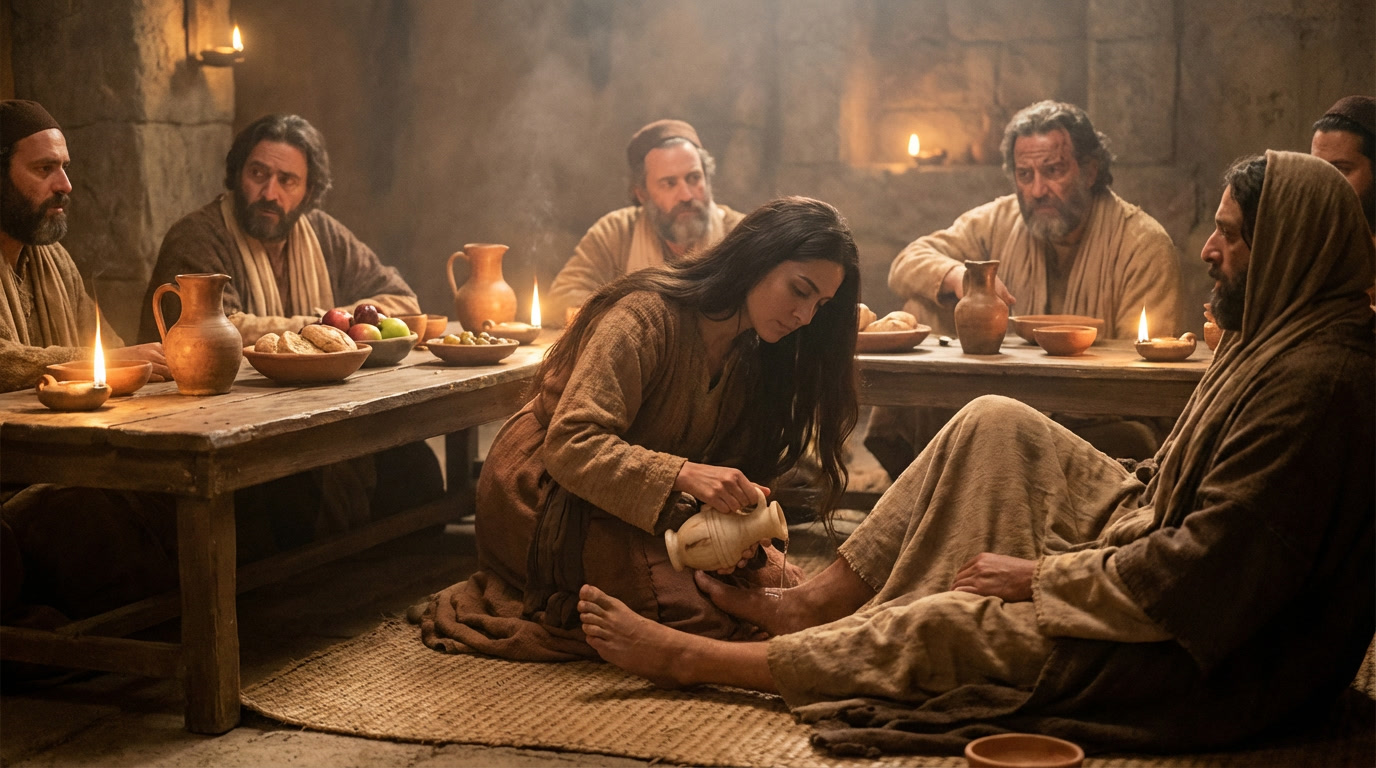
Six days before Passover Jesus came to Bethany, where Lazarus was, whom Jesus had raised from the dead. They gave a dinner for him there, and Martha served, while Lazarus was one of those reclining at table with him. Mary took a liter of costly perfumed oil made from genuine aromatic nard and anointed the feet of Jesus and dried them with her hair; the house was filled with the fragrance of the oil. Then Judas the Iscariot, one of his disciples, and the one who would betray him, said, "Why was this oil not sold for three hundred days' wages and given to the poor?" He said this not because he cared about the poor but because he was a thief and held the money bag and used to steal the contributions. So Jesus said, "Leave her alone. Let her keep this for the day of my burial. You always have the poor with you, but you do not always have me." — John 12:1-8
As Holy Week begins, the Gospel of John presents this intimate scene in Bethany where love meets its approaching crucible. Mary's extravagant anointing of Jesus reveals the heart of discipleship: recognizing the sacred moment and responding with complete generosity.
The Fragrance of Sacrificial Love
Mary's pound of nard cost three hundred denarii—nearly a year's wages for a laborer. This was not impulse but intentional sacrifice. The aromatic oil, imported from distant mountains, represented her life's savings poured out at the feet of Christ.
The fragrance filled the entire house. Scripture records this detail because love's sacrifice cannot remain hidden. When the heart recognizes Jesus truly present, authentic devotion naturally overflows, touching everyone nearby.
Saint John Chrysostom observed that Mary understood what the apostles had not yet grasped: Jesus was preparing for death. Her anointing was both worship and burial preparation, an act of profound spiritual intuition.
Martha, Mary, and Lazarus: A Portrait of Response
Each member of this Bethany household demonstrates a different way of receiving Christ. Martha serves, expressing her love through practical hospitality. Lazarus reclines at table, the living proof of Jesus' power over death. Mary anoints, offering her most precious possession.
All three responses flow from gratitude. Lazarus owed Jesus his very life. Martha and Mary had witnessed their brother's resurrection. Their household had become a sanctuary of thanksgiving.
The same diversity marks the Church today. Some serve, some witness, some offer costly devotion. Each expression of love finds its place in Christ's body.
Judas and the Question of Priorities
Judas voices what seems reasonable: sell the oil, feed the poor. His words echo the calculations that often silence generous hearts. Why this extravagance when suffering surrounds us?
Jesus' response cuts through surface logic. "You always have the poor with you, but you do not always have me." He speaks not against caring for the poor—a central Gospel command—but against using good causes to diminish authentic worship.
The Evangelist reveals Judas' true motive: theft. His apparent concern for the poor masks personal greed. Sin often disguises itself in moral language, making vice appear virtuous.
Preparing for Burial
"Let her keep this for the day of my burial," Jesus declares. Mary's anointing foreshadows the spices that will be brought to the tomb—though by then, the body will be gone.
This moment bridges Jesus' public ministry and his passion. Six days remain before his death. The chief priests plot to kill both Jesus and Lazarus, evidence that threatens their authority.
Yet in this dinner scene, death holds no terror. Love has already conquered through Lazarus' resurrection. Mary's anointing becomes a celebration of life eternal, not mourning for death approaching.
Pray With This Reading
This Gospel passage invites deep contemplation of our own response to Christ's presence. Consider engaging with Ignatian Contemplation to place yourself in the Bethany house, witnessing Mary's act of love and Jesus' gentle defense of her devotion.
Allow the scene to unfold in your imagination. Feel the tension between Judas' criticism and Mary's vulnerability. Smell the fragrant nard. Hear Jesus' voice protecting extravagant love.
What does Mary's anointing of Jesus teach us about worship?
Mary's anointing reveals that authentic worship flows from the heart's recognition of Jesus' true identity and imminent sacrifice. Her costly gift demonstrates that genuine love holds nothing back when encountering the sacred. The fragrance that filled the house suggests that sincere devotion naturally overflows, touching others nearby.
Why did Jesus defend Mary against Judas' criticism?
Jesus defended Mary because she acted from pure love and spiritual insight, understanding his approaching death while others remained unaware. Her anointing was both worship and burial preparation. Jesus protected her from those who would diminish authentic devotion by imposing seemingly reasonable but ultimately false priorities.
What does this Gospel passage reveal about recognizing Jesus' presence?
The passage shows that recognizing Jesus' presence transforms how we respond to him. Mary perceived the sacred moment and acted accordingly. Martha served with love. Lazarus bore witness to resurrection power. Each response flowed from grateful hearts that had experienced Christ's transforming presence in their home and lives.