
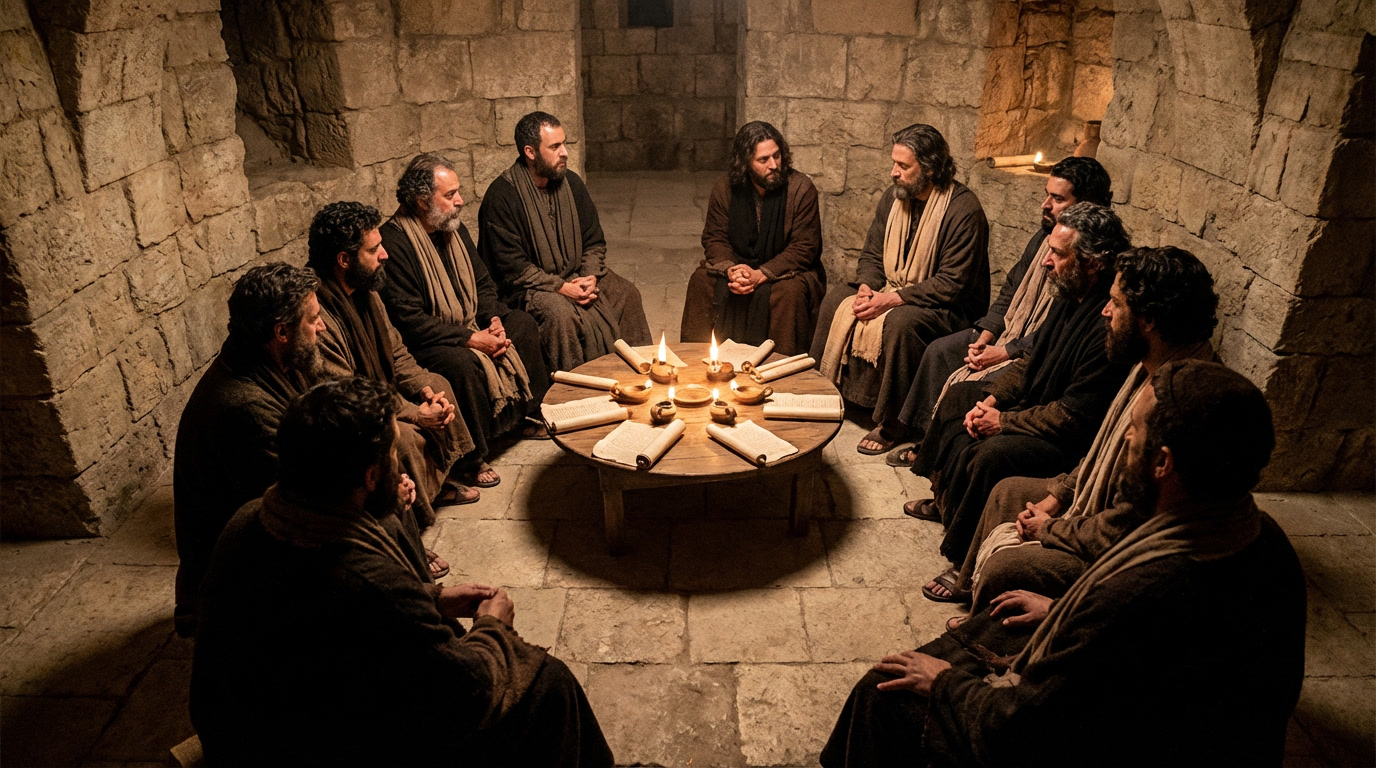
Many of the Jews who had come to Mary and seen what Jesus had done began to believe in him. But some of them went to the Pharisees and told them what Jesus had done. So the chief priests and the Pharisees convened the Sanhedrin and said, "What are we going to do? This man is performing many signs. If we leave him alone, all will believe in him, and the Romans will come and take away both our land and our nation." But one of them, Caiaphas, who was high priest that year, said to them, "You know nothing, nor do you consider that it is better for you that one man should die instead of the people, so that the whole nation may not perish." He did not say this on his own, but since he was high priest for that year, he prophesied that Jesus was going to die for the nation, and not only for the nation, but also to gather into one the dispersed children of God. So from that day on they planned to kill him.— John 11:45-56
The raising of Lazarus has divided Jerusalem. Some who witnessed Christ's power embrace belief. Others retreat into fear, rushing to the authorities with news that threatens their carefully constructed world. In John 11:45-56, we encounter one of Scripture's most profound ironies: a man speaking divine truth while plotting divine murder.
Two Responses to Miracle
The crowd splits cleanly. Those who came to comfort Mary see Jesus call forth life from death and believe. Others witness the same miracle yet run to the Pharisees. The same divine action produces faith in some hearts, fear in others.
This division echoes throughout salvation history. Moses' signs convinced some Israelites while hardening Pharaoh's heart. Christ's miracles drew disciples yet enraged religious leaders. Grace meets human freedom, and freedom chooses.
Saint John Chrysostom observed that miracles alone do not create faith. The heart must be prepared to receive what the eyes witness. Those who believed came seeking comfort for Mary's grief. They arrived with hearts already opened by love.
The Politics of Fear
The Sanhedrin's concern reveals the toxic marriage of religious authority and political calculation. They fear Roman intervention if Jesus gains too large a following. Their spiritual leadership has become indistinguishable from civic management.
"What are we going to do?" they ask. The question betrays their position. They see themselves as problem-solvers, not truth-seekers. Jesus becomes a threat to stability rather than the fulfillment of prophecy.
When religious leaders prioritize institutional preservation over divine revelation, they cease to lead souls toward God. They become managers of a diminishing kingdom rather than servants of an eternal one.
Caiaphas's Unwitting Prophecy
High priest for that decisive year, Caiaphas speaks beyond his understanding. "It is better for you that one man should die instead of the people." He calculates political expedience. God reveals redemptive necessity.
John's Gospel makes explicit what Caiaphas could not foresee: Christ would die not just for Israel but "to gather into one the dispersed children of God." The high priest's narrow nationalism becomes the Father's universal embrace.
This passage demonstrates how God's sovereignty works through human agency, even twisted human agency. Evil intentions serve divine purposes. The cross that Caiaphas helps orchestrate becomes the altar of salvation.
Pope Benedict XVI noted that God's providence does not eliminate human responsibility but transforms human choices into occasions for grace. Caiaphas remains culpable for his murderous intent while unknowingly serving eternal mercy.
Jesus Withdraws to Ephraim
Knowing the plot against his life, Jesus leaves Jerusalem for the wilderness town of Ephraim. His withdrawal is not escape but preparation. The Passover approaches—his Passover.
This strategic retreat mirrors his forty days in the desert and his nights of solitary prayer. Before great acts of love, Christ seeks silence. Before the ultimate gift of self, he communes with the Father.
The disciples who accompany him witness this rhythm of engagement and withdrawal, action and contemplation. They learn that effective ministry flows from deep prayer, not constant activity.
Pray With This Reading
This passage invites us into Lectio Divina, allowing Caiaphas's unwitting prophecy to speak across centuries. Read slowly. Notice how divine providence works through human choices, even destructive ones.
Consider moments when fear has driven your own decisions. Ask Christ to transform your anxieties into trust, your calculations into surrender.
Rest in the truth that God's love cannot be thwarted by human schemes. What enemies mean for harm, the Father uses for salvation.
Frequently Asked Questions
What did Caiaphas mean by his prophecy in John 11?
Caiaphas intended a political calculation—better that Jesus die than the nation face Roman destruction. Unknowingly, he prophesied Christ's sacrificial death for all humanity's salvation.
Why did Jesus withdraw to Ephraim after the Sanhedrin's plot?
Jesus withdrew not from fear but to prepare for his passion in prayer and solitude. He would die at the appointed time—Passover—not at his enemies' chosen moment.
How does John 11:45-56 connect to Christ's passion?
This passage marks the formal decision to kill Jesus, setting the passion narrative in motion. It reveals how human plotting serves divine redemptive purposes.