
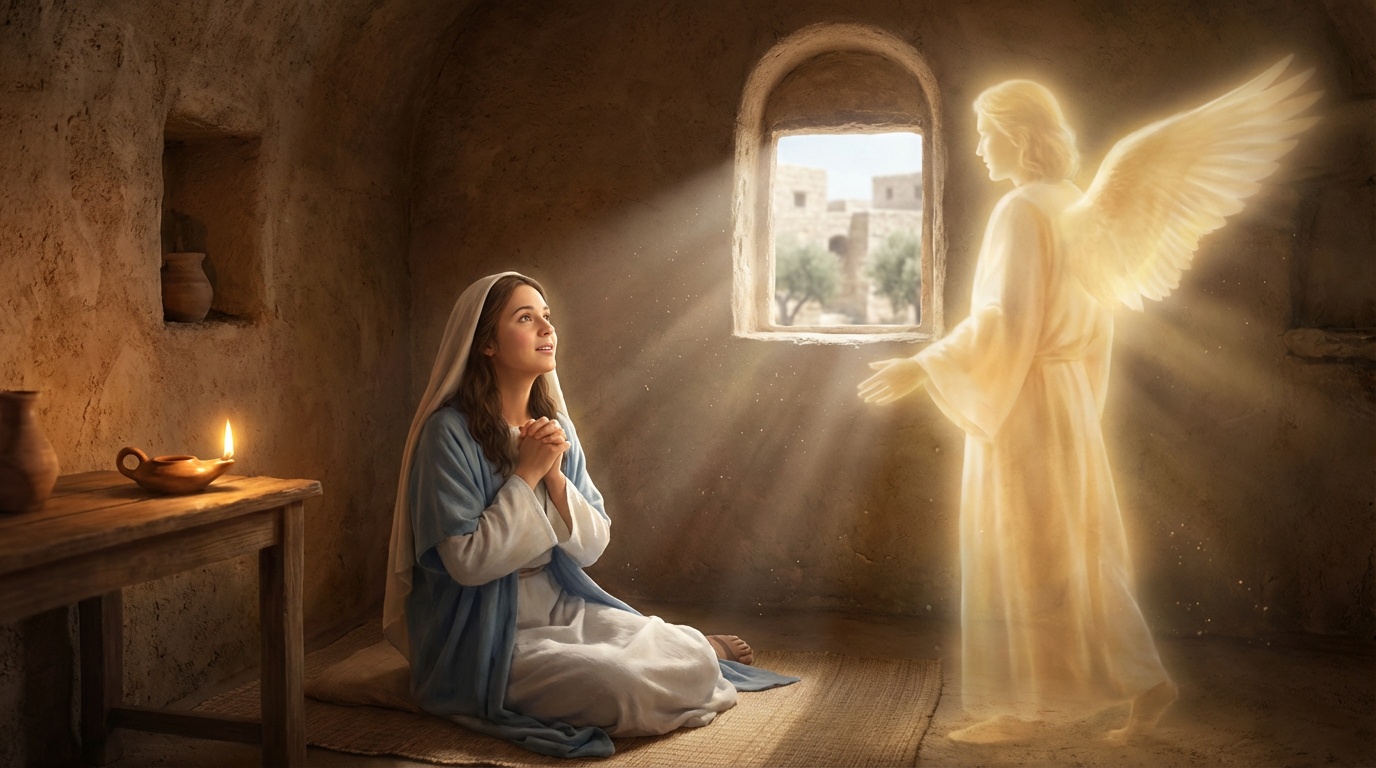
The angel Gabriel was sent from God to a town of Galilee called Nazareth, to a virgin betrothed to a man named Joseph, of the house of David, and the virgin's name was Mary. And coming to her, he said, "Hail, full of grace! The Lord is with you." But she was greatly troubled at what was said and pondered what sort of greeting this might be. Then the angel said to her, "Do not be afraid, Mary, for you have found favor with God. Behold, you will conceive in your womb and bear a son, and you shall name him Jesus. He will be great and will be called Son of the Most High, and the Lord God will give him the throne of David his father, and he will rule over the house of Jacob forever, and of his Kingdom there will be no end." But Mary said to the angel, "How can this be, since I have no relations with a man?" And the angel said to her in reply, "The Holy Spirit will come upon you, and the power of the Most High will overshadow you. Therefore the child to be born will be called holy, the Son of God. And behold, Elizabeth, your relative, has also conceived a son in her old age, and this is the sixth month for her who was called barren; for nothing will be impossible for God." Mary said, "Behold, I am the handmaid of the Lord. May it be done to me according to your word." Then the angel departed from her.— Luke 1:26-38
The Annunciation stands as history's most pivotal conversation. In a humble dwelling in Nazareth, heaven breaks through earth's ordinary rhythm. Gabriel's greeting to Mary transforms not just her life, but the entire trajectory of human salvation.
The Mystery of Divine Greeting
"Hail, full of grace!" Gabriel's words carry weight beyond human language. The Greek term kecharitomene suggests Mary has been graced from the beginning, prepared for this moment before time itself. Her troubled pondering reveals not doubt, but the natural response of a soul encountering the infinite.
Mary's contemplative spirit mirrors what every believer faces when God speaks into ordinary life. The divine often arrives unannounced, disrupting our plans with invitations that seem impossible. Her initial confusion teaches us that wrestling with God's call is itself a form of prayer.
The Courage to Ask Questions
"How can this be?" Mary's question demonstrates that faith and inquiry walk hand in hand. She seeks understanding, not out of unbelief, but from a desire to cooperate fully with God's will. The saints teach us that authentic faith asks honest questions.
Gabriel's response reveals the Trinity at work: the Holy Spirit's overshadowing, the Most High's power, the Son's incarnation. This moment becomes the hinge upon which salvation history turns. God chooses to need human consent for the work of redemption.
Elizabeth's Sign and God's Impossibilities
The angel offers Elizabeth's pregnancy as confirmation. God delights in working through the barren, the overlooked, the impossible circumstances. Elizabeth's late-life conception prepares Mary to believe that "nothing will be impossible for God."
This phrase echoes throughout Scripture, from Abraham and Sarah to the empty tomb. God specializes in transforming impossibility into divine possibility. Mary's story teaches us to recognize these signs of God's faithfulness in our own lives.
The Fiat That Changed Everything
"Behold, I am the handmaid of the Lord. May it be done to me according to your word." Mary's fiat reverses Eve's disobedience and opens the door for salvation. Her surrender prayer becomes the template for every Christian response to God's call.
The word "handmaid" suggests not passive submission but active service. Mary chooses to participate in God's plan with her whole being. Her yes echoes through every generation, showing us how to respond when heaven invites our cooperation.
Through surrender prayer, we learn to echo Mary's radical trust. Like her, we can offer our uncertainties and limitations as vessels for God's impossible work.
Pray With This Reading
The Annunciation invites us into contemplative prayer, where we can place ourselves in that Nazareth room with Mary. Ignatian Contemplation allows us to enter this scene imaginatively, witnessing Mary's courage and feeling our own hearts respond to Gabriel's message.
As we pray with this passage, we might ask: Where is God inviting our own "yes" today? What impossibilities is He asking us to trust Him with? Mary's example shows us that God's greatest works often begin with our willingness to say, "May it be done according to your word."
Frequently Asked Questions
What does "full of grace" mean in the Annunciation?
The Greek kecharitomene indicates Mary was graced by God from her conception, prepared for her unique role as Mother of God. This greeting acknowledges her Immaculate Conception and her complete openness to divine grace.
Why did Mary question the angel if she had faith?
Mary's question "How can this be?" shows practical wisdom, not doubt. She sought to understand how to cooperate with God's plan. Unlike Zechariah's skeptical questioning, Mary's inquiry came from faith seeking understanding.
How can we imitate Mary's response to God's call?
Mary teaches us to respond to God's invitations with contemplative pondering, honest questions, and ultimately radical trust. Her fiat shows us how to surrender our will to God's plan, even when we cannot see the full picture.