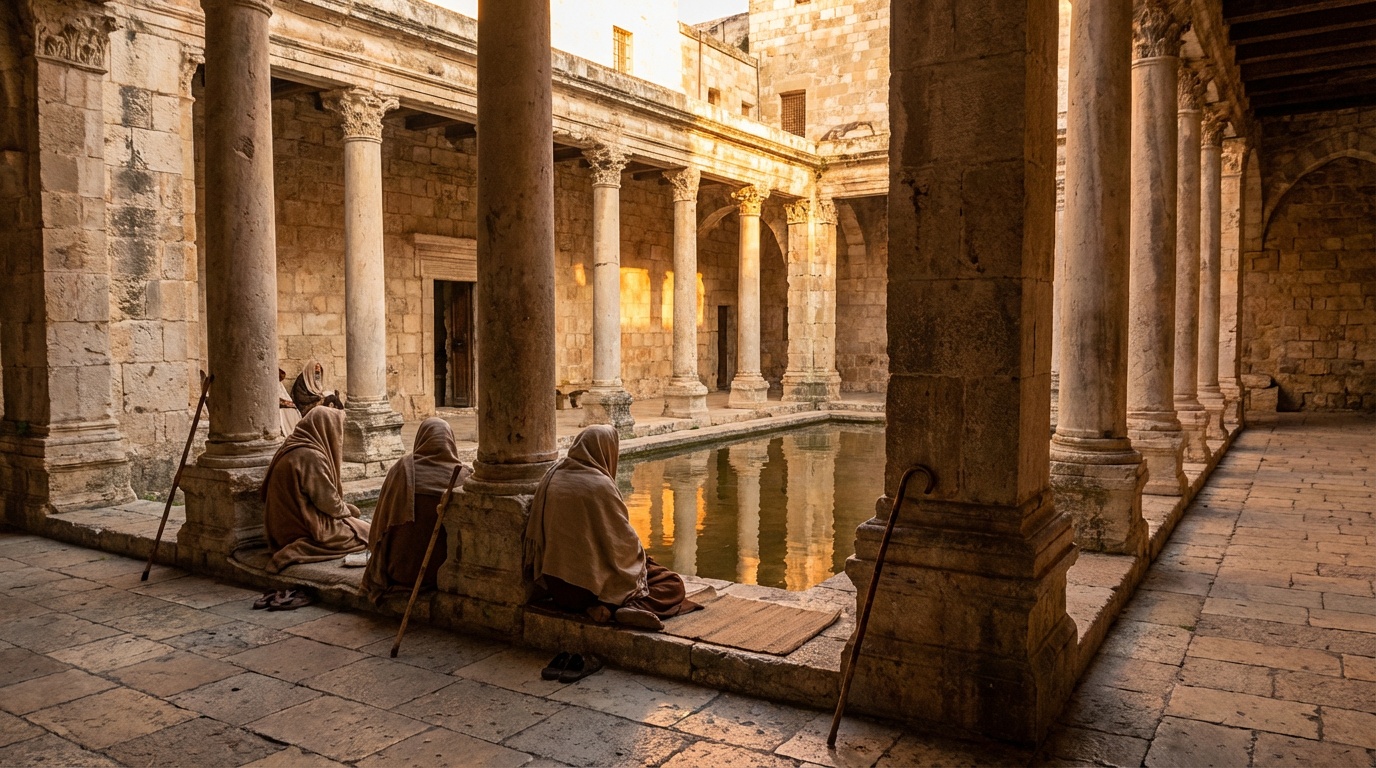
There was a feast of the Jews, and Jesus went up to Jerusalem. Now there is in Jerusalem at the Sheep Gate a pool called in Hebrew Bethesda, with five porticoes. In these lay a large number of ill, blind, lame, and crippled. One man was there who had been ill for thirty-eight years. When Jesus saw him lying there and knew that he had been ill for a long time, he said to him, "Do you want to be well?" The sick man answered him, "Sir, I have no one to put me into the pool when the water is stirred up; while I am on my way, someone else gets down there before me." Jesus said to him, "Rise, take up your mat, and walk." Immediately the man became well, took up his mat, and walked.
— John 5:1-16
The pool of Bethesda draws the broken. Five porticoes shelter those who wait for healing, for hope, for change that seems always just beyond reach. Among them lies a man whose illness has defined him for thirty-eight years—longer than many live entire lives.
Jesus sees him. Not merely glances, but truly sees. The Lord knows the weight of decades spent waiting, watching others step into possibility while paralysis holds firm. Yet Christ's first words pierce deeper than any physical diagnosis: "Do you want to be well?"
The Weight of Christ's Question
This question strikes at the heart of human resistance to grace. After thirty-eight years, the man's identity has crystallized around his condition. Healing would mean leaving behind not just illness, but the familiar landscape of limitation.
The man responds with reasons, not readiness. He explains the system, the competition, his disadvantages. Notice he never actually answers Christ's question. Sometimes the known suffering feels safer than the unknown freedom.
Saint Augustine understood this tension: "You have made us for yourself, O Lord, and our hearts are restless until they rest in you." Yet when Christ offers that rest, the soul often retreats to its comfortable restlessness.
Beyond Human Systems of Healing
The sick man believes healing comes through the pool's stirred waters—a system of scarcity where only the swift receive grace. He has structured his hope around human effort and timing.
Jesus bypasses the entire system. "Rise, take up your mat, and walk." No pool required. No competition for position. Divine power flows directly, immediately, completely.
This reveals how often spiritual life gets trapped in systems of earning rather than receiving. Surrender prayer teaches this fundamental shift from striving to receiving, from earning to accepting the gift already offered.
The Scandal of Sabbath Healing
The religious authorities focus on the mat being carried on the Sabbath. They miss the miracle for the technicality. Thirty-eight years of paralysis ends, yet they see only violation of religious custom.
This blindness reveals how spiritual pride obscures grace. The Pharisees know the law but miss the Lawgiver standing before them. They guard the letter while the Spirit moves freely among the broken.
Christ's healing on the Sabbath declares something profound: God's rest includes restoration. The Sabbath finds its fulfillment not in rigid observance but in the peace that comes when creation is made whole again.
The Temple Encounter and Warning
Later, Jesus finds the healed man in the temple. Physical healing has occurred, but spiritual work remains. "Do not sin any more, so that nothing worse may happen to you."
This is not threat but invitation. Christ offers not just healing but transformation. The body rises; now the soul must choose its direction. Freedom from physical limitation means nothing without freedom from spiritual bondage.
The man then identifies Jesus to the authorities. Whether from gratitude or pressure, his action sets persecution in motion. Sometimes stepping into healing requires courage we do not yet possess.
Pray With This Reading
This Gospel passage invites deep personal examination through Ignatian contemplation. Place yourself among the sick at Bethesda's porticoes. Feel the weight of long waiting. Hear Christ's question addressed personally: "Do you want to be well?"
Notice what resistances arise. What familiar limitations feel safer than unknown freedom? What systems of earning have replaced simple receiving? Allow Christ's direct command to speak into your own places of paralysis.
What does Jesus mean by asking "Do you want to be well?"
Christ's question probes deeper than physical healing. After decades of illness, the man's entire identity centers on his condition. True wellness would require not just restored mobility but complete life transformation—leaving behind familiar patterns of thinking, relating, and existing in the world.
Why did Jesus heal on the Sabbath?
Jesus heals on the Sabbath to reveal that God's rest includes restoration of creation. The Sabbath finds its true meaning not in rigid rule-keeping but in the peace that comes when broken things are made whole. Christ shows that mercy trumps mere law observance.
What can we learn from the man's response to Jesus?
The man responds with explanations rather than answering Christ's direct question. This reveals how often humans retreat to familiar complaints and systems rather than embracing the radical possibility of transformation that God offers. Sometimes known suffering feels safer than unknown freedom.