
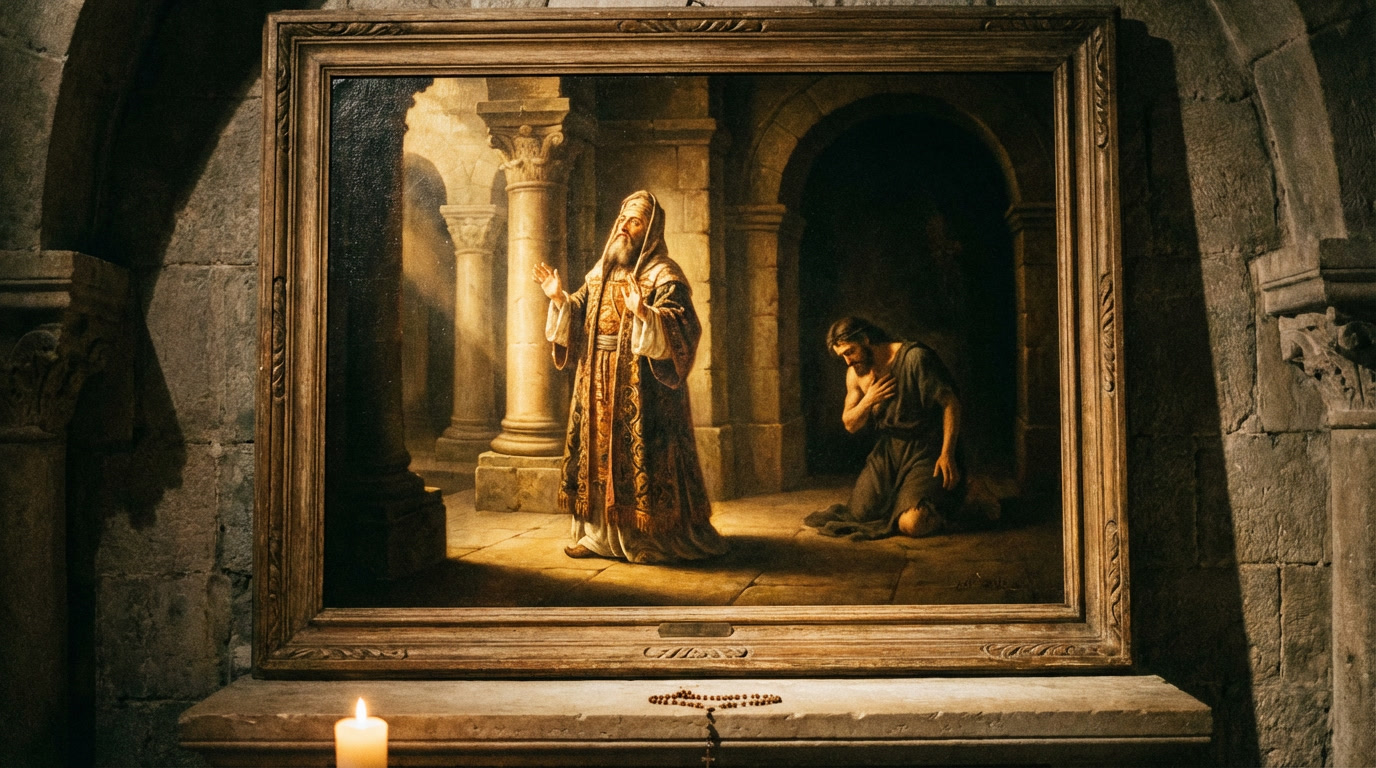
"Two people went up to the temple area to pray; one was a Pharisee and the other was a tax collector. The Pharisee took up his position and spoke this prayer to himself, 'O God, I thank you that I am not like the rest of humanity — greedy, dishonest, adulterous — or even like this tax collector. I fast twice a week, and I pay tithes on my whole income.' But the tax collector stood off at a distance and would not even raise his eyes to heaven but beat his breast and prayed, 'O God, be merciful to me a sinner.' I tell you, the latter went home justified, not the former; for everyone who exalts himself will be humbled, and the one who humbles himself will be exalted." — Luke 18:9-14
Christ's parable of the Pharisee and tax collector strikes at the heart of authentic prayer and righteousness. Two men enter the temple with vastly different approaches to God — one confident in his religious achievements, the other broken by his awareness of sin. Only one leaves justified before the Father.
The Pharisee's Hollow Performance
The Pharisee's prayer reveals a fundamental misunderstanding of righteousness. He prays "to himself" — words that expose prayer as self-focused performance rather than genuine encounter with God. His litany of good works becomes a barrier rather than a bridge to divine mercy.
Saint John Chrysostom observed that the Pharisee made his virtues into vices through pride. Fasting and tithing, gifts from God meant to cultivate humility, became sources of spiritual arrogance. The Pharisee's comparison with others — particularly the tax collector beside him — transforms worship into competition.
This mirrors our own temptation to measure holiness by external observance. How often do religious practices become occasions for self-congratulation rather than self-surrender?
The Tax Collector's Honest Plea
The tax collector embodies everything Christ teaches about approaching God. He positions himself "at a distance," recognizing his unworthiness. His downcast eyes and beating breast express genuine contrition. Most importantly, his prayer contains no self-justification — only a plea for mercy.
"Be merciful to me a sinner" becomes the perfect prayer. These words acknowledge both human sinfulness and divine compassion. The tax collector's humility creates space for God's grace to work. As the Catechism teaches, "Humility is the foundation of prayer" (CCC 2559).
Saint Thérèse of Lisieux understood this principle deeply, recognizing that spiritual childhood — complete dependence on God's mercy — opens the surest path to holiness. Her Little Way echoes the tax collector's humble confidence in divine mercy.
Justification Through Humility
Christ's conclusion overturns every worldly understanding of righteousness. The despised tax collector, not the respected Pharisee, goes home justified. This reversal reveals that God's mercy flows not to the deserving but to the humble.
Justification — being made right with God — cannot be earned through religious achievement. It comes as pure gift to those who acknowledge their need. The tax collector's honesty about his sinfulness creates the precise condition for receiving grace.
This parable challenges every form of spiritual pride. Whether we compare ourselves to other Catholics, non-Catholics, or fallen-away believers, such comparisons poison our relationship with God. Authentic holiness always recognizes itself as gift, never achievement.
Living the Tax Collector's Prayer
The tax collector's brief prayer — "God, be merciful to me a sinner" — became the Jesus Prayer treasured by Eastern Christianity for centuries. These words, when repeated with sincere heart, cultivate the humility Christ demands.
Lenten practices of fasting, prayer, and almsgiving find their proper purpose in fostering this humble dependence. They become dangerous when they feed pride rather than starve it. True penance always leads us deeper into awareness of our need for mercy.
The saints knew this secret. Saint Francis of Assisi, despite his extraordinary holiness, consistently called himself "the greatest sinner." This wasn't false humility but accurate spiritual vision — the closer we draw to God's light, the more clearly we see our shadows.
Pray With This Reading
This Gospel passage invites us into Surrender Prayer, releasing our need to justify ourselves before God. Allow Christ's words to examine your own approach to prayer and righteousness. Where does pride masquerade as piety? Where does comparison corrupt worship?
Place yourself in the temple with both men. Notice your natural sympathies. Do you secretly admire the Pharisee's religious discipline? Does the tax collector's honesty frighten or inspire you? Let these reactions teach you about your own heart's condition.
Frequently Asked Questions
What is the meaning of the Pharisee and tax collector parable?
Jesus teaches that humility and honest acknowledgment of sin open hearts to God's mercy, while pride and self-righteousness block divine grace. The parable challenges us to approach God with the tax collector's humble dependence rather than the Pharisee's proud self-reliance.
Why did the tax collector go home justified?
The tax collector received justification because his humble prayer — "God, be merciful to me a sinner" — created the proper condition for receiving grace. His honest acknowledgment of sinfulness and dependence on God's mercy opened his heart to divine forgiveness, unlike the Pharisee's self-righteous pride.
How do we avoid the Pharisee's spiritual pride?
Avoid spiritual pride by focusing prayer on God rather than self, refusing to compare your holiness with others, and viewing all religious practices as gifts rather than achievements. Cultivate the tax collector's honest acknowledgment of your need for mercy in daily prayer and examination of conscience.